More evidence that climate change is reducing the Colorado River’s flow

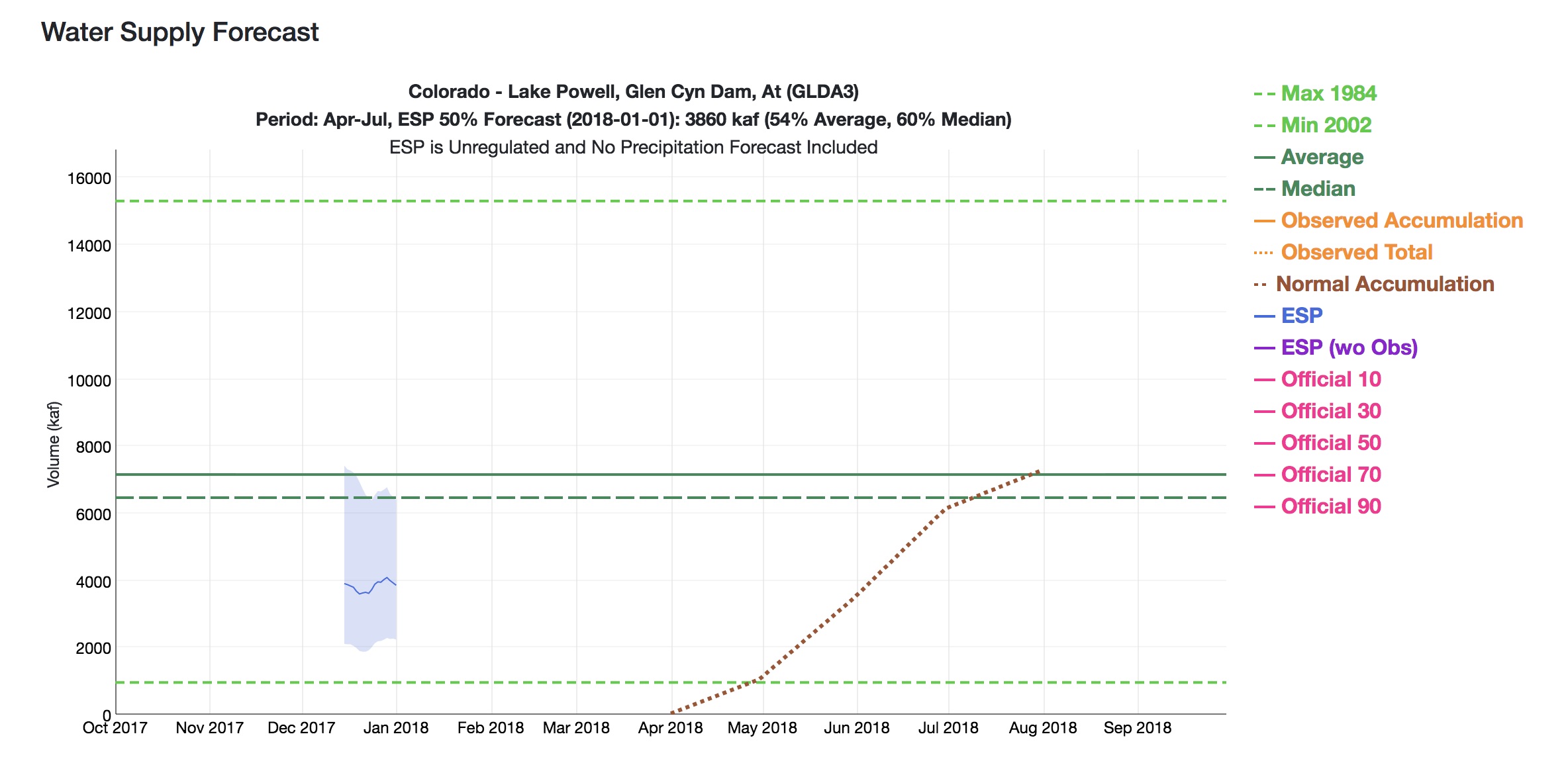
Scientists for many years have projected a decline in the Colorado River’s flow as a result of a warming climate. But it’s only in the last couple of years that we’ve begun to see evidence that this is already happening.

The system has a lot of natural variability, so detecting the relatively smaller impact of warming amid the ups and downs of “did we have a lot of snow this winter or not” is hard stuff. But as the warming grows, so does the impact, and so does the detectability.

The latest, the third such effort, from the USGS’s Greg McCabe and colleagues, found a 7 percent decrease in the river’s flow in the past three decades as a result of warming temperatures.

Additionally, warm season (April through September) temperature has had a larger effect on variability in water-year UCRB streamflow than cool season (October through March) temperature. The greater contribution of warm season temperature, compared with cool season temperature, to variability of UCRB flow suggests that evaporation or snow-melt, rather than changes from snow to rain during the cool season, have driven recent reductions in UCRB flow. It is expected that as warming continues, the negative effects of temperature on water-year UCRB streamflow will become more evident and problematic.

Precipitation, primarily winter snow, remains the dominant variable influencing the Colorado River’s flow. But for a given amount of snow, we’re seeing less water in the river, a decrease in “runoff efficiency”.

McCabe et al

The two previous papers that also showed this:

When wastewater isn’t being “wasted”, Pasadena edition

Pasadena, California, wants to use treated effluent to water golf courses. This is a water policy no-brainer, right? Well….

“As part of preparations to commence deliveries of recycled water to Pasadena, the city of Glendale petitioned the State Water Resources Control Board to seek their approval for a reduction in the amount of treated wastewater discharged into the L.A. River so that it could be delivered to Pasadena. The city of Los Angeles is protesting Glendale’s petition, expressing concern that any reduced discharges of treated wastewater into the L.A. River could impact the preservation of the L.A. River and its habitats.”

Via my old friend Larry Wilson in my old employer the Pasadena Star-News. It’s a reminder that, in thinking about the values of reuse (and they are many), one part of the evaluation needs to be the question – where is the treated effluent going now, and what effect will our golf course use have on that?

California’s private utilities out-conserved its public utilities during the drought

If you had asked me to guess whether public or private utilities did better at water conservation, I would have without hesitation guessed that public utilities did better.

So here’s a fascinating result from Manny Teodoro and Youlang Zhang of Texas A&M, looking at data from the recent California drought:

[O]n average, communities served by private utilities adopted more stringent conservation regulations than those served by public utilities; and so … private utilities were significantly more likely than their public counterparts to meet the state’s conservation standards; and … private utilities on average conserved more water than public utilities. Somewhat counterintuitively, then, private, profit-driven firms were more effective than were local government agencies in achieving the state’s conservation goals.

The working paper, Privatization as Political Decoupling: Water Conservation and the 2014-2017 California Drought, is here. Their argument is that, for a public utility governed by directors facing reelection, rate increases and other conservation constraints on consumers pose political risk. Private utilities, on the other hand, offload that political risk to a state regulation commission, which governs their rate setting.

We argue that, where policy goals can be achieved through regulation of private firms, private provision of public services allows governments to separate public policies from their political costs. By shifting production or service provision from the public to the private sector, governments can achieve policy goals through regulation, while shifting the accompanying political risks to the private sector, where they are less acutely felt. The result is a political decoupling that allows governments to achieve policy goals while insulating officials from their political costs. One implication is that, where financial decoupling exists, regulated private firms are more likely to comply with environmental regulations than are government agencies, because the latter bear electoral costs that the former do not.

This result makes sense, though it is not at all consistent with my naive expectation. But it is consistent with a similar finding from Megan Mullin and Meghan Rubado, who found that water agencies with directly elected boards of directors in Texas responded more slowly to drought.

Fish returning to the Fraser in one of Colorado’s high mountain valleys

An example of what can happen when folks stop fighting over water and search for common ground paths:

Now, instead of a wide shallow creek, the low-flow Fraser River drops into a narrow channel that allows to run deeper, faster and colder. That led to a nearly immediate rebound in the fish population, according to a preliminary assessment by Colorado Parks and Wildlife.

“We found about a four-fold increase in trout population,” said Jon Ewert, an aquatic biologist at CPW who surveyed the river both before and after the project was finished. “It was pretty exciting to see that.”

This arises from a collaboration between environmental groups and a municipal water agency, Denver Water. These folks had been at odds for a while. This is an example of the point Jennifer Pitt made in Tony Davis’s recent piece about Minute 323, the U.S.-Mexico Colorado River agreement:

Pitt warned that if governments and water users end up fighting over a dwindling supply, the environment will be the biggest loser.

“No politician can support nature when communities are threatened by a water supply crisis,” she said.

Two cautions here on the Fraser story. First, it’s just a tiny bit of data. Second, it’s just a tiny bit of river. But it nevertheless is progress.

It takes more than one year to dig out of California’s water hole

California has seen excellent groundwater recovery in the last year, according to a report last week from the California Department of Water Resources:

CADWR

But it’ll take more than a year to dig out of the hole left by the massive groundwater pumping of the last 6 years:

CADWR

From the report:

While images of filling reservoirs and rushing rivers seemed to be everywhere earlier this year, groundwater levels reflected the differing hydrologic conditions of individual groundwater basins. Although water levels in shallow basins may quickly show marked improvement, deeper, severely depleted groundwater basins may take years to recharge.

Looking for flexibility within Arizona

Arizona’s current internal political struggles over allocation and management of shortage on the Colorado River illustrate a central dilemma in the basin’s transition from the era of managing development of the river’s water to the era of managing scarcity. While we generally have demonstrated the ability to use less water across a range of water use domains, and have developed the institutional frameworks for changing the overall “Law of the River” allocations among the states and Mexico (buy my book!), sorting out our response within each state continues to be a bottleneck.

In this regard, Tony Davis had a fascinating story last weekend about one effort within Arizona to provide added flexibility within Arizona to reshuffle the allocation deck:

Four Indian tribes owning the biggest and the most shortage-proof share of Colorado River water in the Lower Basin want to spread that booty around Arizona. They’re offering a “drought supply,” backstopping existing supplies now threatened by growth and climate change.

The Colorado River Indian Tribes, commonly called CRIT, want to lease more river water than is delivered each year to the city of Tucson to various water agencies, utilities and the feds. For that, they want more money than they now make from their alfalfa fields, where the water currently goes.

One of the challenges is finding a path forward through new challenges while we’re still constrained by old legal structures never meant to deal with stuff like this. The Colorado River Indian Tribes are looking for a way out of that, and exploring whether there’s a mutually beneficial deal to be had.

The resilience of the U.S.-Mexico Colorado River relationship

In a recent paper in Water International, Jacob Petersen-Perlman and colleagues identified one of the central features scholars have found in their study of international water agreements:

Once institutional capacity is established between parties it has been proven to be resilient over time, even as conflict was being waged over other issues.

Sitting in an overcrowded hotel ballroom in Santa Fe, New Mexico, late yesterday afternoon, I was privileged to see that happen. In the midst of bellicose rhetoric about border walls and NAFTA trade battles, of “rapists” and “bad hombres”, representatives of the two nations’ border and water management community signed the final paperwork for the entry into force of a sweeping new Colorado River agreement.

The deal extends the core terms of “Minute 319”, a landmark agreement between the U.S. and Mexico that enabled a rich new suite of collaborative measures to managing the shared river – Mexican storage of water in U.S. reservoirs, shared surpluses and shortages, opportunities for U.S. water agencies to collaborate with their Mexican counterparts on conservation measures and a shared effort to restore water to the Colorado River Delta environment.

Two years of work by Obama administration folks and their Mexican counterparts had led to an near-agreement they came to call “Minute 32x” because of the quirks of the numbering system, but it didn’t quite get over the finish line before the change of administrations.

Former Deputy Secretary of the Interior Mike Connor, left, and former Reclamation Commissioner Estevan López, at Wednesday’s signing of the US-Mexico Colorado River agreement

Yesterday, despite the fears of many (including myself), we saw the agreement survive, as Petersen-Perlman put it, “conflict … being waged over other issues.” Here was the Trump administration’s new Deputy Secretary of the Interior David Bernhardt, standing at the podium before an international audience praising his predecessor, Obama administration Deputy Interior Secretary Mike Connor, who stood quietly leaning against the back wall.

Connor and Estevan López, his Commissioner of Reclamation during the final years of the Obama administration, stood together. They two of them had led a determined push in the months after the election to try to get the deal done before the new administration took office, amid fears that a souring U.S.-Mexico relationship might make a Colorado River agreement impossible.

When I got home last night, I spent some time scrolling back through a bunch of pictures I took on the morning of March 28, 2014, in the Colorado River Delta. I’d been down in the delta working on my book, and a chance meeting with Interior staff in the parking lot of the Hilton Garden Inn in Yuma led to an invitation to ride along with Connor and Assistant Interior Secretary Anne Castle to see water flowing down the river in the famous environmental “pulse flow” that year.

Here’s how I described it in the book:

Connor and Assistant Secretary of the Interior Anne Castle acted like eager tourists, pulling out their cell phones to take pictures at every stop. And as we drove, they reflected on the process that had gotten everyone to this remarkable moment when the representatives of nine states and two nations, plus a larger coalition of water agencies, environmentalists, and community groups, had come together to solve what had seemed an insoluble water-sharing problem—putting water back in the Colorado River delta.

Minute 319 was the logical extension, Connor explained to me, of a process in which water users stepped away from Marc Reisner’s old refrain of the Colorado as the world’s “most litigated” river to the approach of the past two decades—of negotiated agreements to deal with the shortcomings of the current water-management rules. “The Law of the River,” Connor told me, “is pretty all-encompassing, but it still has room for interpretation.”

I love this picture of Mike that I took that day. The excitement at what we were seeing was palpable, infectious.

Mike Connor at San Luis Bridge, March 28 2014

I’m nothing if not an optimist about these collaborative processes – writing and speaking about them, teaching them, advocating for them. There’s another picture I took that day that I also love, one of my favorite moments from the trip:

Kids on the Mexican side of the border, waving at delegation of Americans, San Luis Rio Colorado, March 28, 2014

Kids on the Mexican side of the border, waving at delegation of Americans, San Luis Rió Colorado, March 28, 2014

These kids are literally standing on the border, at a place where there is no fence, them on the Mexican side waving, us on the U.S. side waving back. The canal we’re standing on carries agricultural wastewater across the border, the Colorado River is just down the hill to my right.

I am happy to report that collaboration over the Colorado River withstood the test of the recent shock to the U.S.-Mexico relationship, and has emerged resilient.