Faltering on the Klamath

There may be yet another important lesson in what is happening right now on the Klamath River, land of a bunch of very important water management lessons.

The Klamath once was a symbol of all that is wrong with water management in the western United States (a battleground, lesson one) that had come to symbolize all that could be right (a historic collaborative agreement to overcome the fighting, lesson two). Now there is a risk that we may be headed back to the first.

Brett Walton (Circle of Blue) and Emma Marris (New York Times) provide background, and I’d like to highlight a critical part of Brett’s piece that may provide lesson three:

Signed in 2010 and expanded in 2014, the three Klamath agreements were hailed as a model for watersheds that must realign water supply and demand. The three agreements, amounting to the largest watershed restoration project in the West, covered federal lands, funding, and water rights that require Congressional review and approval. But if Congress does not pass a bill by December 31, 2015 that authorizes the new management practices in the package and provides funding to facilitate the transition, three Indian tribes that are party to the agreements have indicated that they will pull out because of inaction.

To say that the agreements were a locally negotiated solution is right as far as it goes, but the fact that the deal(s) required Congressional action means that in important ways it was not entirely a local solution.

As soon as you need federal funding for a deal – as soon as you need to tap into “other people’s money”, as David Zetland puts it, other people’s values come into play as well. Whether this is simply because Congress is dysfunctional, or because there are members of Congress who actually object to the deal, there’s a lesson here: if you want to work out a collaborative water deal at the local or regional scale, best to keep Congress out of it.

Visualizing Albuquerque water conservation

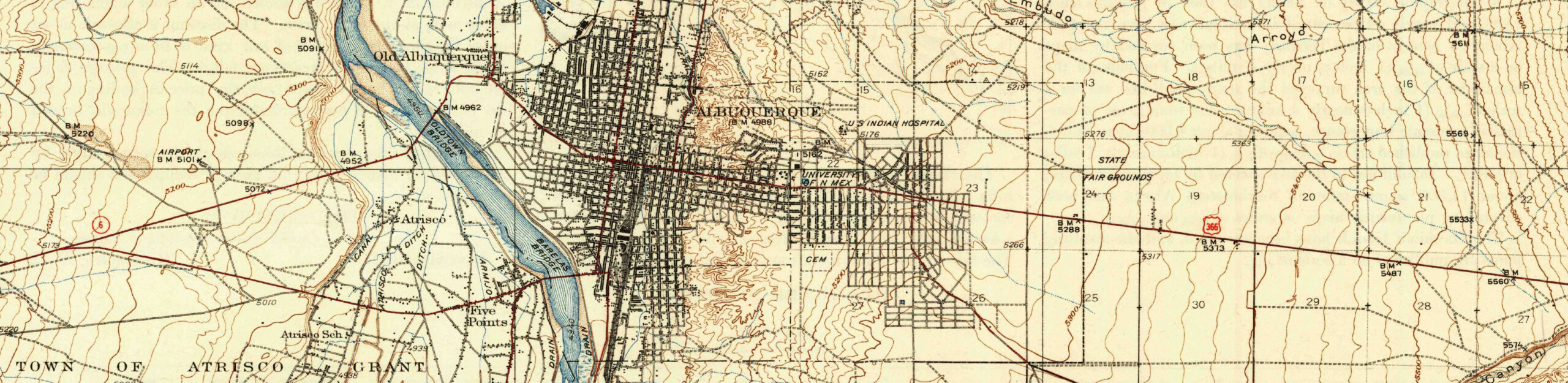
I just stumbled on a very cool tool from the folks at ESRI using U.S. government Landsat imagery (yay public goods! background here) allowing you to look at vegetation change over time. Here’s a graphic look at water use in Albuquerque 1990-2010. The bits in green are places where vegetation has increased. The bits in that reddish colour (magenta?) show where vegetation has decreased. It’s outdoor water conservation, visualized:

Albuquerque vegetation change, Landsat via ESRI

Albuquerque vegetation change, Landsat via ESRI

This covers a time period during which per capita water use has decline from ~250 gallons per person per day to something around 150. The green patch in the upper right is an area of affluent sub-urban sprawl since 1990. The reddish blotch in the center is the already developed area of town (the “northeast heights” for ABQ folks). Fewer trees and lawns.

Another indicator of the resilience of California agriculture

Despite drought, the value of California cropland land has risen 5.4 percent this year, according to the latest U.S. Department of Agriculture survey data. No doubt my economist friends can help me here with an explanation of what this says about how the market is pricing questions about uncertainty, water supply and risk. Looks like maybe drought has slowed the upward growth? But in the two years before the drought set in, cropland value dropped, then began rising again during the drought. Dunno:

Source: USDA

Source: USDA


2015 elsewhere around the Colorado River Basin states:

  • Arizona: $8320 an acre, unchanged from 2015
  • Colorado: $1,910, up 3.8 percent
  • New Mexico: $1,440, down 0.7 percent
  • Utah: $3,300, up $1.2 percent
  • Wyoming: $1,370, unchanged

The best editor I ever had mostly wasn’t my editor

Oh my, this picture of journalism:

Jim Timmermann

Jim Timmermann

That’s my old friend Jim Timmermann, the best editor I ever had, who died last week. He wouldn’t want me to bury the lede.

A few days ago, staring at a computer monitor in frustration as I tried to figure out what to type, I quipped thus….

There is a great risk in journalism of being distracted by “story”, by which I mean some arresting narrative that will grab your reader. “Story” is critical, but my point with that glib tweet was that it’s the wrong place to start, but that it’s often the only place to start.

Many years ago I had the great good fortune to work in the newsroom of the Pasadena Star-News with a smart young journalist named Jim Timmermann. We were kids, products of fine 1970s-80s-era liberal arts educations (Jim from Pomona College in Claremont, me from Whitman in Walla Walla) and largely self taught as journalists.

Jim was insatiably curious about how things worked. For much of the time we shared the newsroom he was the paper’s business editor, but he wasn’t much interested in stories about businesses. He wanted to understand the nature and structure of our community’s economy. He recognized that “business” was just a piece of that, and the stories came from understanding the thing and only then finding the stories that illustrate the thing. It’s sorta like the distinction between anecdote and data, though in neither case is the line separating the two clear, and in journalism it’s a difficult line to find as you’re in the midst of making a newspaper every day, doing inductive reasoning on the fly. It’s mostly an impossible goal, because you’re writing stories, explaining the world 500 words at a time, a collection of anecdotes, what I mean by “story” in my glib tweet. Impossible yes, but a good goal nevertheless. (Sorry, Jim, for the run-on sentences, but it’s my blog, and I’m in tears, and I’ve got no editor.)

I mostly didn’t work for Jim, but he was my closest colleague and good friend and we spent many hours talking about the thing, whatever that thing was lurking behind the anecdotes we were busily jamming into the newspaper every day. I don’t think either of us at the time grasped how hard a task it was, because we were young and had huge printing presses in the basement and ink delivered, I’m not making this up, in tanker trucks (if you were in the newsroom late enough in the evening, you could feel the building shudder when the press run started) and the great joy of making a newspaper every day.

Jim was a fine man, a deeply religious, moral man who loved his family and tried to make the world better with the modest tools at hand.

I also am reminded by Andrea Goodell’s lovely obituary that he was a Jeopardy winner. If I recall his telling of the story (this was before I knew him) he won a set of Skyway Luggage on Wheels.

The Cold War was so much easier – water project development as a matter of national security

Sandia National Laboratories in the 1950s

Sandia National Laboratories in the 1950s

In 1960, the Cold War was a thing – the moral imperative of our global stand against the commies. At the time, Albuquerque, New Mexico, was one of the nation’s centers for nuclear weapons research, development, and management. What better reason for supporting water development?

From a May 20, 1960 hearing before the House Subcommittee on Irrigation and Reclamation on the San Juan-Chama Project came this, from John Bliss, New Mexico’s Upper Colorado River Commissioner:

Albuquerque is one of the most rapidly growing cities in the United States. Located there are large installations which play a vital role in our program of research and development for national defense. An assured water supply is essential for the continuation and possible expansion of that program in the Albuquerque area….

They built the project.

Stationarity, recurrence intervals, and our perception of weather and climate extremes

Robert Osborne and Jonathan Overpeck published interesting pieces in the last couple of days reinforcing an important point about our perceptions and understanding of recurrence intervals in big weather and climate events. Osborne is in the southeastern U.S. and is writing about flooding (short term) while Overpeck is in the southwest and is writing about drought (much longer time scales) but their points have an important parallel.

Osborne spent some time debunking the “1,000-year flood” meme that sprouted around South Carolina’s October floods. They weren’t. And that matters because….

I am afraid that remembering this event as a 1,000-year flood event for the state absolves this event from reality to a statistical fantasy realm where no one lives, works and raises their families. A realm filled with locusts and wild beasts. A realm where we can go back to normal after the page is turned. There is no doubt we will turn the page in our State, but we don’t learn from fantasy tales. We learn from hard reality. We learn from remembering the bumps and the bruises. We adapt based on where we think the next hits are going to come from in the future.

Overpeck makes a similar point when he notes that a drought stretching back to 1999 in the Colorado River Basin does not constitute a “megadrought” – by which he means the kind of drought we know can happen here in the southwest:

Are we in a megadrought? As a scientist who studies Southwest drought, I face this question more and more often. The answer might not be what you think, but first let’s review what a megadrought is, and why we should worry.

Megadroughts are variously defined as drought lasting multiple decades, being unlike anything we’ve seen since Europeans came to the region, or an event with unprecedented consequences for society. The threat is real. The history of drought preserved in tree rings reveals several multi-decade megadroughts in the last 2000 years. The most famous ones occurred during medieval times, and were likely linked to Native American abandonment of settlements across the Southwest. The longest Southwest megadrought yet documented occurred nearly 2,000 years ago and lasted over 50 years.

So, are we in a megadrought now? The best answer is not yet, but we will be unless we act soon. Fortunately, we still have a choice.

Again, but in a different way, Overpeck is arguing (like Osborne) that we have some agency here, an ability to act that is lessened if we think of the crazy weather as “a realm filled with locusts and wild beasts. A realm where we can go back to normal after the page is turned.”

Librarian love for “The Tree Rings’ Tale”

I’m happy to note that my book The Tree Rings’ Tale: Understanding Our Changing Climate (Barbara Guth Worlds of Wonder Science Series for Young Readers) was a November pick of the month by librarians at the Clovis-Carver Library in Clovis, New Mexico.

Not too early to think about a Christmas gift for that bright young person in your life! You can pick up a copy used for 3 cents on Amazon. (Really. 3 cents is a steal. Do it.)

Climate change, the Rio Grande forecast problem, and the death of stationarity

Laura Paskus takes us this morning to the mountains of northern New Mexico, where the snow is melting earlier than it used to, and less of the ensuing runoff is making it into our Rio Grande:

[A]s bleak as southwestern springtime stream flow forecasts have been in recent years, scientists at the University of New Mexico are now saying that actually, they’re probably not bleak enough.

“The warm spring temperatures are one of the clearest observed climate change signals in North America,” says David Gutzler, a professor in the University of New Mexico Earth and Planetary Studies Department.

Gutzler is part of the New Mexico Universities Working Group on Water Supply Vulnerabilities, which has been working on identifying points of vulnerability in our societal-ecosystem-water system. One of their key findings, developed by Gutzler’s student Shaleene Chavarria, is that changes in the climate weaken the old forecast tools, which are used to relate winter snowpack to runoff the following year.

This is the point Chris Milly, Julio Betancourt, and colleagues laid out in an important paper a few years back on “the death of stationarity” (pdf). “Stationarity” was a foundational assumption in water management – that the range of observed variability in the past provides a usable picture of the expected range of variability and system behavior in the future:

In view of the magnitude and ubiquity of the hydroclimatic change apparently now under way, however, we assert that stationarity is dead and should no longer serve as a central, default assumption in water-resource risk assessment and planning. Finding a suitable successor is crucial for human adaptation to changing climate.

The Paskus piece is part of a new reporting project being done by New Mexico In Depth, a non-profit news organization based here in New Mexico.