UC team: California ag “positioned to weather this drought”

The latest analysis by a University of California team has concluded (pdf) that agriculture in that state is doing pretty well in the current drought, all things considered:

The current drought is causing large economic losses but given innovative responses by farmers and others, those losses have been manageable and California agriculture is positioned to weather this drought.

Losses are big: $1.8 billion in a $45 billion California ag economy, or 4 percent. Agricultural employment continues to grow, but not as quickly as it would otherwise have in the absence of drought:

[L]abor-intensive agriculture has, in fact, been growing, and job growth would have been larger, but for the continuing drought.

With ripple effects through the economy, the UC team estimates a total impact of $2.7 billion, which is a drought impact of a bit more than one tenth of one percent of California’s $2.1 trillion (source) economy.

Where has the adaptive capacity come from?

Adaptation methods include changing the typical crop mix by using water for crops with higher revenue per unit of water, substituting groundwater for surface water, water transfers, and additional use of technology.

One of these in particular, the authors note, poses risks that may be providing adaptive capacity now at the expense of adaptive capacity in the future:

[C]ontinuous overdraft of groundwater, a fast-growing proportion of permanent crops, and the use of irrigation systems that minimize recharge reduce the ability to cope with future droughts.

Californians need to do something about that.

The report is Economic Impact of the 2015 Drought on Farm Revenue and Employment, by Richard E. Howitt, Josué Medellín-Azuara, Duncan MacEwan, Jay R. Lund, and Daniel A. Sumner (pdf)


Can we retire “Water flows uphill toward money”?

I’ve come to the conclusion that the whole “water flows uphill toward money” thing is not only wrong, but that its wrongness is problematic.

It’s one of those intellectual shortcuts that can be dashed off uncritically, and audiences nod knowingly because of course water flows uphill toward money we all know that, and no further analysis is needed. Sometimes this is right. But across a huge range of water allocation decision making, it is utterly wrong. While “water sometimes flows uphill toward money, while at other times it doesn’t, and we should think carefully about why it is or isn’t the case here” might be more analytically useful, it lacks the rhetorical punch.

Why is this?

Rules. We have water allocation rules that frequently create barriers that make it difficult, if not impossible, to move water, even if the move might be hydrologically possible. I’m not arguing here that this is good or bad. I’m merely trying to point out that “water flows uphill to money” is a myth, and that it gets in the way of sane water policy conversations.

I’ve been tracing back the history of the phrase for my book, and looking at its myth and reality in the Colorado River Basin, but I’ll save that for another time. Let me instead explain by way  of a crisp example on the Rio Grande here in New Mexico.

Southern New Mexico chiles, by John Fleck

Southern New Mexico chiles, by John Fleck

Consider this Albuquerque Journal story last week from Ollie Reed. First is a comment from David Gensler, who manages the water supply for the Middle Rio Grande Conservancy District, which delivers farm water to Rio Grande Valley farmers in the central part of the state: “Right now the outlook for farmers is pretty good.” That’s been pretty consistent. While there have been some shortfalls in recent years, Gensler and his farmers have limped by with most of the water they needed most years. Meanwhile downstream, Phil King’s outlook for farmers on New Mexico’s southern Rio Grande (the same river) remains dismal:

“The last five years have been so pathetic that we now have really low standards and this year looks good,” King said. “You can’t have the worst year ever every year. But we are still a long way from average.”

Annual agricultural production down south, where King’s farmers are wrestling with shortage, is roughly $7,000 per acre, with big dollar crops like pecans, onions, and chiles. Up here in the middle valley, where Gensler’s farmers are fat and happy, it’s about $3,500 per acre.* That’s pretty much the opposite of water flowing uphill toward money. When I was doing drought reporting for the newspaper, I would hear this all the time from southern New Mexico farmers, glaring at the farmers up north and muttering about how they seem to have all the water they need and what are they growing with it, just alfalfa?

The rules in this case involve the Rio Grande Compact, which sets a boundary between these two parts of the river across which it is physically possible but legally quite difficult to move water. It is legally impossible for a farmer up here and a farmer down there, a willing seller and a willing buyer, to do a deal so the water could flow uphill toward all that pecan and chile money.

I intentionally picked an ag-to-ag comparison here to avoid letting this slip into a “farms versus cities” argument. The ag-urban contrast is more common. Our cities are a big, rich, muscle-bound part of our economy, the farms are just a small percentage, yet the farms have most of the water. There are plenty of exceptions, plenty of interesting and important cases where the alternative is true, that water moved toward the money (think Owens Valley or the vastly expensive Central Arizona Project where the water’s quite literally flowing uphill at great expense). But there are also tons of cases where it hasn’t happened, and thinking through the differences is important.

* Author’s calculations based on income data from the U.S. Department of Commerce and acreage data from the two irrigation districts

An Albuquerque rainstorm for the record books

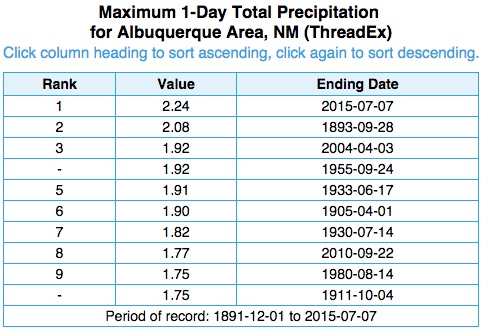
That thunderstorm that woke most of us up early this morning (lightning flashes through our skylight at 1:30 a.m.) was one for the record books. At the National Weather Service’s airport gauge (the “official” Albuquerque gauge), 2.24 inches (5.7 cm). According to Brian Guyer at the Weather Service, that’s the single highest 24-hour total in history:

Albuquerque's wettest day

Albuquerque’s wettest day

Another example of how drought hits the poor

From the Washington Post:

A recent laboratory test found that water in St. Anthony’s shallow well has twice the concentration of arsenic considered safe.

For many Californians, the state’s long drought has meant small inconveniences such as shorter showers and restrictions on watering lawns. But in two rural valleys, the Coachella southeast of Los Angeles and the San Joaquin to the north, farmworkers and other poor residents are feeling its impact in a far more serious and personal way.

Mike Connor and Dan Beard are wrong about the Bureau of Reclamation and replumbing the West

I’d like to take issue with some recent comments by Dan Beard and Mike Connor, two former commissioners of the U.S. Bureau of Reclamation, about the agency’s future. (Audience sees closeup of Fleck crawling out on tree limb. Camera zooms back to show that it is the only tree for miles around, with no buildings and therefore no chance of rescue. Audience hears sound of sawing.)
Deadbeat Dams

Deadbeat Dams

Beard

In a weekend New York Times story Beard, who headed the Bureau during the Clinton administration, renews his call for the agency’s elimination:

Daniel P. Beard, a bureau commissioner during the Clinton administration, said the bureau should be abolished, with the authority for water management returned to the states.

“Here we are in the worst drought, climate change is providing a significant impact, and the Obama administration is just studying the problem,” he said. “They should transition to become an environmental agency, and they should just assist local and state agencies to solve water problems in the West.”

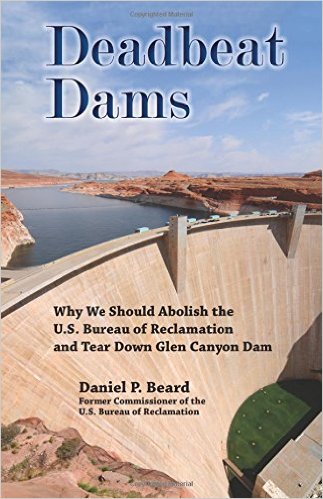
It’s an argument Beard lays out in his appropriately titled new book Deadbeat Dams: Why We Should Abolish the U.S. Bureau of Reclamation and Tear Down Glen Canyon Dam. It’s an important book, raising challenging arguments that you need to wrestle with if you’re thinking about water in the western United States. But I disagree with Beard on this central point.

Water scholar and attorney Sarah Bates and Cadillac Desert author Marc Reisner wrestle with this question in Overtapped Oasis: Reform Or Revolution For Western Water, a book that serves as a sort of odd sequel to Cadillac Desert, helpfully clarifying (walking back?) some of Cadillac Desert’s central themes. Their quick laundry list of the problems posed by abolishing the Bureau makes a central point – the Bureau does a bunch of stuff, and if the agency were to be eliminated, someone would still have to do all that stuff:

[I]ts abolition would create a political, administrative, and water-rights nightmare…. Who would then “own” its canals and dams? What about the rights to more than 30 million acre-feet of water it provides? Who would be responsible for dam maintenance? For emergency decisions regarding drought allocations or fish-flow releases?

Bates and Reisner then raise an important political reality that I think undercuts Beard’s argument:

[A]ny attempt to abolish the Bureau of Reclamation would be fanatically resisted by many politicians and organized constituencies in the western states, precipitating a political battle that may not be justified by the results.

This is the “water nobility” about which Beard writes in much detail, and any attempt to abolish the current Bureau structure would, I believe, disproportionately empower this group in the political processes needed to create a replacement structure to do the stuff now done by the Bureau. These folks have really good lobbyists and lawyers.

Connor
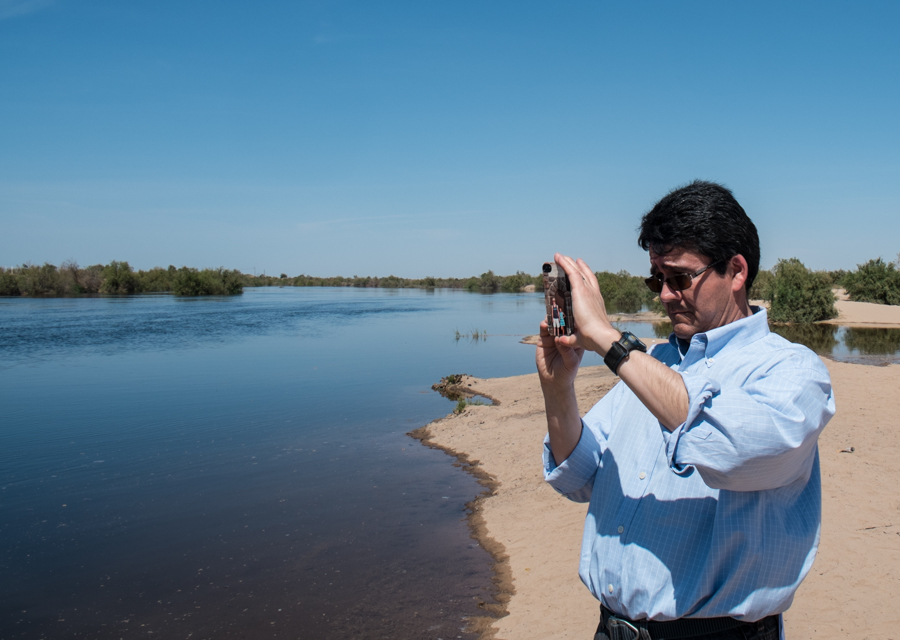
Deputy Interior Secretary Mike Connor watches water flow through the normally dry Colorado River bed at San Luis, on the U.S.-Mexico border, March 28 2014, photo by John Fleck

Deputy Interior Secretary Mike Connor watches water flow through the normally dry Colorado River bed at San Luis, on the U.S.-Mexico border, March 28 2014, photo by John Fleck

I turn my attention now, gingerly, to the comments of Mike Connor, who was the Obama administration’s first Commissioner of Reclamation, now Deputy Secretary of Interior, and (important disclosure) has generously spent some significant amount of time teaching me about the governance of water in the western United States. (Audience hears sawing of the branch cease, replaced by cracking sound.) In the Times, Connor correctly suggests that the West’s water infrastructure needs a massive rethink:

“We have to think differently,” said Michael Connor, the deputy secretary of the Interior Department, which includes the Bureau of Reclamation. “It’s not enough just to conserve water. We need to rethink these projects. We have a lot of infrastructure, but a lot of it doesn’t work very well anymore. We need to undertake what amounts to a giant replumbing project across the West.”

The way Connor says it supports a central theme of the Times story that I think is wrong: the implication that the Bureau and western water management have been humming along unchanged since the days of Cadillac Desert and have suddenly come to the realization: “Hey, a giant replumbing is needed!”

The whole project of my book challenges that. When I set out to write it some years ago, it was with a post-Cadillac Desert notion that a giant replumbing was needed. What I found again and again, in fact, was that the replumbing has been underway for a while (urban water conservation all over, ag-to-urban transfers galore, re-operation of reservoirs, an environmental flow through the Colorado River Delta for chrissakes). Path dependance and historical contingency make this stuff really hard. People optimized their communities and their lives around the old system. You can’t just kick them off their farms or shut down their city water systems willy nilly. Even if you wanted to (and I think there are important questions of equity and justice that make willy nilly a bad idea), these people fight back, and they’ve got good lawyers. But understanding what replumbing is already underway, what has and has not worked, and what the impediments are as seen through the lens of these replumbing efforts, is the critical piece.

I’m pretty sure Connor would agree with this last bit, the idea that the replumbing is already underway, since’s he’s one of the one of the people who taught me about it.

Let’s just agree to blame the reporter. (Camera zooms back in to see Fleck’s desperate scramble to crawl back before branch breaks.)
Tijuana: A reminder that *nine* states depend on the Colorado River

There are seven states in the U.S. and two more in Mexico that depend on the Colorado River’s water. Here, from Sandra Dibble, is a reminder that when shortage descends, it is not just Arizona (as I have been guilty of saying) that takes the first hit:

In Mexico, the first impact of cutbacks on the Colorado River — a basin that links seven U.S. states with northern Mexico — is likely to be felt in the sprawling Mexicali Valley in the neighboring state of Sonora, where the smaller San Luis Valley also relies on deliveries of river water and a series of wells fed by seepage of river water.

If there is a shortage declaration in 2017 (as seems likely), Mexico would see a 50,000 acre foot cutback. Sandra’s story is a good primer on the discussions now underway to clarify who will take the hit.