One of the intellectual frustrations with trying to wrap my head around water policy in the western United States is that it’s really sort of everything policy. There’s climate science and hydrology and history and law and agricultural economics. And, the subject for this afternoon, there’s urban development economics.
Much of the policy struggle has been driven by the explosive growth in sunbelt cities. We started building houses in the 1980s like gangbusters, without a whole lot of thought about how we were going to get enough water to flush their toilets. Here, for example, is single family homes by number of annually issued building permits in Las Vegas:
But then, as you can see, around about 2006 or so we stopped building so many houses. What’s up with that?
Here are the three major metro areas that interest me right now – Albuquerque, Phoenix, and Las Vegas (indexed so that 2001=100 so you can get a feel for the trends in all three, independent of absolute numbers):
My former Albuquerque Journal colleague Richard Metcalf wrote about our situation in this morning’s paper:
The pace of home construction in the Albuquerque metro area has taken a step backward during the first five months of the year, getting off to the second slowest in what is likely decades, according to building permit numbers from DataTraq.
“Population is a huge driver of home construction,” said John Garcia, executive vice president of the HBA, the home builders group in the metro. “We focus on job growth, where we’re at the mercy of business. We need to improve our population growth.”
There’s a rhetoric around this, which you can see in Garcia’s comments, that suggests that many of the region’s economic boosters presume that growth is the norm, and the current situation is not the norm, that we’re gonna somehow “pull out of this slump.”
I’m frustrated that I don’t know enough about the economics of urban development to understand what’s going on here, because the water policy implications of whether this is the new normal, or a slump we’re going to pull out of, are huge. I suspect that if I did understand more urban development economics, I’d simply have a clearer understanding of why we can’t really know what comes next.
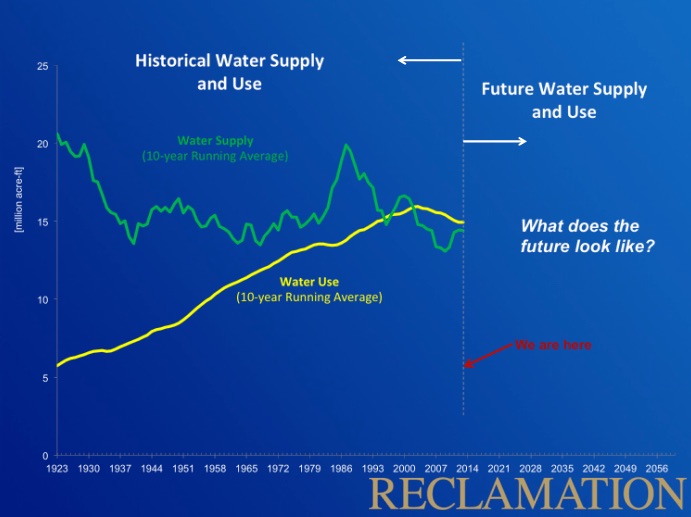
What does all this mean as a matter of water policy? Mainly, I guess for now it means that the west’s water policy problems are a lot easier right now, since we’re not building so many new houses. It means that those pie-in-the-sky population growth projections that have driven a lot of the planning and analysis about how much water we have and will need (like the Bureau of Reclamation’s Colorado River Basin Study) are wrong, in a good way. (Yay, our growth-based economies have tanked! We don’t need as much water!)
 in assisting in the policy process. I prefer for myself the role he characterizes in which a scientist engages in “an effort to expand (or at least clarify) the scope of choice for decision-making in a way that allows for the decision-maker to reduce choice based on his or her own preferences and values.” As OtPR correctly observes, “water wars” rhetoric in our work does not expand the range of political and policy choices. It narrows it.