The price California farmers can get for their almonds doubled between 2007 and last year, according to the U.S. Department of Agriculture. Strong incentive to plant more trees, drought notwithstanding:
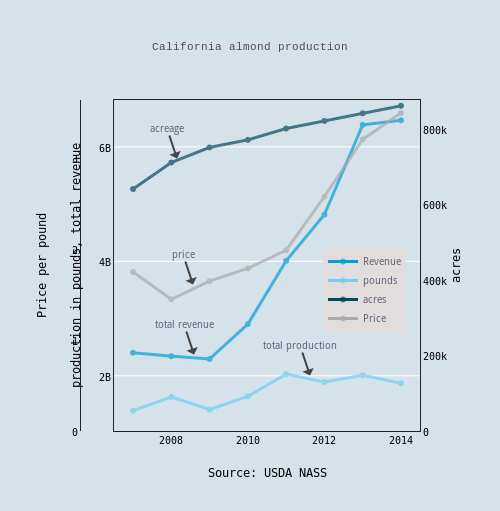
The price California farmers can get for their almonds doubled between 2007 and last year, according to the U.S. Department of Agriculture. Strong incentive to plant more trees, drought notwithstanding:
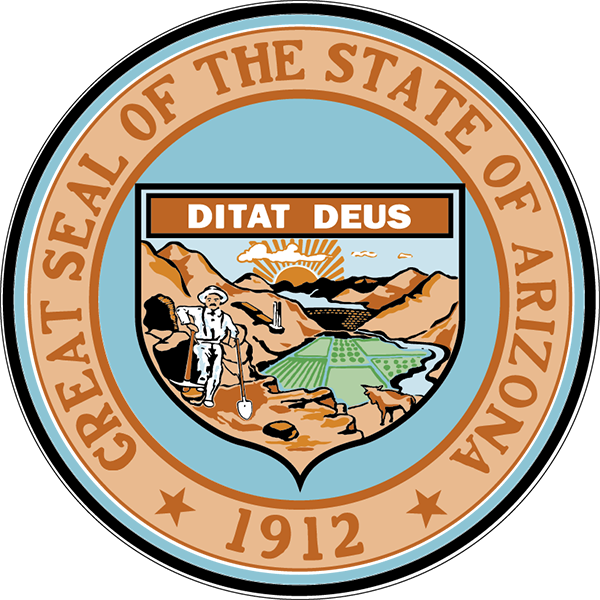
Arizona state seal
Arizona’s state seal is a fascinating bit of iconography in light of the state’s uneasy relationship with aridity and developed water. A dam, a river and irrigated land are given center stage – water projects as state destiny. Today I learned the seal’s details are actually enshrined in the state constitution:
In the background shall be a range of mountains, with the sun rising behind the peaks thereof, and at the right side of the range of mountains there shall be a storage reservoir and a dam, below which in the middle distance are irrigated fields and orchards reaching into the foreground, at the right of which are cattle grazing.
The clouds, apparently, are optional.
Roosevelt Dam was not yet completed when the above language was written during the 1910 constitutional convention, but those gathered were all about the future.
Doug Obegi lays out an interesting argument about the implications of drought for the “Bay Delta Conservation Plan”, the California plan to build great water-carrying tunnels beneath the Sacramento-San Joaquin Delta for farms and cities to the south.
On paper, the tunnels would be largely dry during drought years, to preserve salinity balance in the delta, including for those who get their water there. But the tunnels would make it physically possible, Obegi argues, to just suck up the entire Sacramento River in a dry year like this, if Californians were willing to write off the delta, removing the fresh water flow that keeps sea water at bay. It thus becomes a political question, and there is some precedent for the politics of water allowing the saltwater to intrude, he argues:
While the biological science shows how important delta outflow and other environmental protections are for the continued existence of native fish, wildlife and the people who make their homes and living on these natural resources, the political science in favor of increasing diversions and waiving these standards has often trumped the biological science.
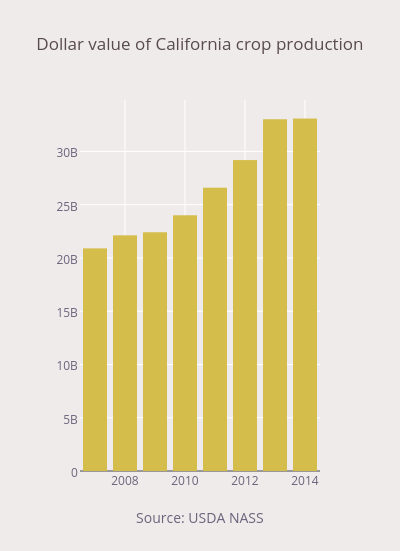
USDA estimates of revenue from California crop production (excluding horticulture) in recent years. I know just enough about this data to be misleading or dangerous, so I make no claims, but it sure seems interesting. Source: USDA NASS
Lea-Rachel Kosnick, in a paper a few years back, described the “tragedy of the anticommons”. In a classic “tragedy of the commons,” every pumper is sticking their straw into an aquifer and sucking it out, with no incentive to conserve because the other folks will just take the rest anyway. In the “anticommons” example, there are sane solutions out there, but too many people are positioned to block them.
The commons can lead to the “Tragedy of the Commons,” where uncoordinated utilization of a good can lead to its overuse, and symmetrically, the anticommons can lead to the “Tragedy of the Anticommons,” where poor collective management can lead to suboptimal use of the resource.
Pat Mulroy, former head of the Southern Nevada Water Authority, pointedly raised this problem at the March 19 California Water Policy Forum:
We are very, very good at blocking. Anybody can stop anything. What we can’t do or can’t seem to do is find a structure within which to say yes. You will never have enough science, you will never have enough data, but at some point, something has to change.
Huge thanks to Chris Austin for posting the text of Mulroy’s remarks, which as usual are interesting throughout.
An interesting paper compares the 19th century work of John Wesley Powell in measuring the climate of the West, and suggesting policy responses, with 21st century efforts to assess and advise with respect to climate change. Powell argued for constraints on development while the science needed to better understand the region was carried out. It did not go well:
The language of this early debate is familiar in the context of the current debate. Powell and the irrigation survey were accused of producing scientific information that “… is consistent only the practice of public fraud….” Further, opponents claimed that the ends for the work of Powell was not the improvement of public welfare but the development of a larger political-scientific monopoly run with machine politics methods.
That is from A historical perspective on climate change assessment, K. John Holmes, Climatic Change
March 2015, Volume 129, Issue 1-2, pp 351-361.
Dean Farr Farrell has made a great visualization tool of western U.S. reservoir levels.
Anne Gold and Eric Gordon at the University of Colorado are doing what looks like a very cool MOOC (Massive Open Online Course) on Water in the West:
We begin our journey with an overview of the geography of the Interior West and its extreme contrasts, from snow-capped high mountain peaks to bone-dry deserts. We will then look at how humans have learned to adapt to the peculiarities of life in such a dry place as we examine the history of water development in the region and the main legal, political, and cultural issues at stake. We’ll explore the primary role of snow as a water source as we discuss the physical science of water in the west—where it comes from, how it gets used, and how a warming climate could affect its availability.
We’ll use the Colorado River, often referred to as the most controlled and most litigated river in the world, as an in-depth case study.
Succeeded in hitting my Monday morning target for this week’s water news.
One of my readers complained that I’m writing too much to keep up with these days (I’ve got a lot of ideas, which I bake halfway and then slop onto Inkstain. You’re my test market.) The newsletter was an attempt to provide a less hyperactive summary. You can subscribe thus:
My former newspaper colleague Win Quigley came over to the UNM Water Resources Program offices the other day to talk to Bruce Thomson and I about central New Mexico’s water problems and the virtue (or inevitability) of muddling through:
“We know how to do this. Humans are adaptable,” Fleck said. “When people have less water, they use less water.”
(Hard to explain how weird it felt to be on the other side of the microphone/notebook. Kinda nerve-wracking, but fun.)