This guy’s been ’round the place the last couple of days, I think lookin’ for love. Spring.
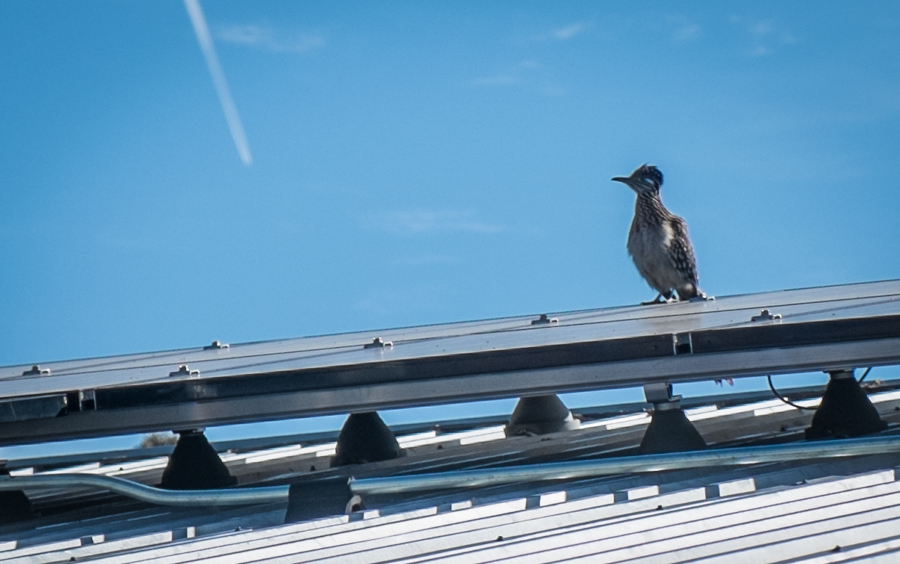
Roadrunner
This guy’s been ’round the place the last couple of days, I think lookin’ for love. Spring.
Roadrunner
My daughter’s got a smart and also hilarious new project involving video games and feminism and goats:
Goats are not restricted by human morality. Crashing into a party onto a jetpack and setting oneself and half the guests on fire is not done with malice when it is done by the protagonist-goat of Goat Simulator; it is simply what one does as a goat who has been granted the powers of flight.
Her voice is fearless; she uses semicolons.
I’ve long dismissed the “pipeline to the Missouri River” (PTM? “canal from the Missouri”? CFM?) and other similar large-scale water importation schemes as vastly impractical distractions from serious water policy (see for example here and here).
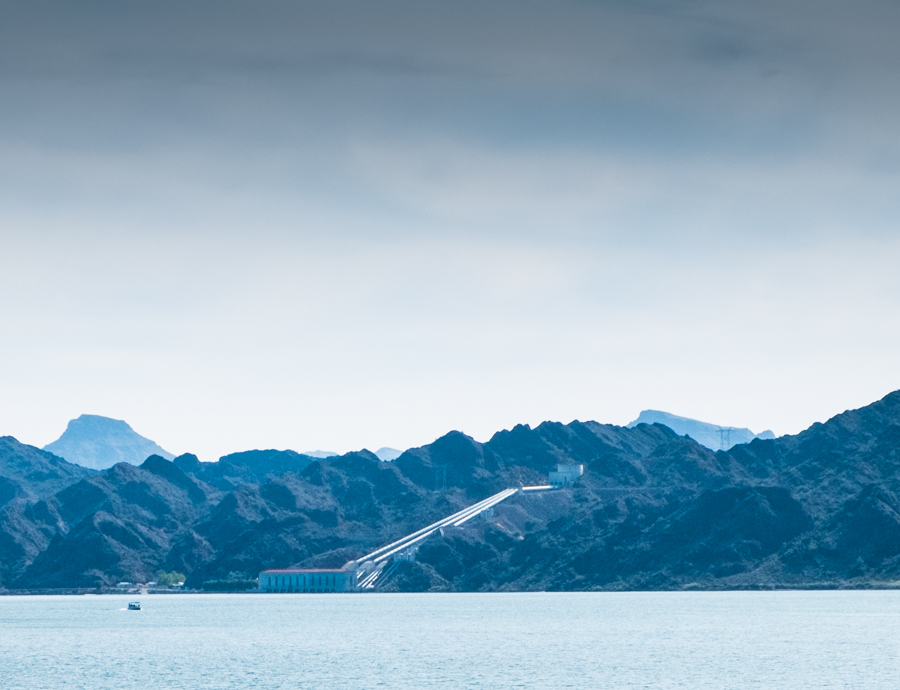
A pipeline to Los Angeles: the Whitsett Pumping plant taking water from the Colorado River for use in Los Angeles; John Fleck, February 2015
The argument, which I get regularly from well-meaning readers, points to the big network of oil and gas pipelines spidering across the United States and asks, Why can’t we do the same thing with water? We’ve had all this flooding in Region X, and we’re so dry here in Region Y. Why can’t we just move it from there to here? Whenever these suggestions come up, my water nerd friends roll their eyes and make jokes about NAWAPA. But what if that’s just all self-referential groupthink?
Two things I read this week got me thinking about a more general problem – the risk of groupthink from the water policy “in crowd”. The first was this from OtPR about the usual suspects at a California water conference saying the usual things:
The range of public water discourse is very narrow; it is all incremental change from how we do things now.
The second was a post yesterday from Mark Lubell, about the role of those in social network cores versus those on the periphery:
Core actors often have high levels of network closure (transitivity), which can lead to redundant ideas and group think. Periphery actors might be less subject to redundant ideas, and they could be engaging in lots of policy or other types of experiments that would be beneficial for the entire system.
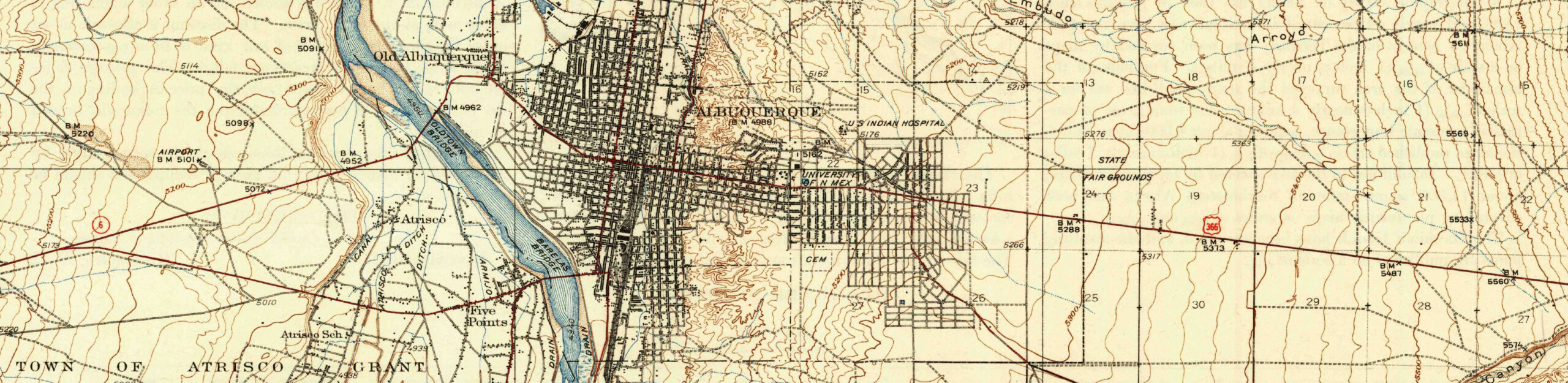
The math behind my answer to well-meaning PTM advocates involves the scale of the water-versus gasoline problem. Let’s say I use a tank of gasoline a week. That’s a little more than a gallon a day. A pipeline network, combined with tanker trucks and stuff, has been sufficient to meet that need. But water, in human-usable quantities, is really big and heavy. The average Albuquerque residents uses 134 gallons of water per day. A pipeline etc. network sufficient to meet that need would have to be two orders of magnitude larger than the system that brings gasoline to my town.
This seems to be a pretty straightforward argument, and I’m off to thinking about resilience theory and collaborative social networks and the role of markets and the other subjects permitted in the polite water policy circles at the sort of high-brown conferences I attend, or the bars I frequent. But what if we’re all doing this wrong?
The Central Arizona Project brings human-usable quantities of water uphill from Lake Havasu to Phoenix at least an order of magnitude larger than the Alaska pipeline bringing oil down from the north slope. The Chinese are doing stuff that makes NAWAPA look like child’s play.
What do you think, Inkstain readers? Should a pipeline from the Missouri or large-scale water augmentation of some sort like it be part of polite water policy discourse?
OtPR:
The range of public water discourse is very narrow; it is all incremental change from how we do things now.
There’s a particularly important passage in Matt Jenkins’ new piece on former Las Vegas water manager Pat Mulroy’s leadership on Colorado Basin issues (behind paywall for now, subscribe!) where he describes an example of a convoluted deal to bank Nevada water in an Arizona aquifer:
It was … the first federally sanctioned deal for a water transfer between two states. But Mulroy has only ever spoken about it euphemistically because transfers, even within the Lower Basin, are so politically charged. “Don’t ever call it a transfer,” she scolded during a 2008 interview. “It’s a banking agreement. That thing will disappear on us tomorrow if we call it a transfer.”
She had learned a crucial lesson, however. In the years that followed, Mulroy would — despite her reputation as a woman who didn’t mince words — speak an increasingly convoluted lingua franca that would eventually include enigmas like “intentionally created unused apportionment.” It sounds like gobbledygook, but it was all for a larger end.
“I learned it’s not what you do, it’s what you call it,” Mulroy told me. “You find the right name for it, and you can do anything.”
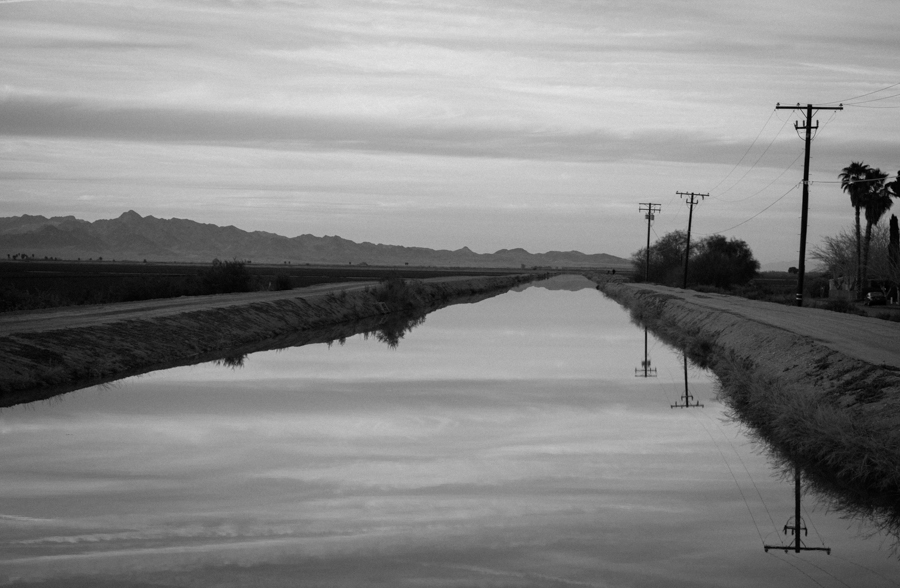
Palo Verde Irrigation District, Blythe, Calif., by John Fleck
In the Colorado River Basin, there is a core network of people representing each of the states and the major water users within the states who understand that the basic problem is this: If each state clings to the water rights volume numbers written down over the years on pieces of paper documenting “the Law of the River,” there won’t be enough water to go around, the reservoirs will empty and the system is at risk of crashing in unexpected and potentially very unpleasant ways. Down this path lies a lack of resilience.
This is a group of varying size and membership that regularly works together on basin-wide problems. After gathering to work out solutions that invariably involve lots of “using less than we though we were entitled to on paper,” each negotiator must sell the deal back home in a political environment motivated almost entirely by domestic concerns. You can’t just say “we’ve gotta use less water,” because then you get things like this:
“If anybody thought we were going to roll over and say, ‘OK, California, you’re in a really bad drought, you get to use the water that we were going to use,’ they’re mistaken,” said James Eklund, director of the Colorado Water Conservation Board.
Eklund knows, or should know, that there are mutually beneficial solutions that involve both Colorado and California (along with everyone else) not using the full allotment of water to which they’re entitled on paper. (Some of the best solutions also involve clever approaches to moving water across state lines. My book will look in detail at a suite of such ideas.) But as Mulroy said, you’ve got to be careful what you call it, because the Eklunds’ of the world gotta make this work back home.
Eklund’s comments were seen (I think correctly) across the basin as playing to the home crowd, while the state of Colorado actually has been a collaborative participant in the search for shared solutions to the basin’s problems.
But if the whole thing blows up, and my optimism about finding solutions to sharing water turns out to have been wrong, it will almost certainly fail because of problems at this boundary between basin-wide realities and the politics of domestic consumption. The scale of water governance requires solutions at the basin-wide scale that must then be implemented back home one river diversion and water district at a time, where the political system at the state and local level incentivizes pounding fists on tables and vowing to fight to save our water from those other people.
See, for example, Eklund.
So the folks working on this problem at a basin level have to structure the deals in such a way that they have a plausible story upon their return to the world of domestic politics. And they also have to invest in what resilience scholars call “social learning“, which is critical to bridging this gap in governance scale.
In the meantime, “intentionally created unused apportionment” may just mean “we used less water than we could’ve, and those other guys got some of what we saved”, but you’ve gotta be careful how you phrase it.
My friends at the Middle Rio Grande Water Assembly are gathering Sat., March 21, to discuss strategies for managing water in the face of climate change in the central New Mexico reach of the river:
While there is a Regional Water Plan for the three county-area (Sandoval, Bernalillo and Valencia), it is ten years old. This event is one of our opportunities to review the Plan and determine what changes need to be made so as to ease our way into a changing climate.
9 a.m. to 3 p.m., Dane Smith Hall at the University of New Mexico, it’s free but they’re asking you to register (but the registration page didn’t work for me, so I may just crash the party uninvited).
I’m fascinated by the geomorphic traces left by the rise and fall of Lake Mead – human scale (egret scale?) shoreline terraces. This is on the northern bank above Boulder Harbor. The bird, shown for scale (I don’t have a rock hammer, it’s a great egret, so quite large), hangs out there because of the fisher people.
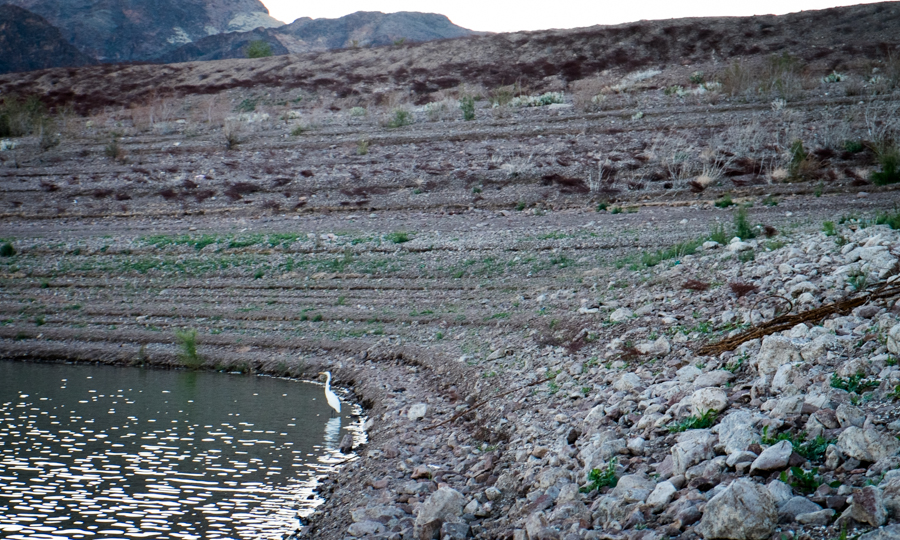
Old shorelines, Lake Mead, February 2015, by John Fleck
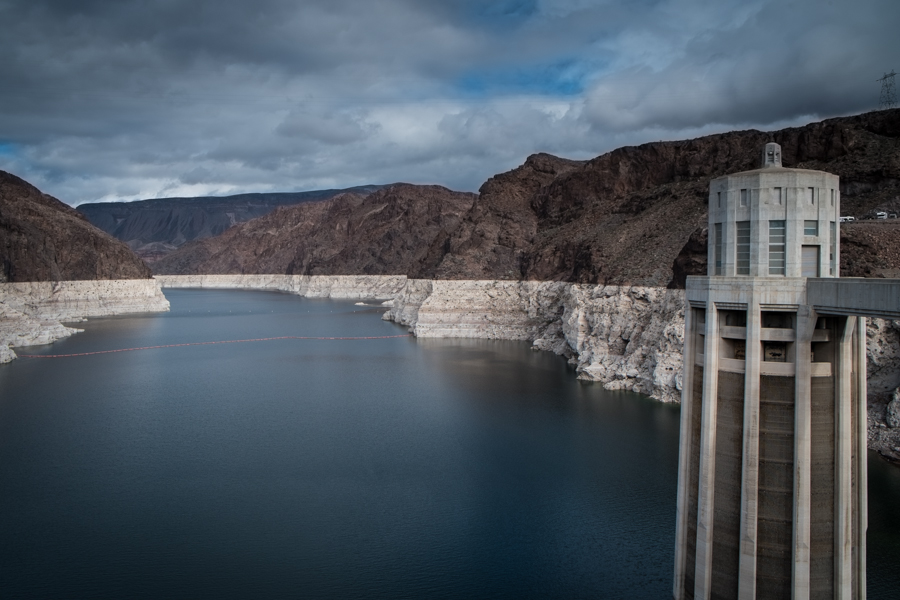
Lake Mead bathtub ring, by John Fleck, February 2015
One of the members of my brain trust was speculating idly the other day about how different the Colorado River dialogue might be if the hydro-geo-chemistry of the bathtub ring was different – if the dropping water didn’t leave a white mark, letting you see how much Lake Mead has dropped, letting people like me take a picture to put on my blog.
Standing atop Hoover Dam last week, I heard one of the Bureau of Reclamation tour guides emerge from the elevators, pointing out the bathtub ring and saying:
I don’t think as long as I live I will ever see it get to the top again.
I’m sure he or she does not speak for the Bureau and the Secretary of the Interior on this sensitive point.
update, Thursday, 3/5: Final March 1 forecast numbers are in, unchanged for those in the preliminary quoted below.
previously: It says something about the drought on New Mexico’s Rio Grande in recent years that a forecast of 67 percent of average runoff into Elephant Butte Reservoir is good news.
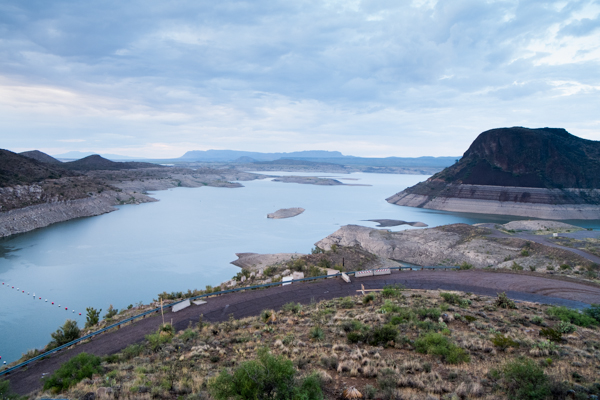
Elephant Butte Reservoir, Aug. 13,2014, by John Fleck
That’s the mid-point of the preliminary forecast sent around to New Mexico water managers and stakeholders today by the Natural Resources Conservation Service. The forecast includes the early March storm, which has pushed snowpack to 87 percent of average in the Rio Grande headwaters of Colorado and near normal in the mountain watersheds of northern New Mexico that feed the river. But as you head south, the numbers drop, and the forecast reflects that.
There’s still a big spread of uncertainty in the forecast, with a lot riding on what happens in March:
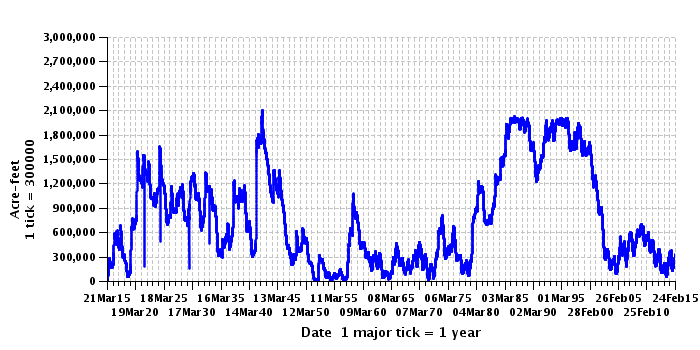
Elephant Butte Reservoir storage, courtesy USBR
This is the fifth consecutive March 1 for which the forecast has been below-average bad news at San Marcial, the gauge at the head of Elephant Butte Reservoir, a point I’m calling out here because the greatest drought impact has been on farmers who depend on water from Elephant Butte. After flush years in the ’80s and ’90s, irrigators drained the Butte in the first decade of the 21st century. As I wrote a couple of wrote a couple of years ago in the newspaper:
Yields are already down – 30 percent in the case of onions, one of the valley’s money crops. A drive through the valley shows tiny spring onion plants already stunted by the salt accumulating in the soil beneath them.
As for chile, Shayne Franzoy said the Hatch Valley should have a decent crop this year for the packers, like Bueno Foods in Albuquerque, that depend on their chile. But if drought conditions continue, the future is less certain. “If we don’t have surface water in the Hatch Valley,” Jerry Franzoy said, “it’s gonna die pretty quick.”
That was two years ago. It hasn’t gotten better.
The latest edition of Inkstain’s infrequent* Ask Me a Colorado River Question feature comes via Paolo Bacigalupi, and it wasn’t quite phrased as a question, but I’m hoping to resurrect the feature.
I’ve always said “cap” for CAP and “snee-wah” for SNWA. But I have no idea why. Odd and embarrassing. @jfleck @waterwired @jonnypeace
— Paolo Bacigalupi (@paolobacigalupi) March 4, 2015
My answer was that I say, and hear others say “cap” for the Central Arizona Project, but I’ve always stumbled over SNWA and usually just say “Vegas” which seems inadequate. Or sometimes “Southern Nevada,” which also doesn’t quite get the thing done.
What do you, dear readers, do with these two initialisms?
* I think it’s appeared, like, once.

