Wilkinson on the environmental shift in western water policy

The University of Colorado’s Charles Wilkinson:

One of the best developments for the environment in the West has been the quiet but deep revolution in federal water policy. Over the course of the past quarter century, we have moved from a dam-and-reservoir, build-at-any-cost mentality to a multifaceted approach that respects all that we need from, and love about, rivers.

The Salt/Verde, climate change and Upper Basin Envy

tl;dr – Heads up, Arizona. Less water headed your way!

longer version – Stuck out here in the Rio Grande Basin, I’ve long suffered Colorado River Basin Envy Syndrome. The Colorado is the sexy river, which means it gets all the cool science. I dream of an analysis this rich of uncertainties in my river’s streamflow.

Turns out that even within the Colorado River Basin there’s a little Envy Syndrome going on:

Numerous studies have assessed the potential impacts of climate change on the upper Colorado River basin… The lower basin is relatively less well studied, due mainly to the fact that most rivers in the lower basin were dammed during the 20th century and therefore do not contribute much surface water flow to the Colorado River basin (except in very wet years). Nonetheless, Colorado River tributaries in the lower basin (including two watersheds studied in this paper) are very important from a water supply perspective, providing totally 54% of the water used in the state of Arizona. (emphasis in original)

That’s Rajagopal et al., in On physical mechanisms related to climate-induced drying of two semi-arid watersheds in the southwest US. Their key finding:

The projections of this model ensemble indicate a statistically significant 25% decrease in streamflow by the end of the 21st century. The primary cause for this change is due to projected decreases in winter precipitation accompanied by significant (temperature driven) reductions in storage of snow and increased winter evaporation. The results show that water management in central Arizona is highly likely to be impacted by changes in regional climate.
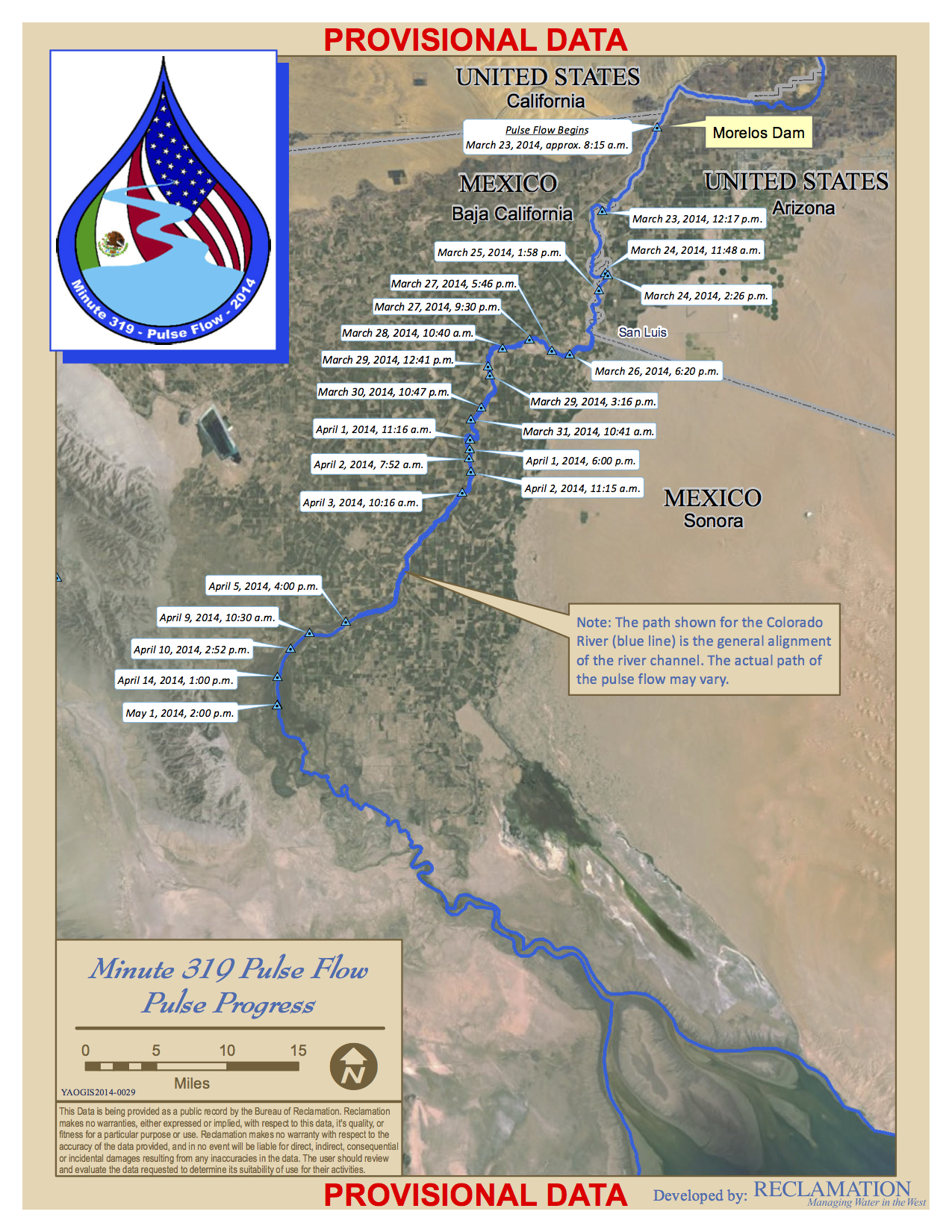
Colorado River Pulse Flow On the Move Again

Minute 319 Pulse Flow Map, 5/1/14

Minute 319 Pulse Flow Map, 5/1/14

After stalling out for a couple of weeks, the Colorado River Delta Minute 319 pulse flow is back on the move.

According to the latest map and missive from the science team, an earthen dam below the downstream-most habitat restoration site was removed, and the pulse has received an added stimulus from the Kilometer 27 Spillway (see nice NASA map/satellite image for the location). The KM27 release is an aspect of the critical “plumbing” aspect of this environmental restoration experiment. The main river channel, because of dry stretches with low groundwater, is not necessarily the most efficient way to get water to environmental restoration sites in the lower reaches of the delta, so some of the pulse flow water is making part of its journey through CONAGUA irrigation canals.

Irrigation and hope for New Mexico’s future

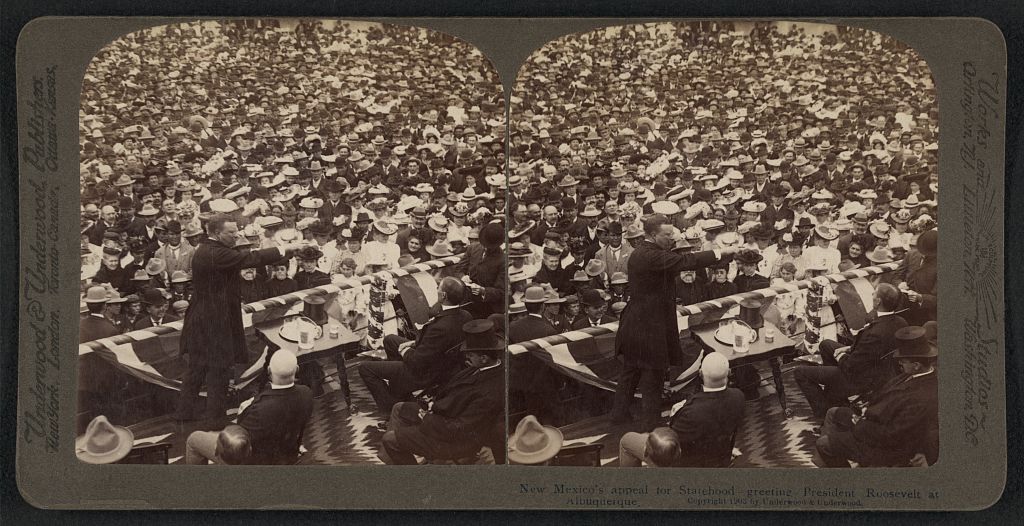
New Mexico's appeal for statehood - greeting President Roosevelt at Albuquerque, Underwood & Underwood, c1903 June 11.

New Mexico’s appeal for statehood – greeting President Roosevelt at Albuquerque, Underwood & Underwood, c1903 June 11. Courtesy Library of Congress

Teddy Roosevelt, speaking in Santa Fe, NM, May 5, 1903, during his grand western tour:

I build no small hope upon the aid that under the wise law of Congress will ultimately be extended to this as to other States and Territories in the way of governmental aid to irrigation. Irrigation is of course to be in the future well-nigh the most potent factor in the agricultural development of this Territory and one of the factors which will do most toward bringing it up to Statehood. Nothing will count more than development of that kind in bringing the Territory in as a State. That is the kind of development which I am most anxious to see here the development that means permanent growth in the capacity of the land, not temporary, not the exploiting of the land for a year or two at the cost of its future impoverishment, but the building up of farm and ranch in such shape as to benefit the home-maker whose intention it is that this Territory of the present, this State of the future, shall be a great State in the American Union.

(I’m a little confused by the dates, but the picture appears to be from that same tour, possibly taken on the same day as his Santa Fe speech.)

more stuff I wrote elsewhere: NM Env. Dept. dings Air Force over groundwater cleanup (or lack thereof)

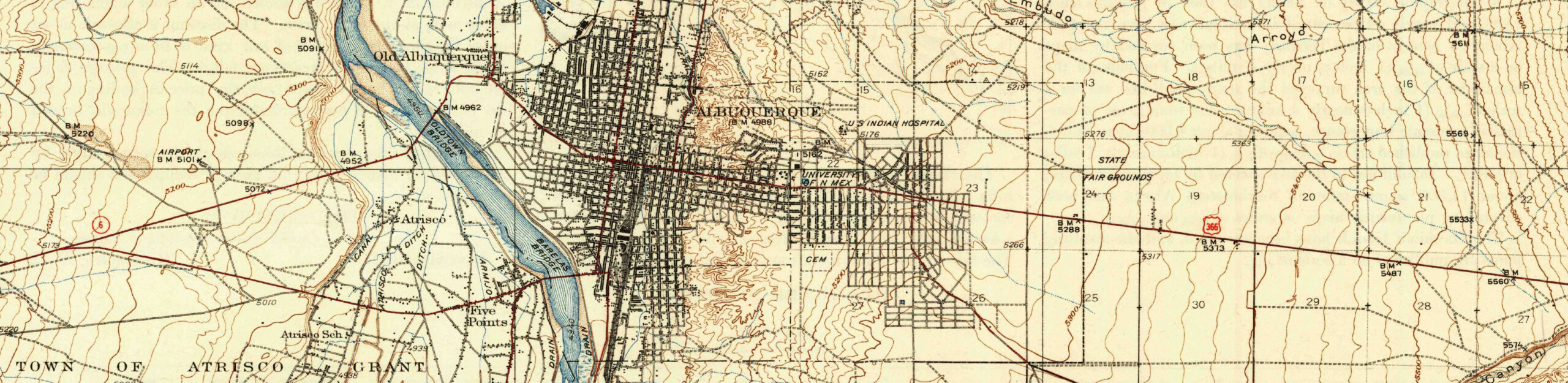
Also from this morning’s paper, a tougher stance from the New Mexico Environment Department on progress (or lack thereof) in cleaning up a massive groundwater mess beneath Kirtland Air Force Base and adjacent Albuquerque neighborhoods:

The letter provided to the Journal is an expression of increasing Environment Department frustration with the cleanup progress. A month ago, in response to Journal questions about progress in meeting cleanup milestones, Environment Secretary Ryan Flynn issued a statement saying, “While we are by no means satisfied with the amount of time it has taken to make meaningful progress on this situation, we are encouraged by the Air Force’s efforts over the past 6 months.”

The April 24 letter takes a sterner tone, complaining about “an overall lack of attention to detail for a matter that is of the utmost importance to NMED and the State of New Mexico.”

Poor-quality work by the Air Force and its contractor, CB&I, “has jeopardized the achievement of the interim measures by the specified deadlines,” state Environmental Health Division Director Tom Blaine wrote.

Stuff I wrote elsewhere: Embudo and the history of measuring water

From this morning’s paper, a visit to Embudo, where stream U.S. stream flow measurement began:

In the world of U.S. water management, this narrow strip where the river funnels between high bluffs is historic.

Powell, most famous as the first person to survey the Grand Canyon, had realized that the ambitions of the continent’s European immigrants spreading west across North America were running up against an arid reality that Easterners failed to understand. Collective effort would be needed to confront the region’s aridity,

Powell realized, and one of the first things the young nation needed was to measure how much water there was in the rivers.

How the media gets drought coverage wrong

The perception of many residents that the drought gravely threatened their pocketbook and way of life was more often than not an exaggeration. Such irrational reactions were in part driven by the media’s coverage of the drought. Water, usually taken for granted and ignored, became their lead story as the drought continued. Video from helicopters circling near dry reservoirs and of antagonistic confrontations in surprisingly full water District board rooms made good copy as news reports. Yet most media sources were largely unable or unwilling to convey the more complex and prosaic aspects of water management. In particular, the gulf between traditional water policies and practices and a changing context of supply and demand had widened over many years, and therefore could not be captured on camera. Thus, media sources often responded to public interest in the drought, not by providing adequate background knowledge, but by exaggerating or distorting the actual nature of the scarcity problem.

Tom Waller, describing the 1980s California drought, in “Expertise, Elites, and Resource Management Reform”, Journal of Political Ecology, 1994