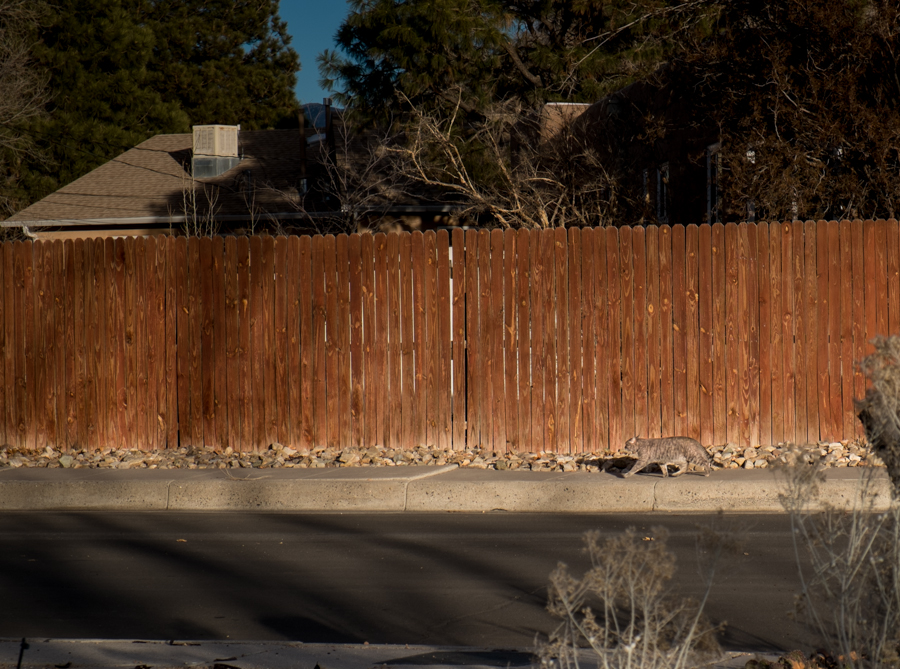
Cat walking down Aliso Dr. January 2014
As part of my new “slow journalism” movement, I’m adopting a more casual style of photography than the hyper-aware Weegee “f/8 and be there” approach.
Cat walking down Aliso Dr. January 2014
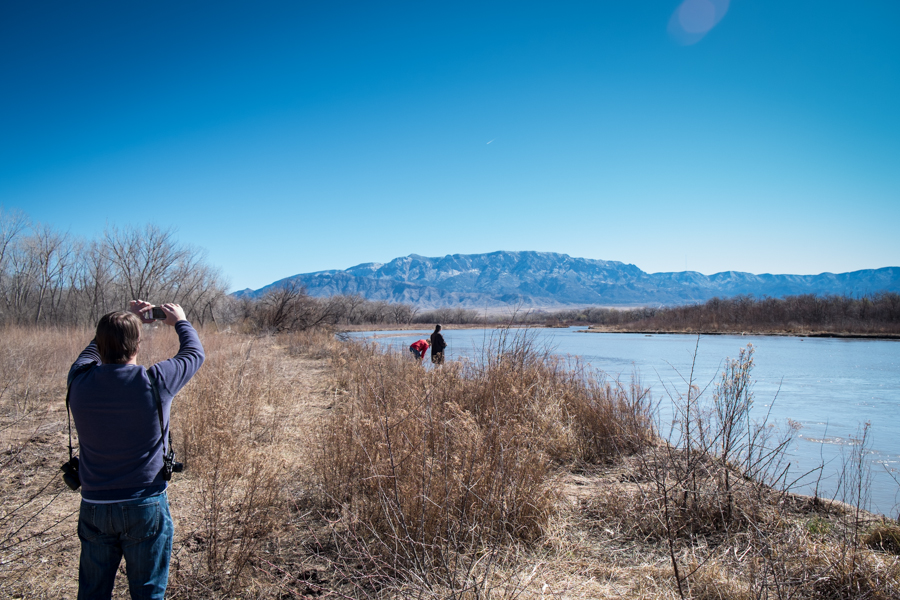
Robert Browman, Laura Paskus and Lissa Heineman along the Rio Grande, March 2014, by John Fleck
Went with friends this morning in the woods along the Rio Grande in search of porcupines. You’d never know you’re in the middle of New Mexico’s largest metro area. (We found porcupines!)
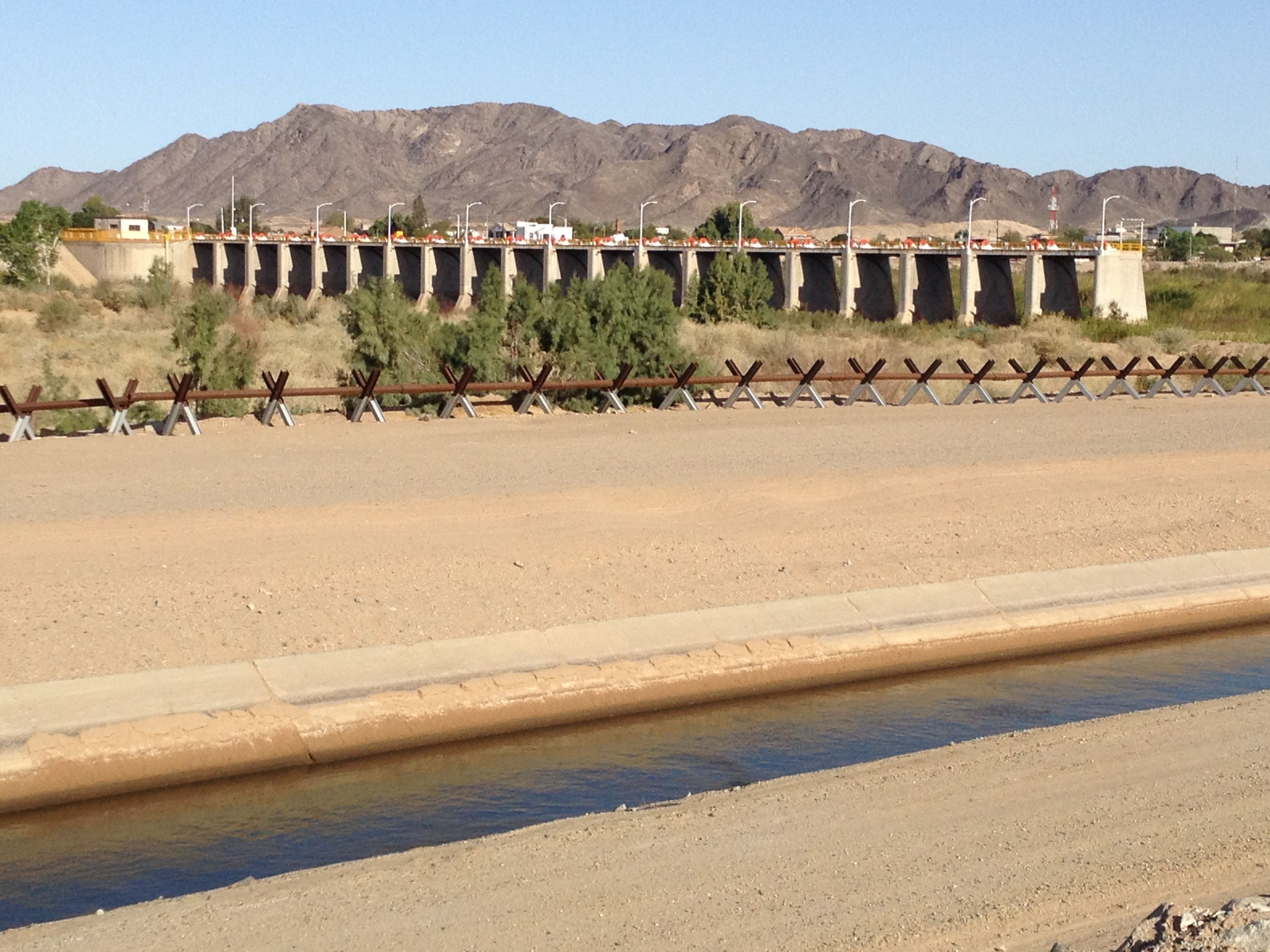
Morelos Dam and the end of the Colorado River, 2010, by John Fleck
When I give talks about western water and the Colorado River they usually end, or sometimes start, at Morelos Dam. Built from 1948-50, it spans the river between Baja California Norte and Arizona, scooping up the last of the great river and diverting it west, to the farmlands of the Mexicali Valley.
Visiting the Lower Colorado River region a few years back, one of my hosts at the Bureau of Reclamation’s Yuma Area Office suggested a drive down the levee on the river’s east bank from Yuma past Morelos Dam to San Luis. It’s probably rhetorical excess to say that drive changed my life, but it sure as hell makes a great storytelling device. A river I’ve spent my whole life on and around, an obsession since I peered down into the depths of the Grand Canyon as a tot and saw a muddy little ribbon between the cliffs, simply stops. In the foreground of the picture above, the Yuma County Water Users Association’s Cooper Lateral delivers Colorado River water to farms on the U.S. side of the border. The road you see is the levee road, with Border Patrol vehicle barriers as a reminder that this is contested ground. Drive south and the levees continue, but they seem comically superfluous, flanking a dry sandy wash, relegated to the service of the ever-present Border Patrol.
If all goes well, at the end of this month I’ll be standing on Morelos Dam watching the Colorado River flow back down that sandy wash. I am very much looking forward to this.
The environmental “pulse flow” beginning this month is an experiment on many levels. At a scientific level, it is an experiment in determining how the parched ecosystem of the once-lush Colorado River Delta responds to the return of water:
The pulse flow experiment is expected to flood low terraces and backwaters, move sediment, elevate the water table, and promote the germination of cottonwood and willow trees…. The information gathered throughout the experiment will be used to inform future binational efforts in the Colorado River delta. (Flessa et al., Flooding the Colorado River Delta, EOS, Dec. 10, 2013)
This is what I think of as the “physical plumbing” level of the experiment. We have turned the Colorado River into a plumbing system, delivering water for human use by 40 million people and 5.5 million acres of land. In the process, that physical plumbing dried up the Colorado River Delta, one of the great estuaries of North America. This experiment will use that physical plumbing to return some water to that natural system. Scientists will be watching and measuring, and I plan on tagging along as much as I can to document what they learn.
But far more important here, I think, is the “institutional plumbing” part of the experiment. In the course of building the dams and canals to deliver all that water to those 40 million people and 5.5 million acres, we also built in parallel a system of institutional plumbing through which we decide how to allocate that water. My notion of “institutional plumbing” is a fuzzy concept, intentionally so, because it’s not entirely clear what fits within its boundaries. Certainly the “Law of the River”, which includes the Colorado River Compact, the Mexican Water Treaty, the various statutes and court decisions that have interpreted and implemented the underlying legal framework. But the institutional plumbing also includes an enormous body of social capital – the people who understand the system and work at the boundaries between physical and institutional plumbing to make the system function.
The thing that makes the “pulse flow” work is a masterwork of an institutional plumbing valve called “Minute 319“, a U.S.-Mexico agreement that acts as an addendum to the two nations’ 1944 treaty governing the management of their shared river. The environmental flow is the shiny part of the deal, but 319 is an incredibly rich, many-layered thing that includes surplus sharing and shortage sharing provisions as well.
Matt Jenkins, in High Country News last December, has done the best takeout on the agreement and the intricate dance between the goals of the environmental interests and the traditional water movers. In short, the big municipal water agencies saw opportunities in Mexico:
[S]ince the early 1990s, the Metropolitan Water District of Southern California had contemplated the possibility of some kind of cross-border water swap. It could provide funding to help Mexican irrigation districts tighten their relatively inefficient water systems, thereby allowing them to grow the same crops using less water. In exchange, Metropolitan would increase its own water use upstream, in the U.S., by a corresponding amount.
Environmentalists, especially the Environmental Defense Fund’s Jennifer Pitt, saw opportunity in that process. If new water was being carved out, maybe some could be carved out and left in the sandy river bed downstream from Morelos Dam. With an increasingly vocal environmental community on the Mexican side of the border and Mexican water users seeing some benefit in a deal that would make themselves more resilient to drought, the space for a grand bargain emerged. Again, Jenkins, who has really done the journalistic heavy lifting on this:
The meetings had blurred traditional lines in water politics, giving conservation organizations unprecedented access to decision-making about the river’s future. And, as Pitt points out, international negotiations proved to be a realm in which many conventional environmentalist tactics – such as using lawsuits to force change – simply don’t work.
“Those tools aren’t there, because you can’t apply them across the border into another country,” she says. “Everything has to be through consensus; there’s no rolling anybody.”
The central thesis of my book is that, for better or worse, we’re stuck with the grandiose physical plumbing we’ve built and the communities that have come to depend on it. Our success or failure in the 21st century will depend on the robustness and resilience of the institutional plumbing to help us adapt to a changing world. It is there, more than in the physical flow of water past Morelos Dam, that the importance of this month’s milestone lies.
From Bobby Magill, more evidence for my thesis that we’re such profligate water users in the United States that we’ve got lots of room to move as drought and climate change reduce supply:
Eventually, TV station weathercasters began reporting the level of the Edwards Aquifer along with the daily weather forecast, forcing residents there to pay closer attention to their water consumption.
“It’s a culture that’s developed here the last couple of decades that was a result of the Endangered Species Act lawsuit that put a cap on how much water could be pumped from the Edwards Aquifer,” San Antonio Water System spokesman Greg Flores said. “That change in culture and behavior in terms of water use and water efficiency really has driven San Antonio in a different way (from how other Texas cities) embarked on their efforts.”
As California struggles against the problems posed by its current drought, there has been a great deal of attention paid to the lack of groundwater regulation. Melody Gutierrez has a great example today, from Paso Robles:
How scant has the crucial underground water supply become around the San Luis Obispo County city? Sue Luft can tell you anecdotally. The water levels in wells that feed homes and wineries around her 10-acre property just south of Paso Robles have dropped 80 feet in some areas, leaving many with no choice but to take out loans to drill farther down. Luft calls it a “race to the bottom.”
Why are they racing? Because they can, I guess:
“The drought is being used as a political mechanism to take away property rights,” said Cindy Steinbeck of Steinbeck Vineyards & Winery in Paso Robles. “We are in a serious drought, but that doesn’t mean individual landowners should have to give up what is theirs by law.”
Groundwater has been regulated in vastly different ways from other water sources. California requires permits and licenses to take water from streams, rivers and lakes, but no such process exists for groundwater. Surface water and groundwater are treated differently in state law in a way that resource experts say makes little sense, given that one affects the other.
“California has the least structure and fewest requirements (compared with any other) state,” said Andrew Fahlund, deputy director of the California Water Foundation. “The system has survived up to this point because we weren’t facing a significant crisis.”
And thus it is framed – property rights versus government regulation. But that’s not quite right.
While Fahlund is right that state government doesn’t regulate, California is home to pioneering examples of communities that, independent of any external regulation, realized the race to the bottom would kill them and found a way to self-regulate to avoid the tragedy of the commons.
Back in the 1950s, water pumpers in the Los Angeles Basin were in a similar race to the bottom. Recognizing the problem, they did the difficult political work of self-imposing a political regime that shared the burden of ending the race. (There’s a great history of this in the Water Replenishment District of Southern California’s annual report – pdf.) It’s where Elinor Ostrom did her pioneering research on common pool resource problems, and it’s fun to read how proudly the WRD folks embrace her work today:
The formation of the Water Replenishment District is one of the studies she used as an example of “how to organize to avoid the adverse outcomes of independent action” and “to obtain continuing joint benefits” in the face of “temptations to free-ride, shirk, or otherwise act opportunistically.”
The details of how the L.A. Basin people did it are beyond the scope of this blog post, beyond noting that Ostrom’s work concluded that there are lots of ways for communities of interest to do this sort of thing. But one of her central findings is that it’s up to the folks in Paso Robles to succeed or fail.
I’ve often written about the ways in which our rivers in the western United States have become like plumbing (and here, here, and especially here). But one of the most interesting things to me about metaphors is when you push them to too hard. You can learn a lot at the point where the metaphor breaks down.
So what does it tells us about the nature of the California “plumbing” system when, as Matt Weiser reports, they have to drive salmon to the ocean in trucks?
On Monday, state and federal wildlife officials announced a plan to move hatchery-raised salmon by truck in the event the state’s ongoing drought makes the Sacramento River and its tributaries inhospitable for the fish. They fear the rivers could become too shallow and warm to sustain salmon trying to migrate to sea on their own.
To folks in many parts of the arid western United States, the notion that some California communities don’t meter residential and business water sales seems crazy.
It is. This may be, by some measures, a record drought in California. But even without it, Californians have known they have serious water stresses. That it has taken this long to get this basic water management tool in place is, in fact crazy. Here’s Paul Rogers:
Despite urgent calls for water conservation amid one of California’s worst droughts, more than 255,000 homeowners and businesses across the state can still use all the water they want without paying higher bills.
And nobody even knows how much water they are using.
Why is this? First, homes and businesses without meters, while large in number, are the exception:
Most California residents have had water meters for generations.
Los Angeles finished installing them in the 1920s. San Jose has had meters on every home since the 1930s. Oakland began installing them in 1906 and was fully metered by 1940.
But people seem to like living in a wet, green world:
But even in a large, prosperous city like Sacramento, plans to require water meters sparked controversy for decades.
“For some people, it’s like going to Alabama and saying you are going to register their guns,” said Barbara O’Connor, director emeritus of the Institute for the Study of Politics and the Media at Cal State Sacramento.
“It’s a visceral reaction,” she said. “People in some places view it as a birthright that they have big trees and green grass. They see the water in the rivers, they walk along it, and they raft on it. It’s part of the right of being a Sacramentan.”
The full article is worth reading for those interested in water policy steps that are relatively straightforward and that can make a difference in building resilience against drought and climate change. “You can’t manage what you don’t measure,” as my business school grad colleague likes to say. And kudos to the Mercury-News for publishing the full data table.
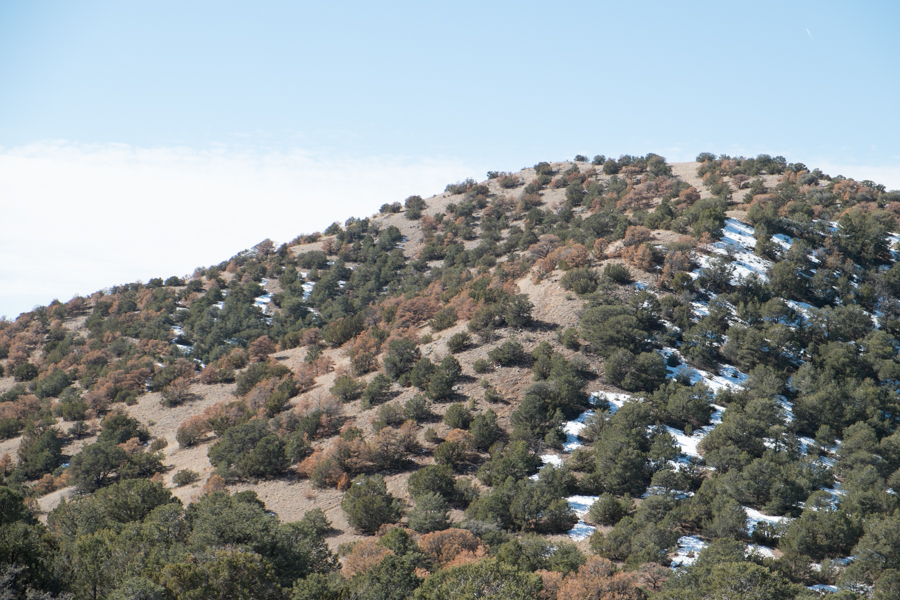
Dead piñon, Sandia Mountains, February 2014
One of the casualties of drought is the piñon in the mountains of New Mexico. I took this picture back in February in the Sandias, the mountains on the eastern edge of Albuquerque. Where you see snow the slopes are generally north-facing. No snow is south-facing, and that’s where you see brown trees.
I tweaked the picture in Lightroom to give a false-color image of the dead trees in red:

Dead piñon, false color, by John Fleck, February 2014
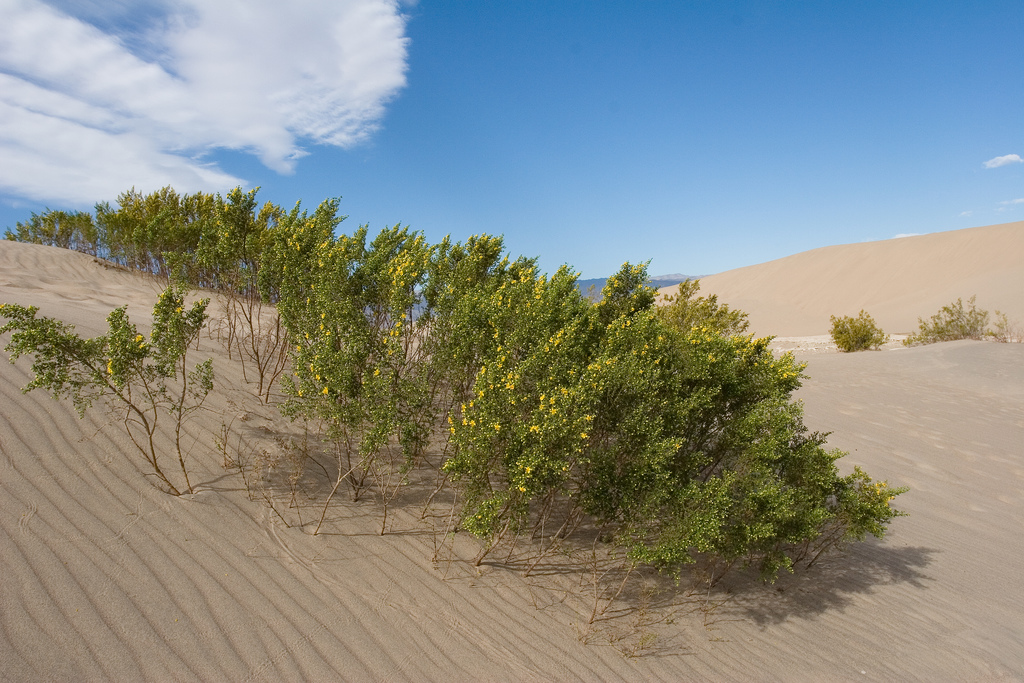
Stove Pipe Wells, California, US, by Flickr user n8agrin, CC
If you have any doubt about it, know that the desert begins with the creosote.
– Mary Austin, Land of Little Rain
If I was a more clever writer, I’d have a joke here about how the statistics of a WIPP accident change now that we’ve got a Bayesian prior:
The radiation leak that has shut down the nation’s only operating underground nuclear waste disposal site was, for all practical purposes, never supposed to happen.
No one knows yet how or why a waste drum leaked at southeast New Mexico’s Waste Isolation Pilot Plant on Valentine’s Day, triggering alarms, exposing workers and setting off a cascade of events that could cripple the nation’s radioactive waste disposal system.
But a Journal review of Department of Energy records shows that, before WIPP opened, the agency put the risk of such an accident at one chance in 10,000 to one in 1 million during any given year of WIPP operations.