Found this behind an old bookshelf. Not sure what it is.
John Fleck, January 2014
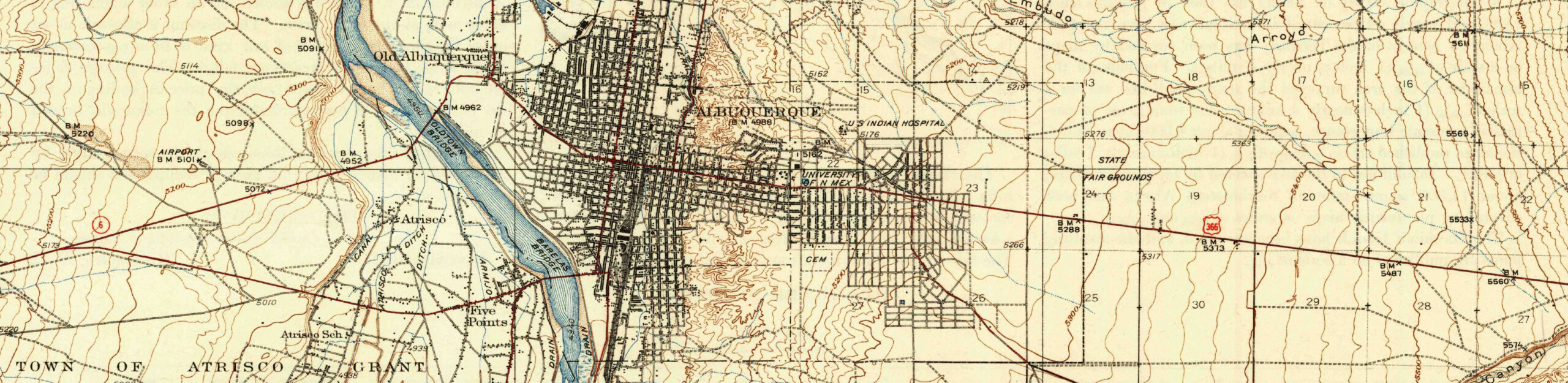
Found this behind an old bookshelf. Not sure what it is.
John Fleck, January 2014
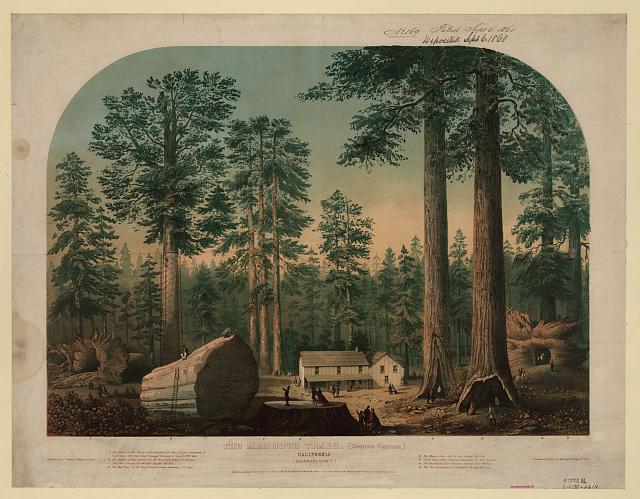
The mammoth trees (Sequoia gigantea), California (Calaveras County) / executed in oil colors by Middleton, Strobridge & Co., Cin. O., circa 1860, courtesy Library of Congress
The tension between scientists and journalists goes back a long time:
The vaporings and idle imaginings of the newspaper man, I am compelled to believe, are more acceptable both to landlords and tourists, than any presentation of actual facts.
That’s University of California Professor C.B. Bradley, writing in Overland Monthly & Out West Magazine in 1886, trying to correct exaggerations about the age of California’s great Sequoias, which had become popular with the tourist trade. Quoted in Jared Farmer’s new book Trees in Paradise: A California History
At a water conference here in Albuquerque last week, one of my water mentors Bill Hume (former editorial page editor at the newspaper, later water advisor to New Mexico Gov. Bill Richardson) made this observation (this is from Bill’s written text, which he kindly shared after the talk and gave permission to me to use):
Water Policy is like the weather: Everyone talks about it – but nobody agrees on how to modify it.
This is because Water is not itself a policy topic; it is the common denominator in a variety of policy topics. Water is a commodity issue for farmers, municipalities and industries. It is a superintending variable in most ecological discussions. It is an omnipresent factor in interstate relations in all directions.
Water to our Pueblo neighbors is all of the above – but also something sacred.
The title of the conference, sponsored by the New Mexico Water Dialogue, was “Implementing Change: Where’s the Political Will?” I didn’t really like the name or the theme, because it presumes that there’s a solution to our water management challenges out there, and we just need to buckle down and do it. But as Bill’s comments suggest, this has the characteristics of a wicked problem (pdf) – the solution depends on the problem definition. Different interests define it differently, and therefore one person’s obvious solution that simply requires political will differs from another’s, and the problem is the process of clarifying those differing viewpoints in a way that clarifies the problem and solution spaces. Once you’ve got that done, political will isn’t much of a problem.
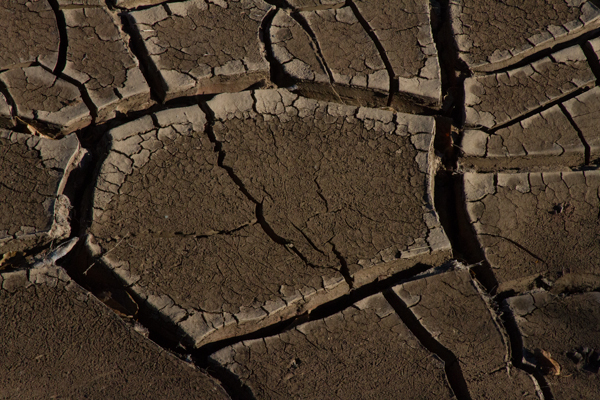
cracked mud, Socorro County, by John Fleck
I was reminded of Bill’s comments by this today, from OtPR, who has taken the occasion of the worst California drought since the Noachian flood receded to rejoin the conversation. The question is what sort of meat Gov. Brown will attach to the bones of a drought declaration:
It all depends on what the state is trying to achieve during this drought. Is the goal of drought management to keep native species alive? Is the goal of drought management to keep all growers in the state prepared to return to growing as soon as water returns? Is the goal of drought management to buffer urban consumers from increases to the costs of meat and dairy? Is the goal of drought management to get a water bond through the state legislature? The state could do a lot, but unless it has some specific goals, I doubt it’ll do much of anything.
It’s easy to say we must do something about the problem of drought. We nod our heads in agreement. But which “problem of drought” exactly do we mean?
Here’s the entire Rio Grande right now, which easily fits through the slot on the east edge of the Angostura diversion dam north of Albuquerque. No water is being diverted. That’s the whole river you see. This is not unusual. The flow measures about 600 cubic feet per second at the San Felipe gauge a few miles upstream. The median at this time of year is in the mid-700s.
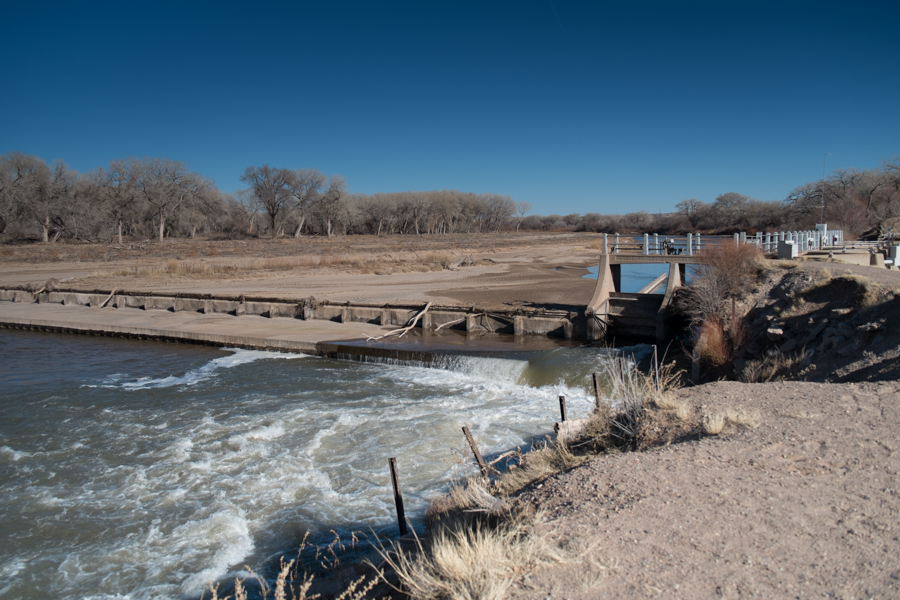
Angostura Diversion Dam, Rio Grande, Sandoval County, January 2014, John Fleck
I was reminded at a talk last night that farmers in the Elephant Butte Irrigation District in southern New Mexico got less than 10 percent of a full irrigation allotment last year.
I say that by way of a preface to noting Juliet McKenna’s observation that there’s a 50-50 chance of a formal shortage declaration in the Lower Colorado River Basin in 2016. We’ve already heard a lot about the risk of the Colorado River’s first shortage, and we’ll hear a lot more. But it’s worth remembering that lots of arid climate water users, especially in the ag sector, deal with shortages with some regularity. This is only interesting on the Colorado River because it’s unprecedented. As I’ve pointed out before, in the midst of the worst drought in the instrumental record, everyone in the Lower Basin has gotten a full allocation, every single year. The notion of the sort of rock solid, reliable 100 percent allocation is the exception rather than the rule in arid climate western irrigation.
The impacts of a Colorado River shortage declaration will be modest compared to what many arid climate irrigation systems cope with routinely as a result of climate variability.
Filing some pictures this evening, I came across this, taken in the bed of the Rio Grande beneath the Hatch bridge in southern New Mexico on April 29, 2013:
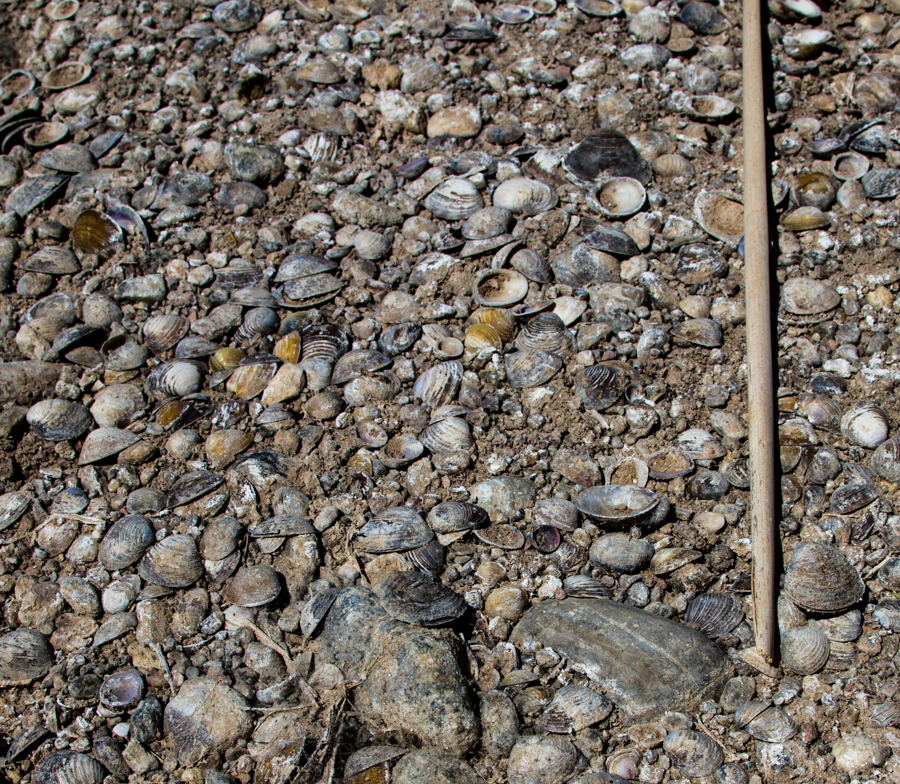
Dead River Clams, Rio Grande, Hatch New Mexico, April 29, 2013, by John Fleck
This is the sort of thing Jack Schmidt of the Grand Canyon Monitoring and Research Center was talking about at a conference in Boulder last August when he said:
Talking about water, and talking about water as a commodity, is not the same as talking about a river.
Beginning in the 1950s, according to USGS data, they’ve been shutting the river down south of Elephant Butte Reservoir most winters. This conserves irrigation water, which is important to grow food and support the economy among those who have chosen to make their livings growing said food. Last year was the longest shutdown in history. They turned the river off around the end of August 2012 and didn’t turn it back on until late May.
This seems to be the sort of thing Schmidt was getting at.
Talking about water, and talking about water as a commodity, is not the same as talking about a river.
Jack Schmidt, Grand Canyon Monitoring and Research Center, speaking at the Clyde Martz Summer Water Conference, August 2013, University of Colorado
“To say Albuquerque is located in a valley,” Paul Bauer and his colleagues wrote in Albuquerque: A Guide to Its Geology and Culture
So, rather than excavating this enormous valley, the Rio Grande actually helped to fill a gigantic depression.
Duly noted, though “valley” seems a practical word nevertheless, imprecision notwithstanding.
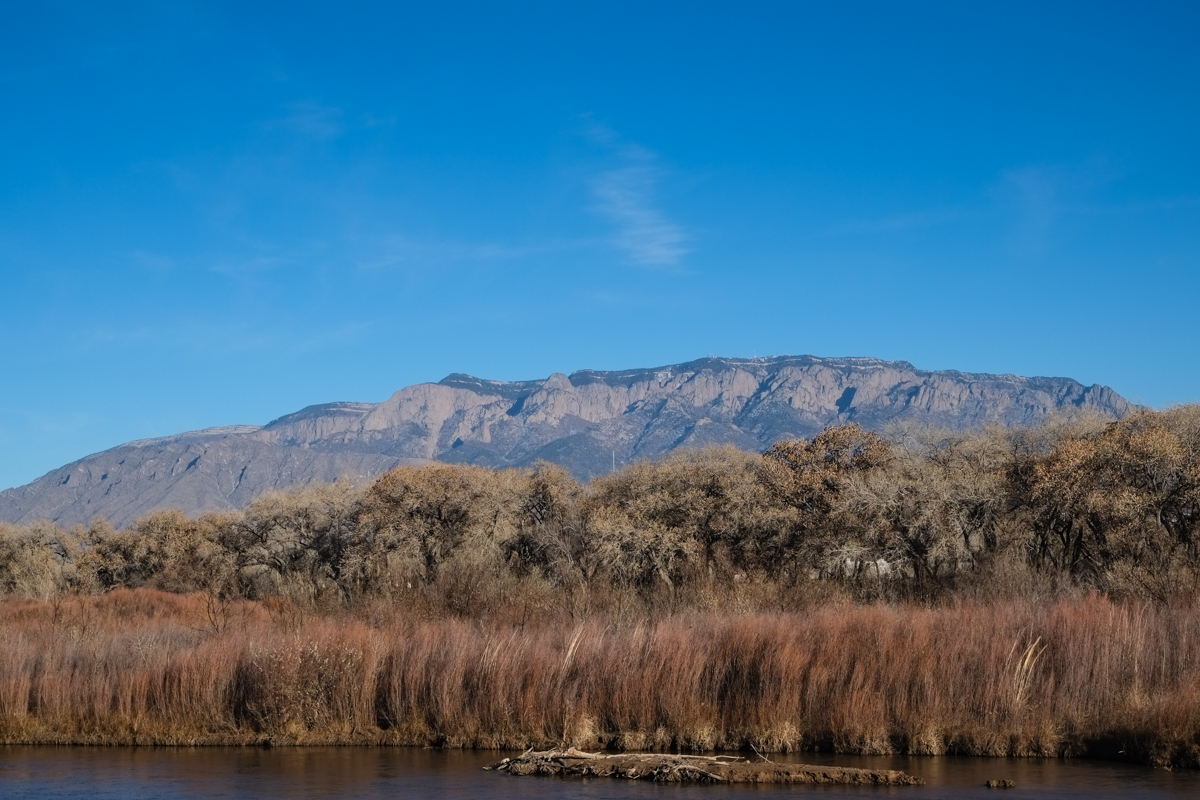
The mountains to the east, the Sandias, are visually as well as geographically defining. Geographically, the city bumps up to their feet and stops. Visually, they show up in a lot of pictures, especially the iconic (cliché?) shot of river in foreground, cottonwoods in midground and mountains as the city’s defining backdrop. Inevitably, the cliché (like the one below) focuses on the characteristic hump of the Sandias’ northern reach. As Lissa points out, it’s the more visually interesting piece of the mountain range.
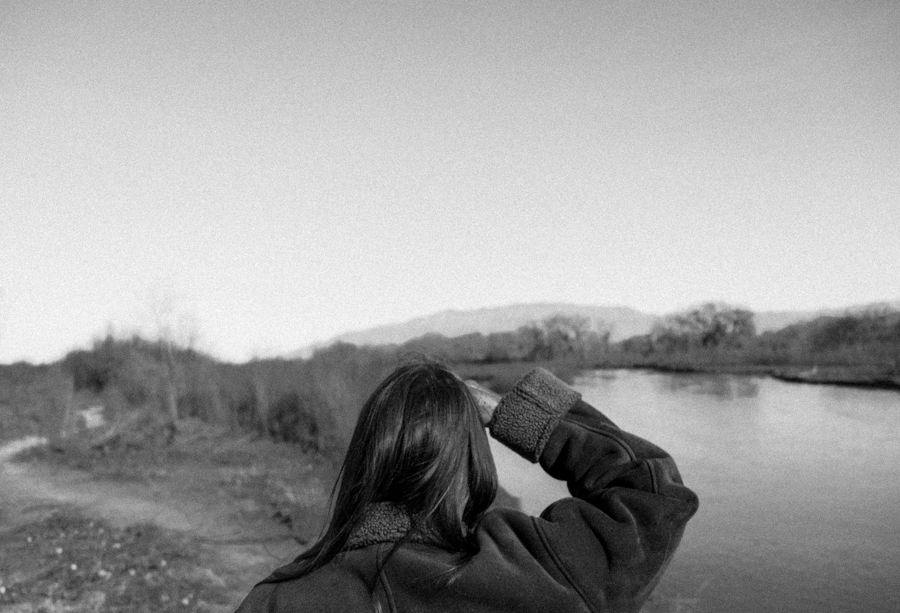
Lissa Heineman, Rio Grande, Sandia Mountains, January 2014, by John Fleck
For the record, she’s not actually looking at the mountains. She’d just heard a bird, which we later identified as a Townsend’s solitaire, high in a cottonwood. (The Bauer et al. book is a a great thing to have on the shelf for your own reference, or as a gift to the curious who might be visiting or live here.)
From this morning’s newspaper:
The community’s total water use for the year, 32 billion gallons, was the lowest for the metro area since 1983, despite the fact that the population in the utility’s service area has grown 70 percent in the two decades since, according to Katherine Yuhas.
Sandias over the Rio Grande, John Fleck, January 2014
If it’s too intense and too early in the spring, it can blow all the snow and moisture away in the mountains as if winter had never happened. Then there’s no snow to become water to drain into the rivers, to come into the fields.
That’s from Stacia Spragg-Braude’s new book If There’s Squash Bugs in Heaven, I Ain’t Staying