El Paso cranking up the desal

The central premise of my book project is that, despite the enormous western water problems I regularly chronicle here and in the various other places I publish, I expect that we’ll do OK in the long run. My optimism comes from the way communities, when they approach the edge of the water supply cliff, show the ability to adapt to shortage.

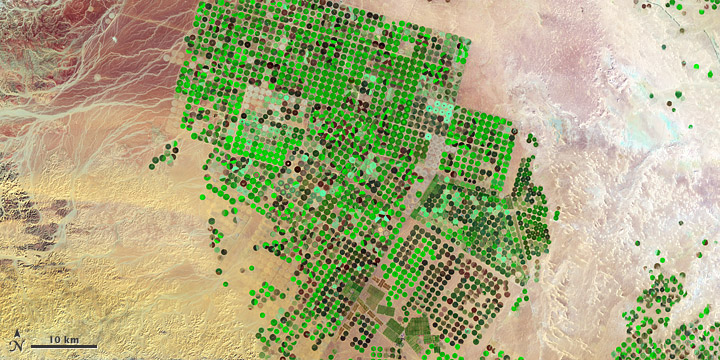
One of my favorite case studies is El Paso, which in the face of some pretty nasty drought conditions is cranking up its desal plant. From El Paso Inc.:

For the first time since it opened in 2007, El Paso Water Utility’s desalination plant has been running at nearly full capacity this month.

And without it, the city would have been in trouble, the utility’s president and CEO, Ed Archuleta, said Friday.

“People have asked me when the desal plant is going to run at full capacity,” he said. “Well, here it is. If we didn’t have that plant, we would be in deep trouble in that part of the city.
 

Hoover Dam from above

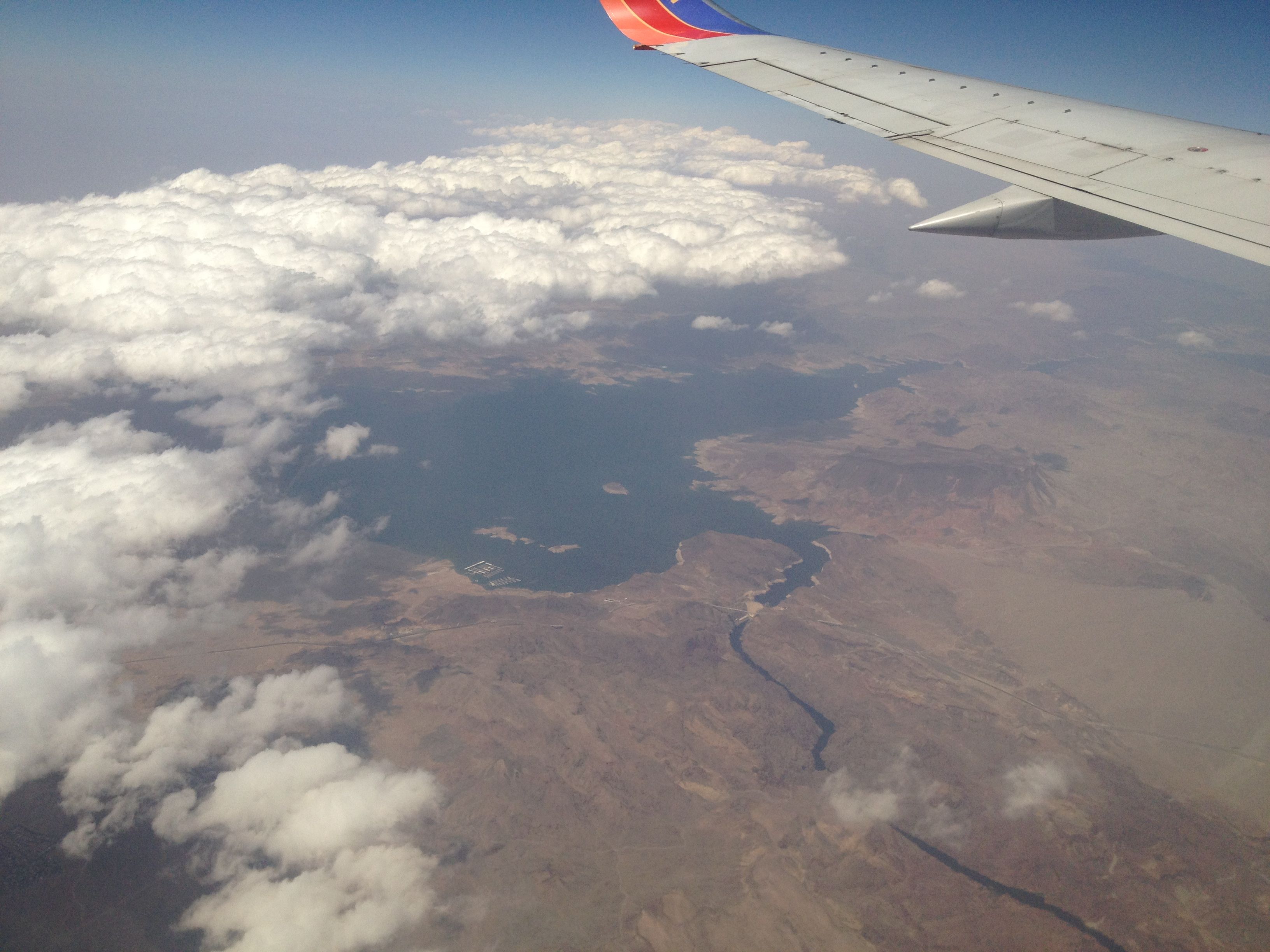
Hoover Dam from above, 5/25/2012

Hoover Dam from above, 5/25/2012, by John FLeck

I believe that anyone who flies in an airplane and doesn’t spend most of his time looking out the window wastes his money.

– Marc Reisner

When your vantage point spans a sufficient chunk of landscape, Hoover Dam doesn’t look so big. Is this really the right scale at which to think of it?

Stuff I wrote elsewhere: Kirtland jet fuel spill

I dashed out of town early Wednesday and failed to share with Inkstain readers the latest in the Kirtland Air Force Base jet fuel saga:

As much as 24 million gallons of jet fuel might have escaped from a decades-long leak in an underground Kirtland Air Force Base pipe, three times more than previously estimated, according to a new calculation by a New Mexico Environment Department scientist.

Officials cautioned that there is still a great deal of uncertainty about the number, and that they may never know how much fuel has spilled. But new data from state-mandated monitoring wells show the fuel in soil beneath the spill site is more widespread that previously known. And regardless of the specific number, the new data show the spill is larger than previously known, state officials said.

The news raised alarm bells at the Albuquerque Bernalillo County Water Utility Authority, which has two large water well fields near the contamination site. The contamination is less than two miles from the nearest well.

“It scares the heck out of me,” said John Stomp, the water utility’s chief operations officer.


Stuff I wrote elsewhere: endangered species problem highlights deeper problems on the Rio Grande

My column in the morning paper on a rift between the state of New Mexico and the feds over water for the endangered Rio Grande silvery minnow. Because it’s not really about a fish:

As has been happening for more than a decade on the Rio Grande, the minnow is merely one of the first places our long-standing, unaddressed water problems show up.

If there is not enough water in the Rio Grande for the minnow, that means trouble for farmers and cities is not far behind. If it were not the federal government right now wrestling over water shortfalls for the minnow, the situation could quickly turn into state and local governments wrestling over who is responsible for ensuring adequate water for crops, toilets and taps. The fact we have minnow problems means we have water problems.

Perhaps we shouldn’t call it drought?

One of the briefs (pdf) in the voluminous filings in the water rights adjudication on the Lower Rio Grande makes this fascinating assertion regarding water for irrigation in southern New Mexico:

The irrigators find themselves in a constant state of drought as compared to the demands of their crops.

Perhaps, then, the word “drought” is not quite right? Perhaps the word we’re looking for is “normal”?

About that gap between Colorado River supply and demand….

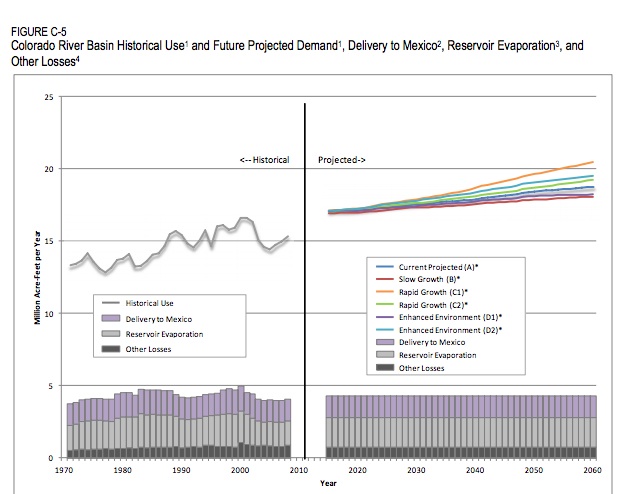
Colorado Basin future demand

Colorado Basin future demand

The US Bureau of Reclamation this afternoon released its latest pass at quantifying water demand in the Colorado River Basin. Recognizing that there’s no one answer for what the demand curves might look like in the future, the agency looked at a range of six scenarios, based on input from the seven basin states on what each state thought its long term needs might be. Some highlights:

  • basic US consumptive demand by 2060 will be between 13.8 and 16.2 million acre-feet
  • add in water for Mexico and evaporation and you’re up to 18.1 to 20.4 maf
  • a population of 40 million people by 2015 rising to 49 to 77 million by 2060
  • irrigated acreage, now at 5.5 million acres, drops to 4.6 to 5.2 million acres

With the river having a total of 15-ish million acre feet to work with going forward, this suggests that, absent iceberg towing or a giant pipe from the midwest, we will not be able to do all the things here in the West that our representatives told the Bureau of Reclamation we would like to do.


Another take on Colorado Basin failure mode concludes that Arizona and Nevada are the trouble spots

Wildman and Forde make my last post on this subject look smart, arguing that the supply-demand imbalance on the Colorado River will hit Arizona and Nevada first:

We find that initial shortages will be borne only by the cities of Arizona and Nevada and farms in Arizona whereas the other Basin states have no incentive to reduce consumptive use. Furthermore, the development of a long-term plan is deferred until greater water scarcity exists.

Wildman, Richard A., Jr. and Noelani A. Forde, 2012. Management of Water Shortage in the Colorado River Basin: Evaluating Current Policy and the Viability of Interstate Water Trading. Journal of the American Water Resources Association (JAWRA) 1-12. DOI: 10.1111/j.1752-1688.2012.00665.x