This is what happens when you have more water than you need

It would be easy to look at this Arizona Republic story as another example of the profligate water wastefulness that will ultimately doom Phoenix:

Valley homeowners’ excess citrus fruit, often picked by volunteer gleaners, can’t be shipped across state lines this year after a fungal disease known as sweet orange scab was found in some citrus orchards in Arizona and other states.

You mean they have so much extra water that they can grow citrus and just throw it away?

I have a more optimistic view. When faced with abandoning a lifestyle of lawns and wasted citrus or abandoning Phoenix, I’m thinking the lawns and citrus trees will go. This is evidence that they have a long way to go in the direction of water efficiency before folks have to pack up and move to Cleveland.

Stuff I wrote elsewhere: rainwater harvesting, the bounding scenario

In water policy terms, this is one of the most important stories I’ve done in a while:

The steady dripping into Carl Axness’ cistern is the sound of next spring’s water supply.

The snow melting from his Rio Rancho roof is the bounty of December’s storms. For the better part of four years, that roof runoff has provided the entire source of supply for Axness and his family.

It’s not that I expect everyone to follow Carl’s path. His situation is unique in a couple of ways. The first is the way his Rio Rancho lot was bypassed by water infrastructure. The second is Carl himself – an energetic tinkerer, willing to fiddle to make his off-the-water-grid life possible. It’s obviously not for everyone. But I think of him as a sort of bounding scenario for what is possible when we’re faced with apocalyptic visions of life in the Southwest with dwindling water supply and growing population. Carl’s a living demonstration that it is possible to live with far less developed water than we use today. Given a choice between apocalyptic abandonment of Phoenix or Las Vegas or Albuquerque as water supplies run low or the widespread adoption of some part of the suite of things Carl’s doing (especially for outdoor watering, which is far less finicky), it seems clear to me what we’ll see.

Stuff I wrote elsewhere: football

Really. I wrote a newspaper piece about football (the pointyball kind). The backstory is the recent departure of a chap named Mike Locksley, who had a less than successful record coaching the University of New Mexico’s football team. I took to the front page of the morning paper to be what is almost certainly his only defender:

Here’s the problem. If I or anyone else were to suggest ending our beloved cultural ritual of fall football, we’d be laughed off the front page of the newspaper. (I know, there’s a good chance a lot of you will have that reaction to this column.) As Clotfelter has written, “Tailgating rituals, painted faces, and screaming fans are part of American higher education as surely as physics labs and seminars on Milton.”

Therein lies the genius of Mike Locksley’s tenure. We need to have football, so I have someplace to eat Miguel’s brats. We just need to help our students’ academic performance by mostly losing.


The year of the budgie

I’d have to call Emma Marris’ The Rambunctious Garden the most influential book I read in 2011, in large part because it fell on fertile ground.
Budgerigar, December 2011

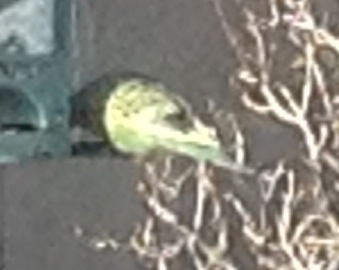
Budgerigar, December 2011

I’ve been puzzling for a long time over the question of what counts as “nature”, both in our political discourse and in my own heart of hearts. Why is it, I’ve long puzzled, that the Arctic National Wildlife Refuge represents land worth laying down on the tracks to protect, but not the patch of what used to be desert scrub that is now my very much altered backyard?

I’ve mulled this issue for a long time, but it’s mostly been an inchoate puzzlement. Maris, in her treatment of the history of our cultural ideas about wilderness and preservation and current ecological science, put some meat on the bones of the ideas. As did our neighborhood budgerigar, a feral parakeet that’s been hanging around of late.

I spotted one in the neighborhood a couple of years back, and this year I’ve got four sightings on my yard list – in July, November and twice this month. The budgie’s clearly “unnatural”, an escaped or abandoned pet. But what, exactly, does that mean? My 2011 yard list includes pigeons, house sparrows, starlings and Eurasian collared doves – none of them native to North America, all feral immigrants that hitched a ride in some fashion with humans to get here. The difference is that, on arrival, the latter birds did better.

My backyard is similarly unnatural, with five different types of feeders and a pond for the birds. It’s a xeric garden, with plants adapted to the arid climate, but we do add more water than nature would otherwise provide. We’ve got a pear tree.

The budgie seems to be well across the line separating natural from unnatural, but as you pull back toward the center it’s not clear where the boundary lies.

What Maris makes clear is that the boundary is a human construct, that there is no untrammeled wilderness but rather a world of ecosystems bearing a world of human footprints.

Which is a long-winded way of introducing my 2011 Yard List – 40 species of birds this year, plus one mysterious swallow. Three were new to my yard life list:

  • red-winged blackbird
  • house wren
  • dusky flycatcher

That brings my yard life list to 59.

This year’s ecological puzzle is the mourning dove, which was ever present in 2008 (that’s when I started listing), ’09 and ’10, but is now only an occasional visitor. A second ecological puzzle is the pigeon. A flock lives at the supermarket and Indian restaurant two blocks away, but until this year they almost never came to my yard. They’re regulars now. I don’t mind. I’ve always been a bit of a pigeon fan. Sadly our state bird, the roadrunner, was a rarity this year. Click through for my year’s yard list. The numbers represent the percent of observations for which the named bird was present.

Continue reading ‘The year of the budgie’ »

Finishing out a dry 2011

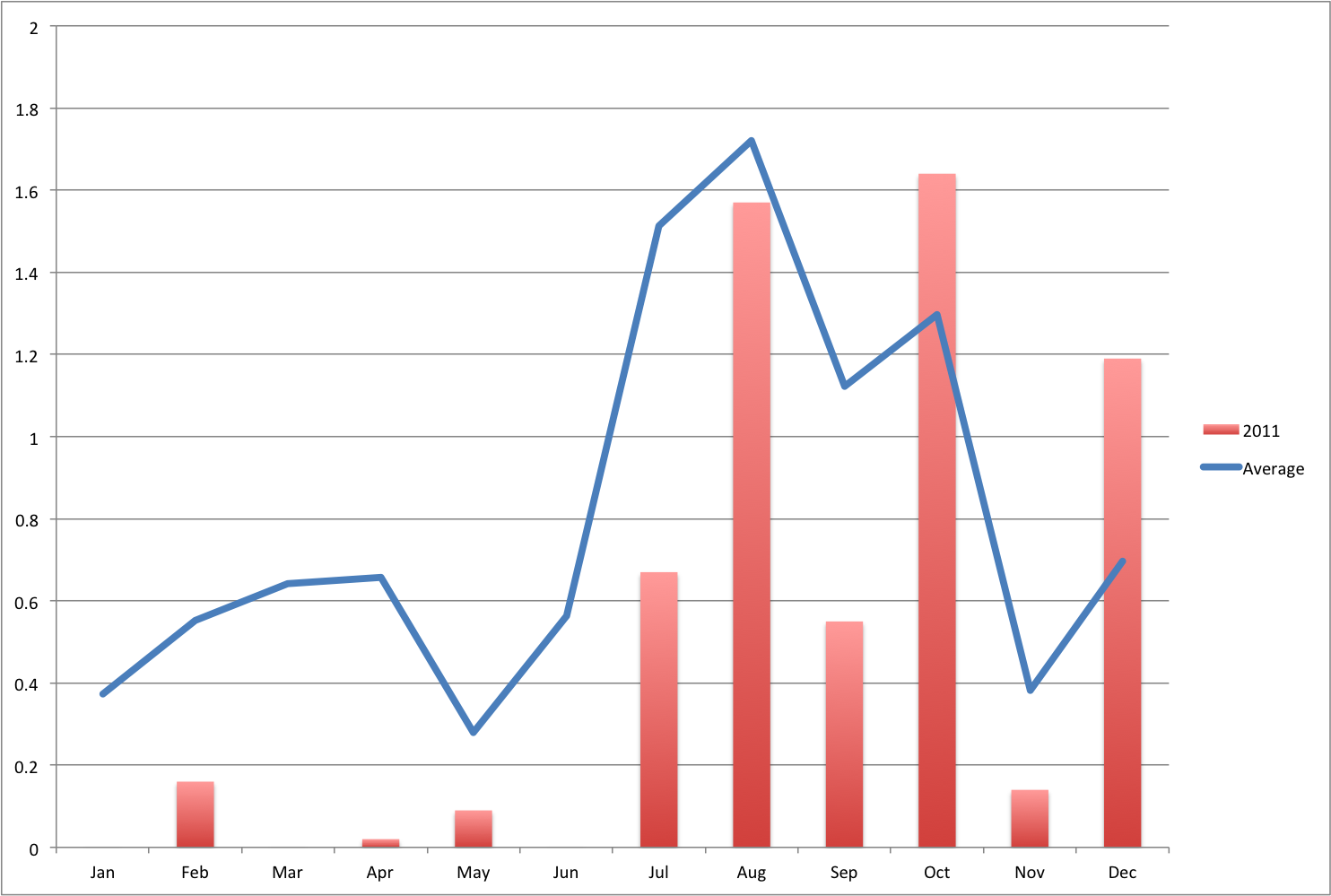
The final Heineman-Fleck backyard precip tally for 2011 is 6.03 inches (15.3 cm). That’s 61.5 percent of the long term average, where by “long term” I mean back to 2000. It is the driest year in my record, just a smidge under 2002’s 6.21 inches (15.8 cm). Only two months, October and the just-completed (I take my measurements at 7 a.m.) December:

2011 Heineman-Fleck precip

2011 Heineman-Fleck precip

Housing and water: a year later, are we closer to an answer?

A year ago, I puzzled over the implications of the collapse of the southwest housing business for our long term water future.

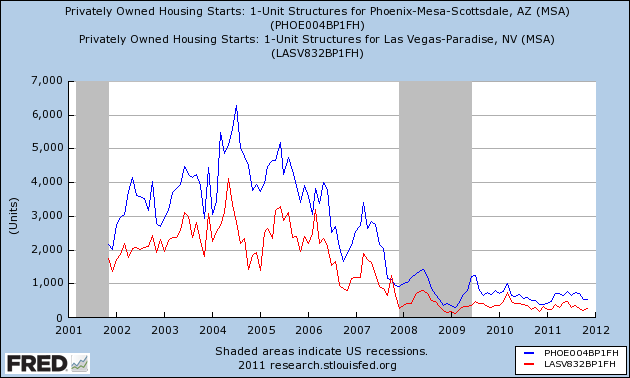
We’ve got another year of data, and no real sign that the southwestern growth engine in Phoenix and Las Vegas, the two cities closest to the edge of the water cliff, are coming back:

Phoenix, Las Vegas Housing Starts

Phoenix, Las Vegas Housing Starts, courtesy St. Louis Fed

What’s funny here is that it wasn’t the reasoned arguments of smart growth advocates, implemented through a wise political and policy process, that achieved this end, but rather the internal contradictions of the overheated housing business itself. Whatever. To what extent does this simplify the water policy dialogue in the southwest? Sure seems like it makes Pat Mulroy’s job easier, though I doubt she’s happy about the circumstances.

How US home builders screwed up

Anthony Downs at Brookings, from “What’s Wrong With American Housing“:

Even before the dramatic collapse of housing starts after 2005, it should have been obvious to home building firms that they were in for a downward ride after starts surpassed two million in both 2004 and 2005. Those years of peak production led to an oversupply in 2006 that started driving nationwide median home prices downward for the first time since 1968. That overbuilding then helped generate the chain of events that led to the lending freeze of 2008-2009.


A Positive Spin on Texas Drought?

Texas precipitation, percent of normal, 2011 (through Dec. 28)

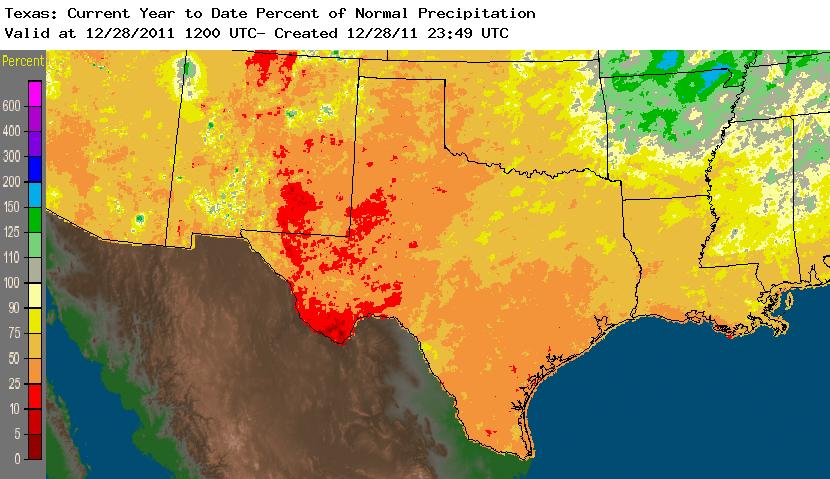
Texas precipitation, percent of normal, 2011 (through Dec. 28)

Let me suggest a positive narrative to the story of Texas’ great drought of 2011.

The Texas Commission on Environmental Quality today released its latest list of communities whose water supplies are threatened as a result of the driest year on record. Topping the list is tiny Groesbeck, between Dallas and Houston, where a line of yellow pipe, built to provide an emergency supply, has become emblematic of the struggle to keep water flowing to Texas homes and businesses.

In converging on Groesbeck, reporters are doing what we always do – singling out the worst. If you tally up the latest TCEQ list, fewer than 8,000 homes and businesses, in a state of some 25 million people, are currently in the most high risk category: “Could be out of water in 90 days or less”. Fewer than 3,000 homes and businesses rank in the next most serious category: “Could be out of water in 180 days or less.”

Is Texas drought really the story of the resilience of an affluent society in the face of an unprecedented environmental insult?

Stuff I Wrote Elsewhere: a water wonk’s Christmas greeting

There’s a tradition in newspaper journalism of the heartwarming front page story on Christmas morn. Here’s mine:

If you could look straight down 538 feet beneath the La Cueva High School neighborhood in Albuquerque’s far Northeast Heights, you would see water returning to the metro area’s depleted aquifer.

The water table in the area had dropped more than 60 feet after decades of pumping to meet the city’s drinking water needs. But, in the past three years, as the metro area’s largest water utility reduced its groundwater pumping and shifted to using river water instead, the water table beneath the La Cueva neighborhood has risen 8 feet.