Graphing the energy boom

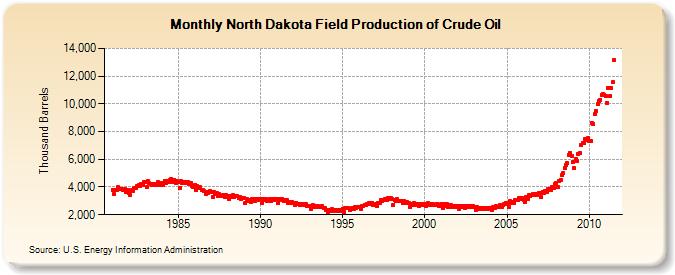
I’ve not been writing much about energy for the last couple of years, and only following it shallowly, so the fact that New Mexico’s oil production has reached the highest level since 1998 kinda snuck up on me. But what’s going on here is child’s play. Look at North Dakota:

North Dakota oil production

North Dakota oil production

John McChesney’s done some good stuff explaining what this all means on the ground, and now comes Keith Schneider with some excellent new reporting out of North Dakota over at Modeshift. Schneider’s talking about North Dakota, but framing the argument more broadly – North Dakota as the epicenter of a remarkable US energy boom:

Bottom line: The 481,000 oil and gas production jobs are generating 1 million more jobs in related industry, service, and product sectors like tanker, pipe, and gas turbine manufacturing, construction equipment, real estate construction and the like. That’s 1.5 million jobs or “as many as 3 of every 5 new jobs created by the US economy since 2005 can be attributed to the recent surge in US oil and natural gas production,” said Robison.

One other point. EMSI found that the roughly 481,000 new oil and gas sector jobs generate an annual payroll of nearly $38 billion.

We’re not seeing North Dakota-style action here in New Mexico yet. Oil production here may be at its highest level in more than a decade, but unemployment in San Juan County’s oil patch is still at 6.4 percent – greatly improved from the recession peak of 10.6 percent in the summer of 2010 but far from pre-recession levels under 3. But the Baker Hughes rig count for New Mexico stands at 80 this week, up from 68 at this time a year ago.

So I’m watching.

Untangling the QSA

Elizabeth Varin had an interesting story this morning about the latest Imperial Irrigation District discussions about the Quantification Settlement Agreement*, the Byzantine** water deal that provided a path for California to go on a Colorado River diet (reducing its use to its legally allotted 4.4 million acre feet per year). The deal has two key elements – an agreement to reduce ag use in the Imperial Valley and sell the saved water to cities on the coast, and a somewhat vague plan to make the Salton Sea suck less even though reduced ag runoff will make it even smaller and smellier than it is today.

The deal’s sort of a decade old, and to say its implementation isn’t going well would be an  understatement. Varin’s story suggests fears in the Imperial Valley that folks there will be left holding the bag if (when?) the deal falls apart, which is why they’ve hired Chuck DuMars and his team of water policy analysts and lawyers to try to think through what a “Plan B” might look like.

Overall now, though, it seems like the goal of any plan B would be proposing a restructuring to deal with what is actually happening, he said.

“Much of our activities, much of the way we address society today is to propose a theoretical solution, and when it doesn’t work pretend it is working,” (DuMars) said.

That’s what troubles him about the QSA, he said. People wanted it to happen because it’s a great concept to keep agriculture viable and support the economic interest of the Valley, but it’s a product of huge urban political forces, the state, Bureau of Reclamation and Colorado River states all pushing for a result. At the end of the day that is not working

One major concern, both when the water transfer was originally being negotiated and now, is whether IID will retain its water rights on the Colorado River.

As part of the agreement, no, the water rights should not be affected, said Stephen Curtice with Law & Resource Planning Associates, DuMars’ law firm out of New Mexico. But in reality, whenever a city gets a source of water, they rarely give it back. The local water district won’t be using that water in 40 years, leaving it open to lawsuits about whether it should have present perfected water rights to it.

The QSA may have legal protection of the water rights of the Imperial Valley, but it’s not a permanent protection, he said.

* There’s a nice untangling of the QSA history in the USBR’s Colorado River Documents, which is a big fat book printed on pieces of paper.

** I mean “Byzantine” here in its sense of “excessively complicated”, not in the more pejorative “devious” connotation often suggested by the word. I think.

Coveting thy neighbor’s water

It’s not clear to me whether the US Bureau of Reclamation’s Colorado River Basin Water Supply and Demand Study is a tool for developing solutions to the long term supply-demand imbalance on the river, or a process for the states and other interests to stake out their turf. Probably some of both.

Witness, for example, the comments in a story I recently did framing the study from a New Mexico perspective:

By 2035, according to new data released last month, annual demand for the basin’s water could exceed supply by 13 percent under the most likely scenario as use continues to grow while climate change reduces flows in the river. Such an imbalance is unsustainable, emptying the reservoirs on which the region depends, said University of Colorado professor Doug Kenney.

“That’s enough to crash the system,” Kenney said.

The risk for New Mexico, which is not yet using its full share, is that others may covet our underused allocation as supply-demand tension grows, said Estevan López, head of the New Mexico Interstate Stream Commission and acting state engineer.

“We should be working with the other states to try and make sure that the other states aren’t looking at water that New Mexico is entitled to,” López said in an interview this month.

Note that staking out turf and developing collaborative solutions are not mutually exclusive.

Power for the coming centuries!

Power for the coming centuries!

Power for the coming centuries!

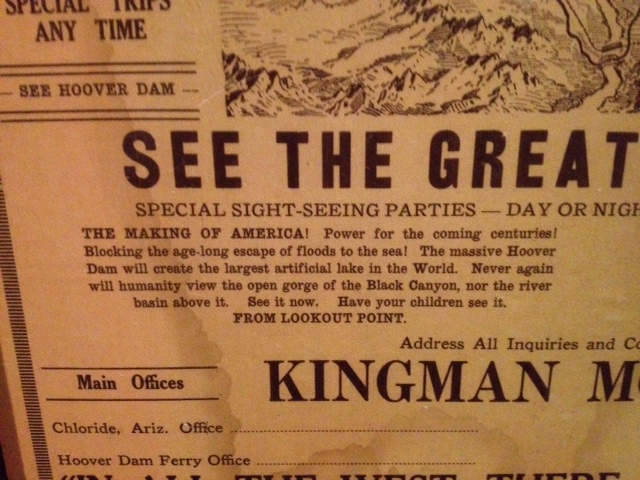
In Colossus, Michael Hiltzik talks about the way Hoover Dam, during its construction, became a tourist spectacle.

When Lissa and I were in Boulder City last week, I found this in the museum-y hallway at the Boulder Dam Brewing Company (which has a lovely collection of similar memorabilia), a poster hawking tours:

THE MAKING OF AMERICA! Power for the coming centuries! Blocking the age-long escape of floods to the sea! The massive Hoover Dam will create the largest artificial lake in the World. Never again will humanity view the open gorge of the Black Canyon, nor the river basin above it. See it now. Have your children see it.

What’s Aaron Million’s Water For?

Not being up in Colorado, I don’t have a good feel for how seriously to take Aaron Million’s Flaming Gorge pipeline proposal. My hallway conversations at CRWUA left me with the feeling that not a lot of people in the basin take it very seriously, but I don’t know water issues in the state of Colorado well enough to know if I was talking to the right people.

Bruce Finley’s latest Denver Post story on the project gave me pause:

The pipeline to move up to 200,000 acre-feet of water a year could sustain water-intensive hydraulic-fracturing operations in Wyoming and Colorado, Million said.

“We’ve heard rough figures of 15,000 to 20,000 acre-feet annually for fracking needs,” Million said. “If this new water supply helps with the fracking issues, then, without question, we would consider delivering water for the industry.”

Here’s the puzzle. During the tangled federal approval process last year (at the time, the project was before the US Army Corps of Engineers), Million delivered a list of potential users that was mostly front range municipal water users, with some ag thrown in. (pdf here) Now that fracking is hot, Million’s talking fracking and energy with the Denver Post. Does this kind of changeability mean this is a flakey project I should ignore? Or, conversely, does this mean that water demand from multiple sources on the front range is such that I should take it even more seriously?

Colorado River Water Users, odds and ends

Some more odds and ends from last week’s Colorado River Water Users Association meeting

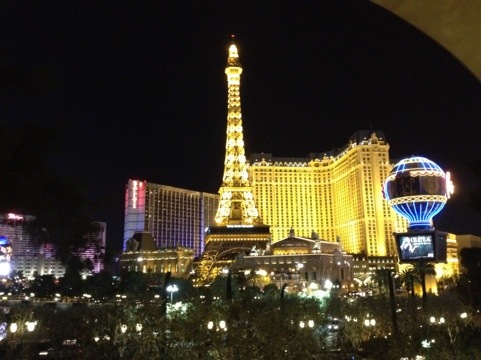
Water in the Desert, Caeser's Palace

Water in the Desert, Caeser's Palace pools

Yuma Desalting Plant

The trial run of the Yuma Desalting Plant “went well,” according to Terry Fulp, head of the USBR Lower Colorado office. YPD was built in the early 1990s to clean up icky agricultural drain water to meet US delivery obligations to Mexico, but it’s never really been used until a trial run in 2010-11 intended to see what it might take to put it to use. According to Chuck Cullom of the Central Arizona Project, one of the YPD trial run’s funders, the operational costs worked out to about $300 per acre foot of water for the 30,000 acre feet produced during the trial run. That makes it relatively expensive water. Fulp said one of the things they learned is that major infrastructure upgrades would be needed to move beyond the trial phase into routine operation.

Brock Reservoir

The Brock Reservoir, formerly known as “Drop 2”, “saved” 110,000 acre feet of water in the 2011 water year. Brock’s purpose is to capture water released from Lake Mead but then not needed by Imperial Valley farmers because it rains. Such water was “wasted” because it would flow on to land formerly known as the Colorado River Delta unused by humans, though it’s worth noting that one person’s “waste” is another person’s “environmental flows”.

Environmental Flows

Worth noting – the discussions about YDP and Brock both expose the significant unresolved conflict between water development and the growing recognition that environmental flows need to be part of the discussion as we divide up the increasingly stressed Colorado.

Water for Mexico

50,000 acre feet of Mexican water is currently being stored at Lake Mead as part of an agreement that for the first time allows the Mexicans to take advantage of storage behind U.S. dams. This is being done after the April 2010 Mexicali earthquake damaged irrigation canals there. It seems like a very important first step toward some broader cross-border water management.

Still moving last year’s water

The Bureau of Reclamation continues to run Glen Canyon Dam’s power full bore to move last year’s bounty downstream. There was so much inflow that the dam’s power plants have been running all out for months.

Navajo-Gallup

We should see a request for bids soon (by the end of this month) on construction of Reach 12A of the Navajo-Gallup water supply project, which will ultimately connect the eastern Navajo Nation to San Juan River water. This is the first length of pipe on the project, and would in the near term carry groundwater. The US Bureau of Reclamation was really pushing this project at the meeting. “We’re bringing drinking water to people who are still hauling it to their homes,” Anne Castle, Interior’s Assistant Secretary for Water and Science, said during one of the meetings. But it’s also clear that finding money for the full project in the long term will be a challenge.

Protect the Flows

Molly Mugglestone of Protect the Flows gave an interesting presentation on the relatively new organization’s work. It’s a growing coalition of businesses that depend on water in the river – fishing guides, rafters, tourism-based businesses of various types. It’s the business-economic case for instream flows.

Las Vegas

Did I mention that Las Vegas (NV) is a very strange place? But well lit.

A drought of the Lower Colorado River Basin’s own making

For better or worse, my decision to not pay the $15 a day for an internet connection at Caeser’s Palace has left me with a bow wave of things to write about after a week spent in an around the Colorado River Water Users Association’s annual meeting in Las Vegas, NV.

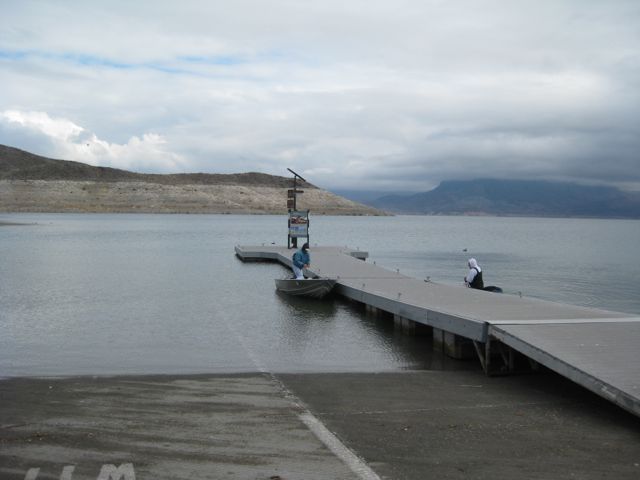
Boulder Harbor 2011

Boulder Harbor, 2011

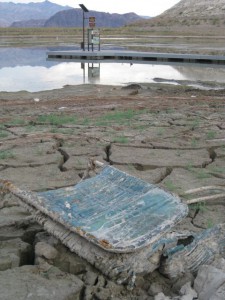
Let’s start with Lake Mead itself, which hovers over Las Vegas like a reminder of trouble to come. But hey, the reservoir’s up this year, what’s not to like? Lissa and I drove the scenic road past the marinas on Mead’s western shore, the Las Vegas playground that was not so playground-y when I was there a year ago. At Boulder Harbor this year, I found a couple of guys fishing off the boat landing that a year ago was mired in mud. The striped bass were biting, and they looked big and tasty.

Boulder Harbor, 2010

Boulder Harbor, 2010

Thanks to an epic snowpack, the reservoir is up more than 40 feet from where it was when I visited in October 2010 trying to document its drop to historic low levels. There were places where the shoreline was unrecognizable. But at the risk of sounding like a broken record, a close look at the data offers a reminder of the underlying problem. The Law of the River seems to ensure that the Lower Basin states are guaranteed 8.23 million acre feet a year of water released from Glen Canyon Dam. In the water year just completed, the US Bureau of Reclamation released 12.5 maf – 4.3 million acre feet of “bonus water” above and beyond what one might consider the system’s reliable yield. But Mead ended the water year up just 2.9 million acre feet. Some of the 2010-11 bonus water has already been used.

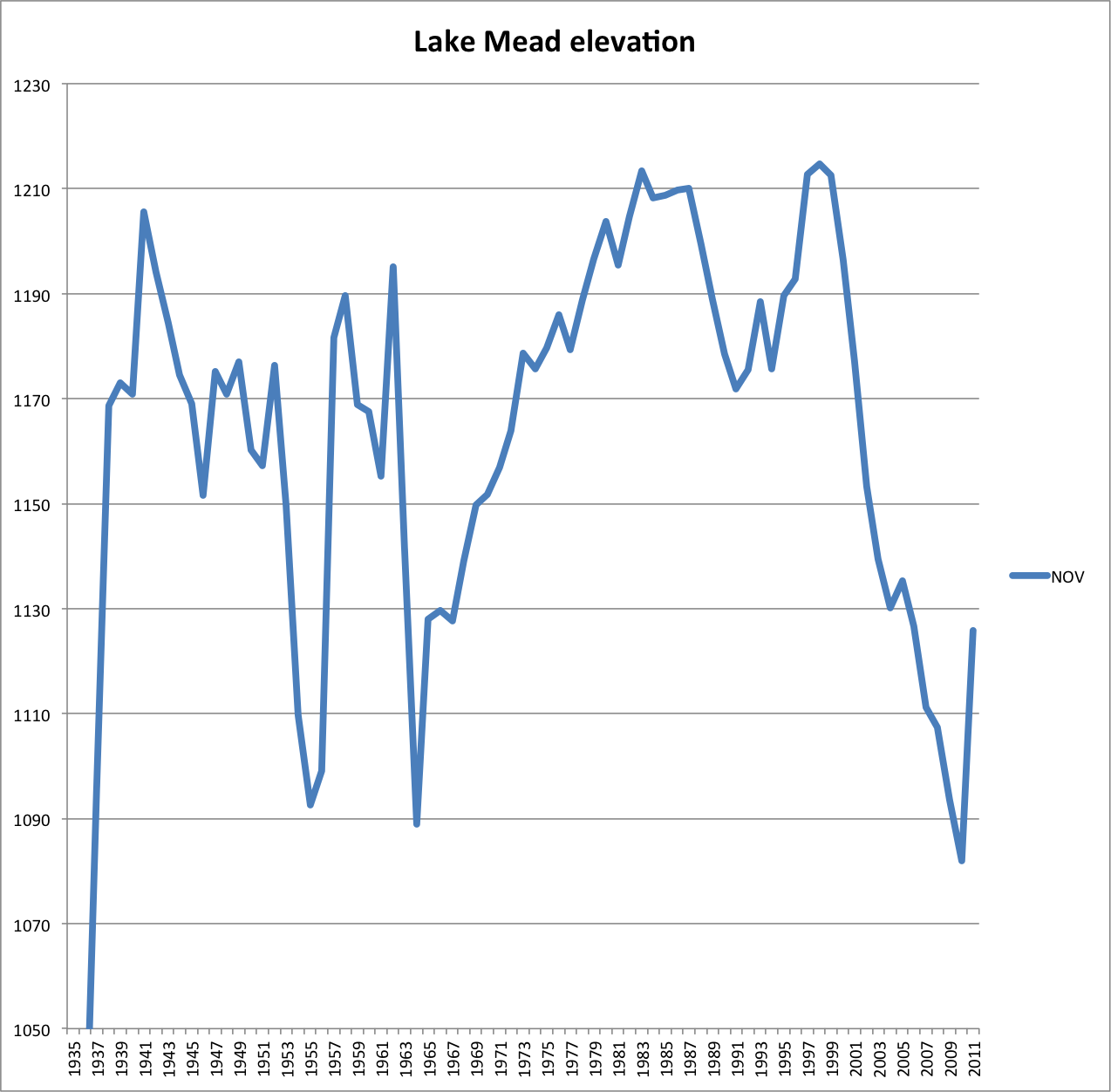
Consider the long term elevation of Lake Mead.

Lake Mead Elevation

Lake Mead Elevation

The big long decline you see in the reservoir’s surface elevation, beginning in 2000, coincides with a period during with the full Law of the River release from Lake Mead, 8.23 maf, happened every single year. All it takes is three or four years of such minimally required releases – either because of drought in the Upper Basin, or because the Upper Basin states’ increasing consumption of water they’re legally entitled to but are not currently putting to use, to wipe out this year’s bounty.

In a sense, the Lower Basin’s drought is a situation of its own making.

Grand Canyon

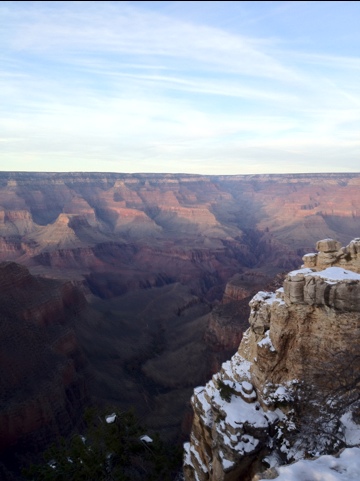
Standing at the Grand Canyon’s south rim this evening at sunset, I saw a woman walk up clutching her luggage, spellbound. “Oh my God,” she said. The look on her face said everything.

She was seeing it for the first time. She’d come to celebrate an “important birthday”, and said she wanted to spend it with something older than she was.

I’ve been here many times, and I still choke up at my first fresh glimpse of the canyon.

20111211-194017.jpg

Stuff I wrote elsewhere: New Mexico water law needs to catch up with reality

Thrown on driveways ’round town last week:

The New Mexico Court of Appeals has turned into the state’s chief water policy nag.

Three times in a little more than a year, most recently last week, the court issued rulings tinged with exasperation at the need to apply 20th century New Mexico water law to 21st century water problems.

“The review gives us pause to consider that there are substantial issues awaiting consideration with regard to future policies governing water,” the court’s most recent opinion explained in a plaintive footnote.

The court seems to suggest the Legislature needs to step in and noted that its ruling in the most recent case involving the Albuquerque’s use of river water left “these issues concerning future overall management of the Rio Grande Basin and its water resources … largely unresolved.”