The economic origins of wildlife refuges

In his richly detailed The Fall and Rise of the Wetlands of California’s Great Central Valley, Philip Garone explains a bit about the origin of wildlife refuges that I never knew:

During the early decades of the twentieth century, much of the Sacramento Valley was converted to profitable rice production. However, because the valley’s natural wetlands had been reclaimed, crop depredations that followed led to a crescendo of calls by the same farmers who had benefited from the valley’s reclamation to create wetland refuges in the valley. Some of the earliest motivations behind the creation of these refuges in the Sacramento Valley stemmed, therefore, more from economic interests  than from an ecological awareness of the importance of wetlands….

The sound of bark beetles

A Great Aridness

A Great Aridness

I’m thinkin’ you’ll want to head out to your favorite local bookstore and buy Bill deBuys’ A Great Aridness. It’s full of stuff like this, on the dry winter of 2001-02, when a bear came out of hibernation early because it was so warm and ransacked deBuys’ yard in search of something to eat:

That winter was a bad one for the bear, but a good one for the bark beetles, and once spring came, bringing weather so hot and dry the pastures never greened, you could walk among the piñons and hear a faint mechanical drone, as of a thousand tiny chisels rhythmically chipping away. It was hordes of beetles, tunneling and feeding.

I admit I was skeptical, but when I related deBuys’ account to a couple of northern New Mexico denizens, one an actual tree scientist, they said it’s true. When it’s scary warm and dry like that, they both told me, if you’re really quiet in the woods, you can hear ’em.

Creepy.

Stuff I wrote elsewhere: megadrought

Because it’s hard to resist the word “megadrought” – or, frankly, the concept:

Tree rings from the headwaters of the Rio Grande show a 50-year drought from 122 to 172 AD, suggesting that “megadroughts” may be a recurring feature of the region’s climate, according to new research by a University of Arizona team.

Scientists have long known about similar drought a thousand years later that has been linked to the end of the early Native American culture of Chaco Canyon and the Four Corners area. But it was never clear whether that drought was unique.

The new evidence, being published in the journal Geophysical Research Letters, comes from a grove of bristlecone pine found by University of Arizona graduate student Cody Routson in the mountains near Summitville, Colo. He initially spotted the trees through binoculars during the summer of 2007, and returned in later years to take samples used to show the trees’ year-by-year growth.

Plus, I have an inordinate fondness for the tales tree rings tell.

Stuff I wrote elsewhere: the endangered species act process brokenness

Thrown on driveways this morning, my effort to explain why I think the endangered species act process, as it relates to the silver minnow on the Rio Grande, is broken:

If you believe those who argue we are overusing water in the Middle Rio Grande Valley and headed for a crash (and there’s good data to support that position), it’s likely the problem will first show up in the river itself, as we take out too much surface and groundwater and leave the Rio Grande dry.

The first specific legal and regulatory manifestation of that problem would be a lack of water to meet Endangered Species Act requirements for the Rio Grande silvery minnow.

Farmers and cities will get their water while the Rio Grande goes dry, until someone – federal regulators or an environmentalist with a lawsuit – steps in.

The cliche is to call the minnow a “canary in a coal mine,” a sign of a crashing ecosystem. But it’s also a canary for our water supply problems. As a result, as often happens around the West, society ends up using the Endangered Species Act as a sort of de facto water policy management tool. When water runs short, who has to give some up to keep our rivers wet? We use the ESA to decide that question.

the problem with living in good times

White, Yampa, and Little Snake Rivers

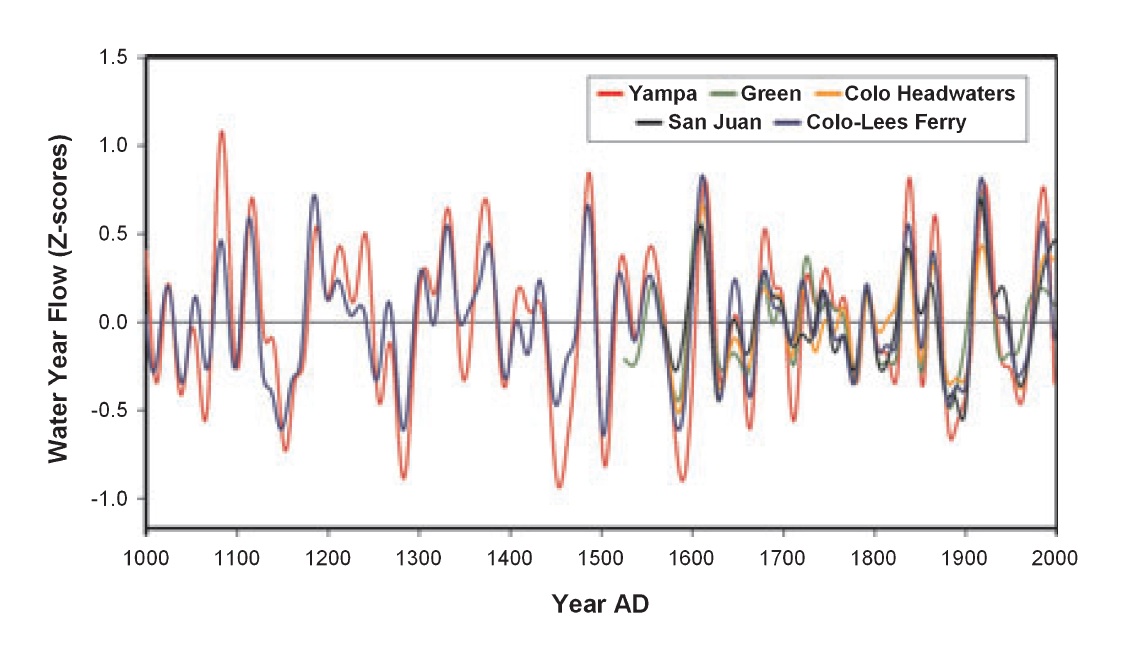
1,000 years of runoff on the White, Yampa, and Little Snake Rivers

Those pesky tree ring scientists are at it again, spoiling a perfectly good party.

Stephen Gray and colleagues have taken a dig into runoff over the last 1,000 years on three major Colorado River tributaries, adding a new level of granular detail to something that already seemed apparent: Runoff during the 20th century, when we built all this infrastructure and farms and cities, is a bit of an anomaly in the long run, and not in a good way:

[T]hese reconstructions point to the unusual wetness of the gage period, and the potential for recent observations to paint an overly optimistic picture of regional water supplies. The future of the Upper Colorado River will be determined by a combination of inherent hydroclimatic variability and a broad range of human-induced changes. It is then essential that regional water managers, water users, and policy makers alike consider a broader range of hydroclimatic scenarios than is offered by the gage record alone.

Gray, Stephen T., Jeffrey J. Lukas, and Connie A. Woodhouse, 2011. Millennial-Length Records of Streamflow From Three Major Upper Colorado River Tributaries. Journal of the American Water Resources Association (JAWRA) 47(4):702-712. DOI: 10.1111/j.1752-1688.2011.00535.x

The forecast language dilemma

River forecaster Tom Pagano, late of Portland, Ore., and Australia, is on the road working on a book about river forecasting, so naturally he’s ended up in Thailand. In a post today, he talks about a language dilemma forecasters face:

A phrase like the “worst case scenario” is a double-edged sword. This is the kind of information that decision-makers crave and request from forecasters. But what is the chance of this worst case scenario happening? 1 in 3? 1 in 10? 1 in 100? History is filled with examples of where the actual outcome was above the worst case scenario and decisionmakers ended being very resentful of this. Of course, forecasters could instead conjure up a wildly high scenario (e.g. take the above map and multiply it by 3), but this leads to wasteful overplanning and its own form of resentment.

(Tom was one of the water-climate scientist characters in my book, The Tree Rings’ Tale, which you should head to your local bookstore to buy in time for that smart young person on your holiday shopping list.)


The rent on Hetch Hetchy is not high enough

John Muir and Theodore Roosevelt

John Muir and Theodore Roosevelt

Just when you think the great comedy act that is California water politics has exhausted itself, another white-faced, red-bulb-nosed, big footed character climbs out of the Golden State’s Great Clown Car.

Comes now the Honorable Devin Nunes, he of the muscular, fiercely independent southern San Joaquin Valley, suggesting that the Department of Interior up the rent it charges San Francisco for the effete liberal city’s use of Hetch Hetchy Valley from the current $30,000 per year to $34,000,000 per year.

In a Nov. 4 letter helpfully posted by Michael Cannon, Nunes wrote to the congressional deficit-cutting “super committee” suggesting legislative language and the argument for making the change:

The Raker Act, enacted nearly 100 years ago, mandated that the City of San Francisco pay the Department of the Interior a meager annual charge of $30,000 for the easement to use Hetch Hetchy Valley in Yosemite National Park as a water reservoir. Even with the negative effects to the environment, this annual charge, set in the early 1910s, has never increased. Furthermore, since the construction of the Hetch Hetchy Water and Power System a century ago, the environmental damage to our nation’s flagship National Park has never been mitigated.

Is it wrong of me to see this as a first step toward restoring Hetch Hetchy to its great glory, and to think of Devin Nunes as a great environmental champion? Is Nunes showing his true colors, his inner John Muir?

Dam Hetch Hetchy! As well dam for water-tanks the people’s cathedrals and churches, for no holier temple has ever been consecrated by the heart of man.

Teddy Roosevelt was a Republican, too.