In praise of nerd culture

This blog post has two introductions:

1) When I grew up in the far suburbs of Los Angeles, I was surrounded by aerospace culture. It drove our economy and employed many of my friends’ parents. Or,

2) When I was searching for an “expert” to help me in my epic 1980s journalistic debunking of Rose Parade size claims, I turned to a clever and witty local skpetic named Al Hibbs.

Which brings me to this lovely essay in Zócalo about the way aerospace culture helped define Southern California:

Consider Al Hibbs, whose papers recently arrived in the aerospace archive. As a young mathematician, Hibbs calculated probabilities in Las Vegas casinos and sailed the Caribbean for a year on his winnings. (Along the way, he trapped alligators to sell to zoos.) He went on to earn a Ph.D. in physics at Caltech and to help design the early space program at NASA’s Jet Propulsion Laboratory. He also popularized science on radio and television, flew sailplanes, invented an electronic trombone, applied to the astronaut corps, acted in local theater, and pursued underwater photography and kinetic sculpture.

Hibbs may be an extreme example, but Southern California aerospace abounds with ostensible nerds who designed new ways of having fun when they weren’t designing airplanes and spacecraft. Bob Simmons, a Caltech engineering student who moonlighted at Douglas Aircraft during World War II, applied aircraft materials—fiberglass, polyester resins, polystyrene foam—and advanced hydrodynamics to revolutionize surfboard design. A couple decades later, another aerospace engineer, Tom Morey, combined his knowledge of advanced aerospace composites with a quirky sensibility to invent the Boogie Board; another aerospace engineer at the Rand Corporation invented the windsurfer. And so on.

The father of my best childhood friend was an inventor. I never fully understood what that meant, but their garage was awesome.

River Beat: Gray-Lee moves on, Fulp steps in

Lorri Gray-Lee, who has headed the Bureau of Reclamation’s Boulder City office (the folks with that big dam) is heading to the Pacific Northwest, and Terry Fulp, her deputy, is stepping in as acting chief. This is one of the Bureau’s more important jobs, herding the Lower Colorado cats. Not exactly herding, even. Cajoling. Persuading. (This is the office that serves as “watermaster” for distribution of the Lower Basin’s share of Colorado River water.) From the BuRec release:

Bureau of Reclamation Commissioner Michael L. Connor has announced that Lorri Gray-Lee will succeed Karl Wirkus as the Pacific Northwest Regional Director when he retires at the end of December. In January, Gray-Lee will move to the Pacific Northwest Region after serving the last four years as the Lower Colorado Region Regional Director….

Terry Fulp will be the acting Regional Director in the Lower Colorado Region beginning in January. Fulp currently serves as the Deputy Regional Director in the Lower Colorado Region.


Stuff I wrote elsewhere: renaming the VLA

VLA

VLA, Image courtesy of NRAO/AUI

I am not an expert in branding. So I do not know whether renaming the iconic Very Large Array is a good idea. What I do know is that when the idea was proposed, hilarity ensued. I do know that covering this story will be fun for months to come:

Proposals will be accepted via a website through Dec. 1, and the new name will be announced in January at a meeting of the American Astronomical Society.

The search immediately drew jokesters on Twitter, suggesting such names as “iVLA,” “Wicked Large Array” and “Too-Big-To-Fail Array.”

You can add your suggestions here. My favorite additional idea contributed this morning:

A remarkable bit of science policy ignorance

Robert Bryce of the Manhattan Institute has clearly not thought terribly hard about the use of science in supporting policy decisions. If he had, he would not have said this (the subject is climate science, but you can substitute anything you want here):

The science is not settled, not by a long shot. Last month, scientists at CERN, the prestigious high-energy physics lab in Switzerland, reported that neutrinos might—repeat, might—travel faster than the speed of light. If serious scientists can question Einstein’s theory of relativity, then there must be room for debate about the workings and complexities of the Earth’s atmosphere.

Because if he had thought about this, he would have realized that he is arguing here that no science can ever be used in any public policy decision, because, you know, if serious scientists can question Einstein’s theory of relativity, then they can question X, where X is any science at all.

“already contested issues”

I had occasion this evening to revisit “Sensitivity of Streamflow in the Colorado Basin to Climatic Changes,” by Linda Nash and Peter Gleick, circa 1991:

Water availability, quality, and demand may be affected by higher temperatures, new precipitation patterns, rising sea level, and changes in storm frequency and intensity. Water supply and water management in the Colorado Basin, already contested issues, are likely to be aggravated by these changes.

Of course, as they pointed out in 1993 (and as remains true today), “large uncertainties remain”. But their central point is well taken.

Stein’s Law and Colorado’s Water

courtesy Republican River Conservation District

I’ve become entranced with “Stein’s Law” as an alternative to the faux Twain “water’s for fightin’ over” as a cliche to help guide water policy rhetoric:

If something cannot go on forever, it will stop.

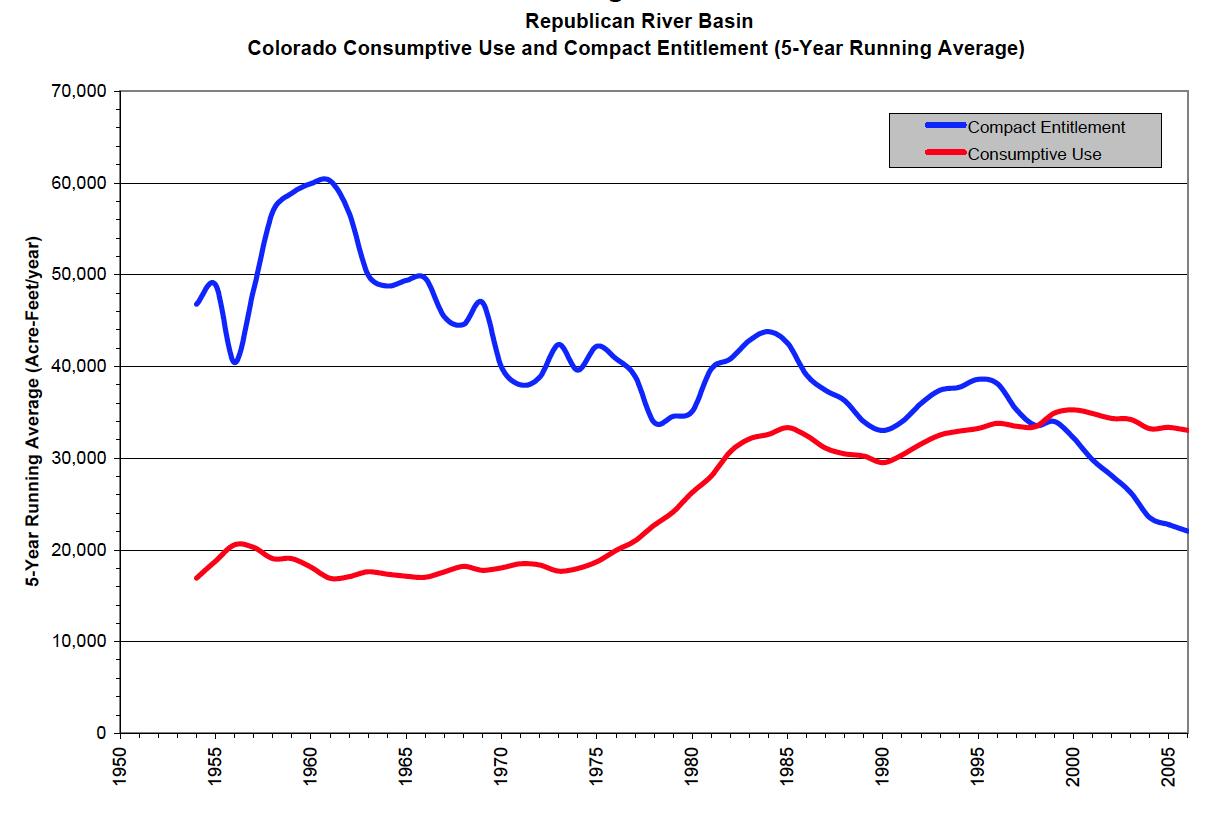
The draining of Bonny Reservoir in eastern Colorado to comply with the terms of the Republican River Compact – such an odd event that it even drew the attention of the Brits – is my latest example. There wasn’t enough water in the Republican to keep Bonny wet and still meet everyone’s water needs. The blue line is supply. The red line is demand.

So it’s being drained. No fighting here, just a harsh reality in the era of limits, and a compact complied with.


The soil moisture data problem

It’s that time of year when a water wonk’s thoughts turn to the hills, to the romance of the beginnings of a winter snowpack’s accumulation. But there is a problem every year at this time – soil moisture. In particular, a lack of data about soil moisture. This matters come spring, when things start to melt, and the first water must soak into the ground. How moist was it the melt began? How much water will be soaked up by dry soil before the streams and rivers that feed our reservoirs begin running?

Sadly, our soil moisture data is problematic. That is one of the messages in a new Department of Interior report, Strengthening the Scientific Understanding of Climate Change Impacts on Freshwater Resources of the United States:

Numerous specialized soil moisture networks exist across the Nation, but there is no design for a national soil moisture network. The NASA Soil Moisture Active Passive Mission, planned for 2014, in conjunction with a robust in situ network for calibration, could provide adequate soil moisture data for many applications at regular intervals over much of the country if these efforts were implemented in a coordinated manner.


The conservation-revenue dilemma, private sector edition

On the subject of the problem of declining revenue from water conservation, there is this, from the February 2009 10-k filed by American Water Works, a private water utility, with the U.S. Securities and Exchange Commission:

Increased water conservation, including through the use of more efficient household fixtures and appliances among residential consumers, combined with declining household sizes in the United States, has contributed to a trend of declining residential per customer water usage. Our Regulated Businesses are heavily dependent upon revenue generated from rates we charge to our residential customers for the volume of water they use.