Sadie: 1997-2011 photo by L. Heineman
We are sad, and also concerned that without Sadie to bark faithfully, the mailman will simply remain on the front porch.
Sadie: 1997-2011 photo by L. Heineman
We are sad, and also concerned that without Sadie to bark faithfully, the mailman will simply remain on the front porch.
From the morning paper, a wander in the bosque to look for signs of drought (sub/ad req.):
There is a resilience, it turns out, to these desert ecosystems. They’re used to this happening every so often, and they know what to do in response. Some leaf out less, or leaf out later. Some depend on deep roots that reach down to groundwater. Some shut down water to parts of the body, sacrificing branches to save their core.
Jeffrey Mount and Jay Lund (UC Davis water guys) draw lessons for California from Morganza and the lower Mississippi:
In the Central Valley, those in the floodplain operate under an old adage: You hope that the other guy’s levee fails first. For political, economic and legal reasons, our institutions have been unable to move beyond this ad hoc system toward a new paradigm – designating areas suitable for emergency floodwater storage and bypass, and providing adequate compensation as an incentive.
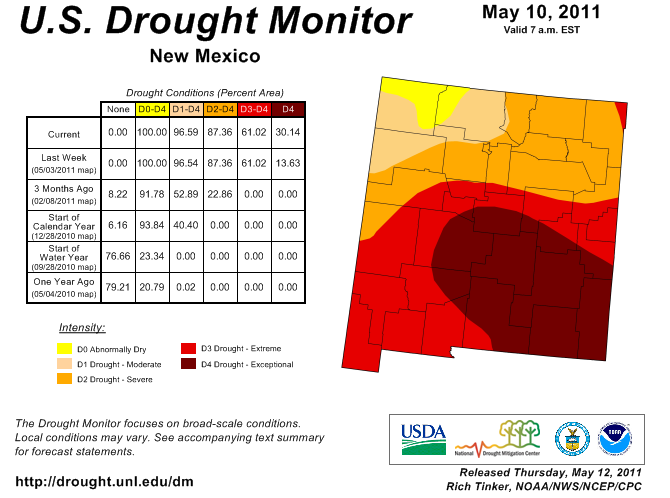
May 10, 2011 NM Drought Monitor
How dry is it this year in New Mexico? So dry that rafters on the Rio Chama will have to use spare drinking water, pumped through the system weekends this spring and summer, for their fun. From Friday’s ABQJournal (sub/ad req, I think):
Albuquerque has to move its water supplies down the Rio Chama sometime, so why not do it on the weekends, when it can help river runners?
That is the gist of an agreement announced Thursday between the Albuquerque Bernalillo County Water Utility Authority and federal agencies that manage the river.
The water, imported to the Rio Grande Basin from the headwaters of the San Juan-Chama Project, currently sits in storage in high mountain reservoirs. Eventually, the water utility would release it for use in the city’s new drinking water system.
The new operations plan merely calls for its release sooner, allowing it to flow down a stretch of the Chama that has been designated a “Wild and Scenic River” and is popular with recreational boaters.
Karl Moffatt offered up a more detailed look at the river recreation picture in Friday’s New Mexican:
White-water thrill seekers will be lucky to see a high-water rafting season this year because of below-average snowpack and a lack of real runoff.
Complicating matters are the ongoing drought, low soil moisture conditions, warm, windy weather and a storm-stingy La Niña pattern.
“It looks like it’ll be poor runoff season for rafting,” says Wayne Sleep of the USDA’s Natural Resources Conservation Service in Albuquerque, which monitors snowpack and other water conditions. “The snowpack is melting, but it’s just not making it to the streams.”
There’s a myth that has firmly taken hold of a busted La Niña forecast on the Colorado River this year. It shows up this morning in a Las Vegas Review-Journal editorial.
No.
This issue came up last September, as we were heading into the La Niña season. It was a common misapprehension back then, and it seems to have stuck. Here’s the reality, as I wrote back then, based on conversations with the folks at the Colorado Basin River Forecast Center – the ones who actually do the forecasting:
La Niña’s strongest effect is found in the southern part of the basin, while most of the Colorado River’s water comes from the northern part of the basin.
There’s almost zero correlation between La Niña/El Niño and Colorado River runoff. There may have been people saying they expected a dry year on the river, but it wasn’t the actual forecasters.
updated with an, umm, minor edit
I’m a big fan of beat reporting – steady, day-in, day-out attention to a topic. I love to do it, and when I’m trying to learn a new topic, the first place I turn is to the beat reporters who cover it.
Today’s example is the Stockton Record’s Alex Breitler, who cut through the noise a couple of days ago to explain what state water official Jerry Meral had and had not said about the state’s views toward building a giant tunnel to divert water around the Sacramento Delta to points south:
People are tweeting today that the Brown administration will “seek” a smaller conveyance in the Delta, and that “big tunnels appear out.”
Easy, there.
What was said in yesterday’s Assembly committee hearing — and reported by the Bee’s Matt Weiser– is that a wide range of alternatives will be considered, including a 3,000 cfs pipe (five times smaller than the 15,000 cfs system described in last year’s Bay Delta Conservation Plan working draft).
A big tunnel isn’t “out.” It’s just that officials are no longer touting it as the leading solution.
The latest USBR monthly Colorado River is out, and just wow. From Shaun McKinnon:
In its latest 24-month report, the U.S. Bureau of Reclamation added almost 1 million acre-feet to the estimated amount of water that will be released from Lake Powell downstream into Mead, the wetter forecast possible because of near-record snowpack on the upper Colorado system.
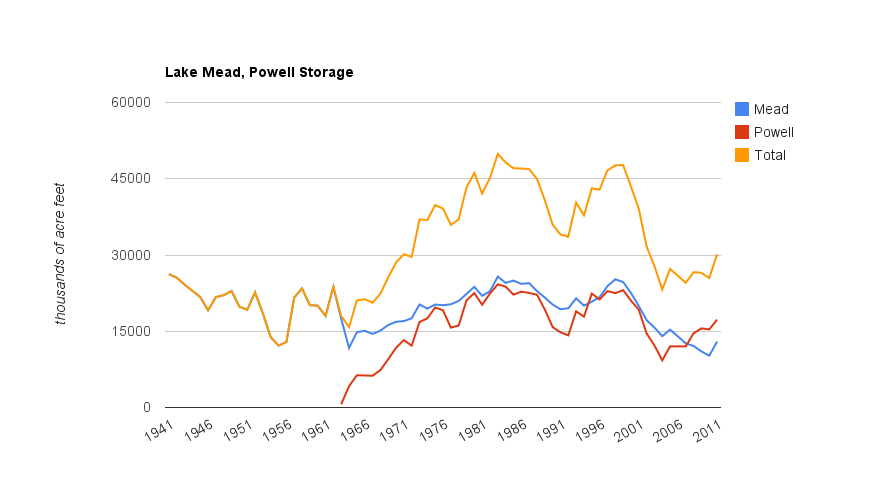
Total Storage in Lake Mead, Powell
This is unquestionably good news. And yet there’s something disconcerting about the numbers that should give us pause.
First the good news:
The current estimated year-end storage in Mead and Powell, the Colorado’s two main reservoirs, is now estimated at 30 million acre feet, up nearly 5 maf from last Oct. 1. Back then, Mead had dropped to record low levels, and there was talk of the first ever formal shortage declaration on the Colorado River as early as 2012. Shaun reports that now “no shortage is likely for at least five or six years, probably longer.” Mead would end the year under the current forecast with a surface elevation of 1,115 feet above sea level, the highest it’s been since 2006. Powell would be up to 3,650, its highest since 2001.
Now the disconcerting part:
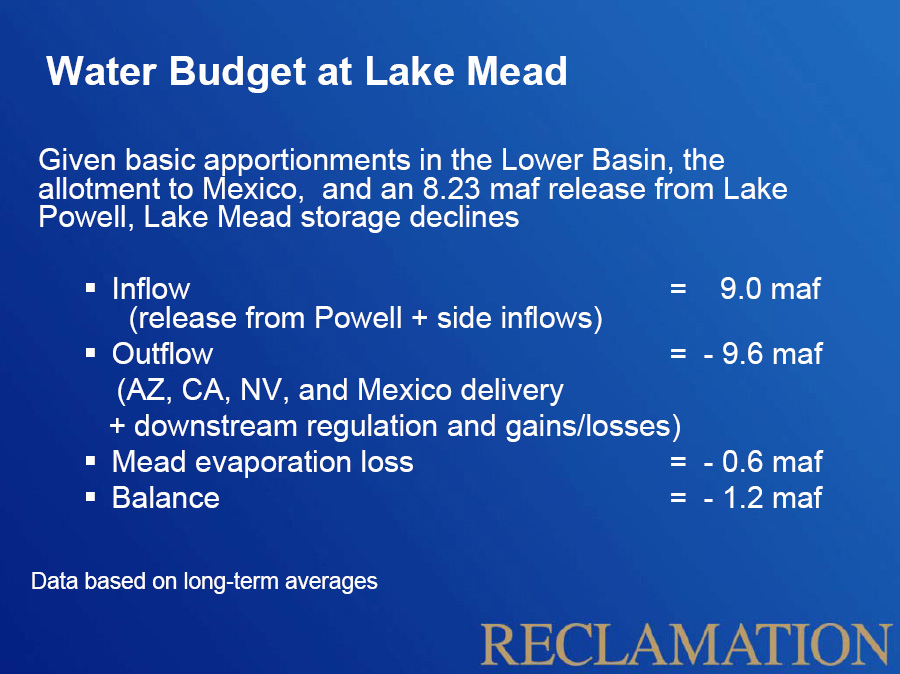
Supply-Demand Imbalance, courtesy USBR
Under the Colorado River Compact and related “Law of the River” accretion of laws and operating procedures, the Lower Basin is legally entitled to a delivery of 8.23 maf each year, to be released from Lake Powell for water users in Nevada, Arizona and California. If there is extra, either because it snowed like hell or because the Upper Basin states aren’t using their full allotment, the Lower Basin states can get extra, “bonus” water.
This year, according to the latest 24-month study, there’s enough slopping around in the system for a Lake Powell release of 12.46 maf, the largest since 1998. That’s 4.23 million of acre feet of bonus water. But the year end storage in Lake Mead is estimated to rise only 2.78 maf from last year. That disparity is evidence that the Lower Basin is continuing to live beyond its means – that is, beyond the 8.23 maf that it can legally count on over time in deliveries from Lake Powell. As you can see from the slide, the supply-demand imbalance averages about 1.2 maf per year in the Lower Basin.
So good news, yes, but the bonus water could be gone in a hurry.
(see here for my review of the supply-demand problem)
Matt Weiser reports the Brown administration* is backing away from a giant “Peripheral Tunnel” option for solving California’s bay-delta mess, or at least backing away from the notion that the big tunnel is The Plan:
Gov. Jerry Brown’s top water official revealed Tuesday that a giant tunnel diverting water from the Sacramento River is no longer the leading option to solve the Delta’s chronic water and environmental problems.
Jerry Meral, deputy secretary of the state’s Natural Resources Agency, told an Assembly committee that a range of alternatives will now be considered by the Bay Delta Conservation Plan, an effort to balance water supply and environmental stresses in the Sacramento-San Joaquin Delta….
Meral did not say the large tunnels would be ruled out for consideration. But he did say the Brown administration will consider much smaller options, including a 3,000 cfs tunnel proposed by environmental groups that never got traction during the Schwarzenegger administration.
* The dude was governor when I was in high school. I just can’t get over that.
Given the current flooding on the Mississippi, this from the Public Policy Institute of California’s discussion of flood risk in that state seems relevant:
Perception of risk directly changes pressure for improving flood management. Longer periods of time since a natural disaster reduce the perception of risk—a phenomenon referred to as the “flood memory half-life.” The problem is well in evidence in Californian’s flood insurance coverage behavior, which peaked soon after the 1997 floods—the last large floods within the state—and has declined ever
since. (p.300)
The data:
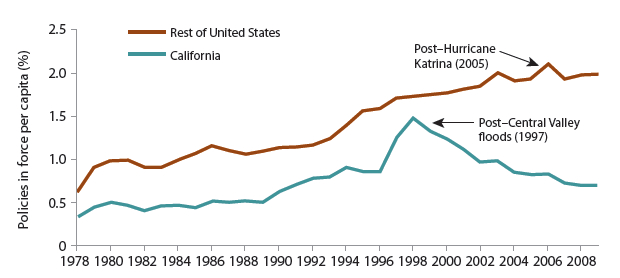
Flood Insurance Over Time source:PPIC
update: Discussion on twitter (see here and here) suggests interesting questions about where else this might apply, and what data one might use to examine the extent to which it generalizes to things like earthquakes and drought. Any suggestions for a) other areas this might apply, and b) data one might use?
We won’t have solid numbers updating the Colorado River runoff situation until later this week, but Henry Brean has an early read on the situation, reporting that Lake Mead is now expected to rise 30 feet between now and the end of the water year.