Stuff I Wrote Elsewhere: My Visit to Lake Mead

You folks have already seen most of this, but for readers of what we call “the print product”, I pulled together today some of my thoughts about the draining of Lake Mead and its implications for New Mexico. I did this (perhaps not coincidentally) as I’ve been pulling together some thoughts to speak tonight at a meeting of the Middle Rio Grande Water Assembly’s executive committee about some of the threads between Colorado River issues and New Mexico.

Here’s the new bit (sub/ad req):

[T]he system is reaching a breaking point. If the lake’s surface drops another 7-plus feet, Arizona and Nevada will begin to see their water curtailed.

How the shortage might affect New Mexico’s share is uncertain. For the next few years, Mead’s troubles are more of a problem for Lower Basin states than they are for us.

But Jennifer Pitt of the Environmental Defense Fund pointed out during a congressional hearing in April that the states in the Colorado’s Upper Basin, including New Mexico, have not sorted out who gets what in the event the shortages get so bad the Lower Basin states issue a demand that we send them more water.

Mexican Desal

As I’ve mentioned before (and to remind that, despite my recent rant, I really do like a lot of David Zetland’s ideas!), the cost of coastal desalination represents one of the important boundary conditions on water supply in the western United States.

In that regard, Sandra Dibble reports this week on four proposals in various stages of the planning process to build desal plants in Mexico:

With scarce rainfall and increasing competition for water from the Colorado River, Baja California faces many of the same challenges as Southern California as it strives to meet the needs of a swelling population.

Now water managers are considering whether to build four desalination plants along the Pacific Ocean corridor that spans Rosarito Beach to Ensenada. Two of the proposals are binational ventures — one private, the other public — that would pipe a portion of the processed seawater to users in San Diego County.

Powell and Watershed Boundaries

A friend recently described a New Mexico water rights battle currently underway as a “water lawyers stimulus act.” I was reminded of that reading Frank Jacobs at Strange Maps describing John Wesley Powell’s thinking regarding the division of the West’s water:

Powell’s warning at an irrigation congress in 1883 seems particularly prescient: “Gentlemen, you are piling up a heritage of conflict and litigation over water rights, for there is not sufficient water to supply the land.”

On the Difficulty of Fixing Water Problems

There have been a series of helpful exchanges, in the comments here as well as elsewhere on the web, between economist David Zetland and Francis, a veteran of California’s water policy world.

Zetland is a bright and articulate advocate for the use of market mechanisms to solve the thorny problem of water distribution under conditions of scarcity. David’s done a lot in helping me understand the value of markets as a potential water policy solution, and the distortions caused by market failures inherent in our current system.

Francis is an equally bright and articulate advocate for what I might call the “realpolitik” of the actual on-the-ground water world. Francis’s repeated “yeah, but” arguments resonate with my three decades as a journalist watching institutions succeed and fail over the years at trying to solve societal problems large and small.

Here, with a  bit of literary license, is a template for the exchange:

DZ: “Markets!”

F: “How, in practice, do you plan to implement that?”

When I wrote last month about Lake Mead’s dropping levels, for example, David said:

[T]he solution to this problem is obvious. Lower demand. If you need a hint on how to do that, I can tell you in 3 minutes, or you can just go and RAISE PRICES.

To which Francis responded:

Really, if you can explain in three minutes how to undo the 80+ years of Supreme Court rulings, Acts of Congress, international treaties, interstate compacts and all the rest making up the Law of the River, have at it and post the video on your website. I could use a good laugh.

Francis often follows with specific examples of existing legal, institutional and political structures that stand in the way of “Markets!” and, by extension, in the way of any particular recipe one might offer up to solve the problem.

And therein lies the reason I’ve become convinced that Francis is having the better of this exchange. It is not enough to articulate a particular solution that might better allocate the scarce resource. Markets? A ban on lawns? Abandon Phoenix? Sure, whatever. But to be in any way relevant, you have to show how that solution might be effectively implemented given the existing legal, institutional and political framework, along with the physical plumbing we have in place or could conceivably build to move the water hither and yon.

The latest round of the argument has played out over the last couple of days over on David’s blog, in response to a proposal by David for the convening of a “California Water Conference” to figure out how to solve that state’s water problems, with the conference’s conclusions to be made binding.

Francis was characteristically quick with the realpolitik:

There are plenty of solutions; there’s just no political will to make hard choices because the politicians are accurately reflecting the will of their constituents. (emphasis in original)

One sees this over and over again in western water fights: any particular suggested solution has winners and losers (if it wasn’t so, the problem would be trivial to the extent that we would already have solved it and wouldn’t be having the conversation) and the political representatives of the losers rightly object. I agree with Francis that the notion of a conference with binding solutions that could overcome the constraints imposed by existing legal and political institutions is, indeed, ridiculous. You need only look at the comment thread on David’s blog, as advocates for particular constituencies complain about being left out, to see that this would not end well.

This is not, however, to say that the problem is hopeless. I’ve been spending a lot of time of late reading about and interviewing participants in the development of the 2007 shortage sharing agreement (SSA) on the Colorado River, which has what seems like a couple of key characteristics that are a necessary precondition for effective solutions.

One is a shared definition among participants regarding the problem to be solved, what Elinor Ostrom calls “an authoritative image”. A key part of this is a common understanding of the data (which in the case of the SSA was an agreed-upon use of the Bureau of Reclamation’s Colorado River model).

As I wrote in another setting (sub/ad I think req), a discussion on how to grapple with water problems on the Rio Grande:

By that, Ostrom meant that everyone involved in trying to solve a shared resource problem like our water system must have a common understanding of the problem’s details: how much water there is and what happens under different future scenarios in terms of its continued use.

But the real key is to have participants – genuine stakeholders with a strong interest in developing a solution with a recognition that the risks of not getting to the table and figuring something out are not acceptable. That’s a hard one to force.
Drowning Connecticut

In Colossus, Michael Hiltzik makes nice use of Franklin Delano Roosevelt’s dedication address 75 years ago atop Hoover Dam. Inspired, I went back and found a copy of the text to pull a quote for a newspaper column. Roosevelt said this:
We are here to celebrate the completion of the greatest dam in the world, rising 726 feet above the bed-rock of the river and altering the geography of a whole region; we are here to see the creation of the largest artificial lake in the world – 115 miles long, holding enough water, for example, to cover the State of Connecticut to a depth of ten feet.

I did some quick math. Looks like enough water in Lake Mead to cover Connecticut to about 3 feet right now. The good news, I guess, is that no one will drown if we go ahead and do it.

update: It occurs on reflection that extremely short people (small children, perhaps) as well as those lying down might still have difficulty, so perhaps we should wait for Mead to drop a bit more before trying the Connecticut experiment.

River Beat: Weekly Report

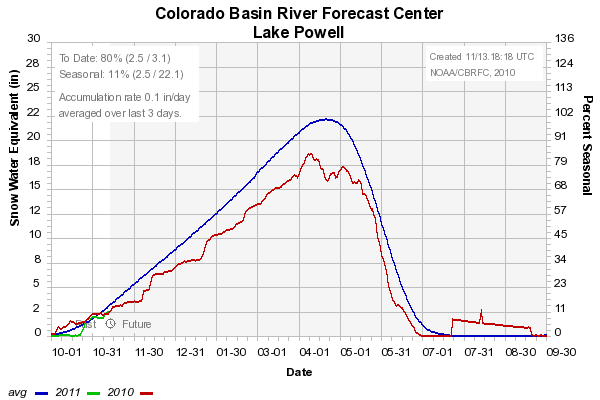
It’s still early in the season, so this doesn’t mean a lot, but it at least means a little (click to blow it up big enough to read – blue line is average, red line is last year, green line is this year to date):

Snow pack above Lake Powell, 11/13/2010

Snow pack above Lake Powell, 11/13/2010, courtesy CBRFC

This is a handy graph from the Colorado Basin River Forecast Center that sums up snow gage data for sites feeding into the Colorado River at Lake Powell. The basin is currently at 80 percent of normal for this point in the water year. That isn’t a big deal, given how early it is, but it given the sensitivity of the entire Mead-Powell operating system to inflow into Lake Powell this year, this is a number that matters more as time progresses. (I’m hoping to make this a weekly feature, to track the evolution of the system over the course of this year, though my track record on Inkstain at providing “weekly features” is flakey.)

Lake Mead’s surface elevation is 1082.24 feet today. It looks like the low point of just above 1082 is past, and we’re in that part of the year when inflows will be exceeding downstream releases for a bit. The latest USBR 24-month study, which projects lake elevations for the coming year, calls for about a 9-foot rise on Lake Mead through February before things start heading down again.

By comparison, last water year Mead rose 10 feet during the winter months, then dropped 20 feet during the summer for a net loss of 10 feet. The current projections call for a little better in 2010-11, with a slug of bonus water out of Lake Powell and a net drop of just 6 feet over the course of the year on Lake Mead.

Stuff I Wrote Elsewhere: The Birds

From the morning paper, an invite to one of New Mexico’s treasures – the Bosque del Apache (sub/ad req):

Come for the sandhill cranes and the grand clouds of snow geese. Stay for the coyote, or possibly the American pipit.

The big gray cranes and waves of geese are the marquee attraction at the Bosque del Apache National Wildlife refuge — its charismatic megafauna, if you will.

To see the geese take flight by the thousands is awe-inspiring, said Albuquerque bird-watcher John Arnold.

“That is spectacular, and that really speaks to people,” Arnold said.

But there is a quiet side that draws Arnold back each November. It is his birthday tradition to spend a day at the Bosque del Apache, seeing how many different species of birds he can identify.

Also, check out Marla Brose’s terrific pictures.

The View of Mead From Upstream

Folks on the Colorado River upstream of Lake Mead are sounding a little nervous.

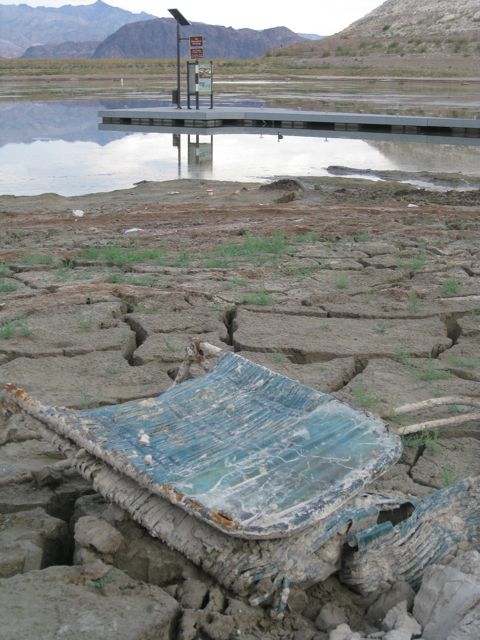
Lake Mead was here

Lake Mead was here

Dennis Webb had a very nice piece in the Grand Junction Sentinel over the weekend taking stock. Meet Colorado rancher Carlyle Currier:

When he hears that Lake Mead’s water level is at a historic low, he worries about the degree to which Powell may be relied on to stabilize Mead’s water supply.

That Lake Powell supply is water that Colorado and other states in the upper basin of that Colorado River scarcely can afford to let go, Currier said.

Currier and others involved in water policy in western Colorado see Lake Powell as a bank account for upper basin states, ensuring their ability to fulfill their water delivery obligation to lower basin states under the terms of the 1922 Colorado River Compact.

Lower basin states are using more Colorado River water than they are entitled to under the compact — a rate that has proven to be an unsustainable during a decade of drought and has drawn down Lake Mead.

“If we are required to allow too much water to meet the needs of the lower basin … and those that benefit from Lake Mead, well, that puts us in jeopardy of lowering Lake Powell too much and getting us in real trouble if we do have another severe drought like 2002,” Currier said.

It’s not a far-fetched fear. Recall the folks I talked to at Lake Mead last month, who argued that the solution to their lake’s problems was to release more water from Lake Powell upstream. While the current legal structure makes that difficult beyond efforts to equalize the contents of the two reservoirs so that they can, in theory, share both surplus and shortage, it’s a common line of argument.

Current contents:

  • Lake Powell: 15.2 million acre feet
  • Lake Mead: 10.0 maf

Stuff I Wrote Elsewhere: The “Festering Issue” of NM Domestic Wells

From the morning paper, a quick look at the New Mexico Court of Appeals decision on the state’s domestic well statute (sub/ad req):

New Mexico’s law giving homeowners the right to drill their own water well is legal and does not unfairly harm other water users in violation of the state constitution, according to the New Mexico Court of Appeals.

The court, in a decision issued late Friday, overruled a lower court decision that the domestic well law violated the state constitution because of harm such well drilling could have on nearby water rights holders.

The Appeals Court ruled that the state engineer, the state’s top water official, has sufficient administrative authority to manage water resources in such a way that pre-existing water rights are protected.

But this really deserves more than a quick look, because there’s a nuance in the decision that telegraphs what might be happening next:

The Appeals Court ruled that the Legislature created the statute requiring the state engineer to issue domestic well permits, and that it is therefore up to the state engineer and the Legislature to fix any resulting problems in the administration of water rights.

“The present case is a showcase of the festering issues involving senior water rights owners, the Legislature, and the State Engineer,” the court ruling said. (emphasis added)

In other words, appeal or not, we haven’t heard the last of this.