River Beat: It’s the Temperature

In an interview over at Grist, Brad Udall reminds us that, as we think about the effect of climate change on the West, it’s not just the thorny question of whether precipitation rises or falls that matters. Despite the uncertainties surrounding that question, as temperatures rise (a projection about which there is considerably less uncertainty), available water falls:

[T]here were three years that were really bad at the beginning of the 2000s, 2001-2003. Almost all the years since then have been about average in terms of precipitation. But runoff has been significantly less. And we believe that these significantly high temperatures that we’ve been experiencing, especially over the last 10 years because of man’s emissions of greenhouse gases, have reduced the runoff in the river. What our research shows is a couple different things: We can develop relationships between temperature and runoff, and precipitation and runoff, and it appears that this system is very sensitive to increased temperatures.

To illustrate Brad’s point, some data from the Western Regional Climate Center. The first is precip for the Colorado headwaters climate division in eastern Colorado. You can see that precip has been low over the past decade, but we’ve seen dry spells like this before. Then look at temperature, specifically how much warmer it’s been than in previous droughts:

That’s what Brad’s talking about.
Daybook: Sept. 1, 2010

Water in the desert: not exactly nature, but close

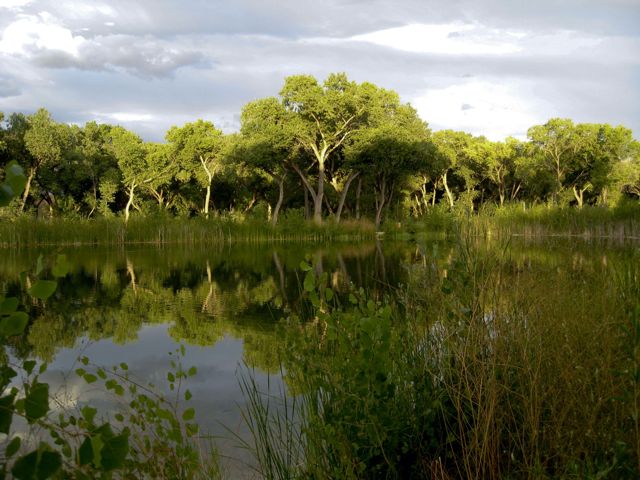
Tingley ponds, Albuquerque, August 2010

Tingley ponds, Albuquerque, August 2010

Lissa and I were walking in the Rio Grande bosque, the riparian cottonwood forest, last night when the sun dropped below the clouds just before sunset and lit the trees across the pond with the most exquisite light. All we had was a cell phone camera, so I went back this evening at the same time hoping for the best. Nature did not disappoint.

Much like the Las Vegas Wash I wrote about in the spring, this is not “nature”. People built this pond as a habitat restoration project. It’s become a favorite birding and walking spot for us. This evening I saw a pair of summer tanagers dining on extremely large bugs in the cottonwoods. A ruddy duck and a coot were sitting on a jam of floating wood at one end of the pond. On the downstream end, the water spills out into a rich cattail marsh, all muddy and rich with bugs and birds. This year pampas grass has grown in towering clumps along the pond’s edge, and Lissa and were pondering whether someone had planted them, or whether they seeded themselves, escaped from gardens in the Country Club neighborhood just off the river to the east.

If this was nature, the Country Club neighborhood would be a swamp, and the riverside woods wood be clumps of cottonwoods here  and there, rather than a ribbon of trees locked into a narrow corridor by levees.

Nature or not? Important not to get too hung up on the question. I’d miss the lovely.

Water in the Desert: Tempe Town Lake

Tempe Town Not Lake

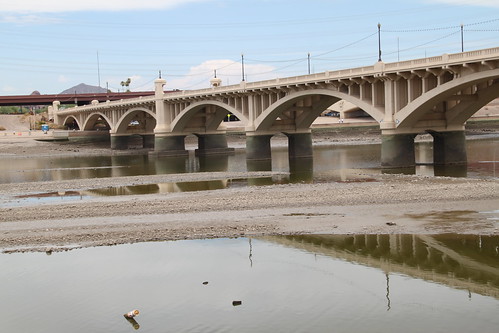
Tempe Town Lake sans water, July 2010, courtesy Titoxd

Great essay in High Country News by Jackie Wheeler about the strange and wonderful (and currently empty) Tempe Town Lake and our quirky relationship with water here in the affluent desert southwest:

In so many ways, Town Lake was frivolous, artificial, and naïve. It didn’t produce hydroelectric power. It wasn’t built by beavers or glaciers. Every several years, it has even lost its “lake” status when dam releases upstream dictate that the Salt flow free again. There are many rational reasons to fret about it, but when it comes to water, desert dwellers’ rationality dims. And not just human desert dwellers either; critters like beavers and ospreys had inexplicably begun appearing in the lake, to considerable acclaim.

Stuff I Wrote Elsewhere: It’s the Water Bottles

A bloggy bit from an ongoing project with Journal photographer Roberto Rosales on the trash in Albuquerque’s flood control system, and the people who try to catch it before it reaches the Rio Grande:

“The vast majority of the floatables were plastic water bottles,” Daggett told me. “You buy your plastic water bottle and it ends up in the Rio Grande.”

Drinking Fountains at the Ballpark

When Albuquerque’s new AAA baseball park opened in 2003, the drinking fountain by the restrooms on the third base side was somehow connected to a hot water line. I’m sure it was an accident, right? We’re dealing with the flaws of arguing from anecdote here, but Peter Gleick’s piece this week offers a number of other cases that are at least consistent with a trend:

It is time to stand up and demand that our public places and spaces have clean, working, water fountains. It used to be that no city in ancient Greece and Rome could call itself civilized unless public fountains were available for everyone. Even today, when our tap water is remarkably safe and inexpensive, we need water in our public areas.

Stuff I Wrote Elsewhere: Measuring the Weather

Eleven years ago next week, I stuck up a rain gauge in the backyard and starting dutifully writing down daily data on NOAA WS FORM B-91, “Record of River and Climatological Observations.”

Today, my employer kindly indulged my little hobby, affording me space on the front page of the newspaper for a riff on the problem of determining how much it rained in a geographically diverse place like Albuquerque (sub/ad req):

I’m a weather nerd, and my trip to the city’s official rain gauge was something of a pilgrimage. I’ve been keeping rainfall data at my house for more than a decade, and I’m always comparing it to the official airport total. But I had never actually visited the official weather station.

So on a bright summer morning a couple of weeks back, Journal photographer Marla Brose and I joined Camacho and a group of his colleagues, piling into a pair of National Weather Service trucks. Through a guarded gate, with Camacho in regular contact with the airport tower to make sure we didn’t get run over by a jetliner, we drove down the taxiways and onto the dirt next to a line of instruments that collect Albuquerque’s weather data 24 hours a day, 7 days a week.

There are thermometers, a device that looks up to measure cloud cover and an ultrasonic wind sensor. But it was the rain gauge that interested me, the AWPAG — All Weather Precipitation Accumulation Gauge.

It looks like a big shiny bucket, with a funnel on the top and a very precise scale inside to measure the water that falls. Fiber optics connect it to a nearby rack of communication gear and, via a network of weather websites, to the world.

If you look up “the weather in Albuquerque,” this is most often what you get.

As if the weather gods somehow knew I was working on the column, we had a lovely rainstorm last night in Albuquerque. I got 0.14 inch at my house. They got 0.13 at the airport. For once, we almost match. (updated with embarrassing typo on rainfall amount fixed)

Rutledge on Climate Change and Peak Stuff

Caltech prof David Rutledge’s “peak coal” argument is getting a lot of traction of late, and came up in a discussion on twitter this morning. The question was posed: if Rutledge is right, does this mean greenhouse gas regulation is not needed? Rutledge, in a talk two years ago here in Albuquerque, said the answer is “no.”. Here’s how I summarized (adwalled):

Most energy experts argue that Earth’s vast reserves of coal could last for centuries, which is one reason advocates of action on climate change have focused on policies aimed at reducing coal use. But Rutledge, who makes his prediction based on historical decreases in coal production, argues that coal supplies may simply run out, solving the problem through shortage.

That does not diminish the importance of searching for alternative energy sources like large solar plants, Rutledge said. Whether they are needed to reduce climate change or to replace fossil fuels when we run out, they will still be needed, he said.

He also argued that simply burning up all the fossils fuels we have might cause unacceptable climate change, and there could be benefits to setting aside areas of land as nonminable reserves. One example, he said, is the Grand Staircase-Escalante National Monument in Utah, which has significant coal reserves that are now off-limits to development as a result of action taken in 1996 by the Clinton administration.

To stabilize Earth’s climate at reasonable levels, he said, “you really need to leave it in the ground.”

Moving Water, Moving Silt

Imperial Dam

Imperial Dam siltation basins, Farm Security Administration via Library of Congress

One of the central struggles in moving water out of the Colorado River a century ago was the silt. Moving water moves a lot of it, and when you slow the water down, the silt drops out. It was siltation that kept clogging Charles Rockwood’s Imperial Valley diversions, where he was taking water from the Colorado . Or maybe George Chaffey’s diversions? The assignment of blame here is fickle. The need to keep cutting new diversions is what eventually led to the Colorado River jumping out of its channel in 1905 and flowing into the Salton Sink, turning it into the Salton Sea. The fingerpointing that ensued….

That is why the Imperial Dam, built in the 1930s, has these huge siltation basins, located between the diversion gates and the All American Canal, built in the 1930s.