Chasing Water

Las Vegas Marina

New location of Las Vegas Marina on Lake Mead. Note the bathtub ring in the background. Photo courtesy National Park Service

When I was in Vegas in April, I heard several talks on the way folks on Lake Mead engage in a practice they call “chasing water”. As the water storage reservoir recedes, the Park Service extends boat ramps farther and farther. The owners of the Las Vegas Marina, which used to sit up in Las Vegas Wash, did a series of incremental moves of their infrastructure until the finally had to give up the site entirely and move miles around the lake to a new site that is not as vulnerable to the lake’s rise and fall. Most notably, the Southern Nevada Water Authority is building a massive new intake pipe deeper in the lake for Las Vegas’s water supply: the “third straw”.

I was reminded of that today by a New York Times story about how this is done on the Dead Sea, where dropping water level is a way of life:

“We chase after the water with steps,” said Yusef Matari, a lifeguard at the private beach, Neve Midbar, or Desert Oasis. Mr. Matari has been working in the area for 20 years. “It changes every month,” he said. “There is no permanent shore.”

(h/t Robert Osborne for pointing out the Dead Sea story)

The Imperial Irrigation District’s Problem – LA Might Get the Water!

You would think that on the over-appropriated Lower Colorado River, downstream from dwindling Lake Mead, getting by on less water would be a good thing. But this little news blurb from KXO radio in El Centro, in California’s Imperial Valley, suggests otherwise.

The problem, apparently, is that the Imperial Irrigation District, the largest water rights owner in the West (I think) is using less than its full allotment this year. The extra water that it doesn’t use goes to San Diego and Los Angeles:

Last year, the District was 135,000 acre feet under. That water went to the MWD. The under usage is being blamed on the poor agricultural economy resulting in fewer acreage planted. Officials say it would be in the IID’s best interest to use the water reasonably and beneficially, whether it be in agriculture or otherwise.

Spam Bot Knows Whereof It Speaks

A spambot recently left the following comment on one of my water posts:

water conservation should be done because we are already having some water shortage these days

It was accompanied by a link to a web site apparently selling products intended to alleviate gastrointestinal distress. Less flushing, I guess?

Nighthawks

This was the best nighthawk week I’ve had in my yet young birding career.

I’ve sort of vaguely watched birds since I was a kid, something I picked up from my mother. When Lissa and I got married, mom and dad passed on their Peterson’s guide, and we made a tradition of taking it with us on vacation and writing the birds we saw in the margins. But I didn’t really get hard core until a couple of years ago, when I spent time with University of New Mexico ornithologist Chris Witt for a piece on bird genetics. I had asked Chris to come up with a specific example from around here to make his genetic work meaningful. He pointed out the surprising genetic link he and his colleagues had found between hummingbirds and nighthawks, both of which are birds that he sees in his backyard.

Maybe he does, but I didn’t. Hummingbirds are easy, but nighthawks, which come out to hunt bugs at night, are elusive. So I’ve always got my eye out for them.

I spotted one from our backyard two years ago, and another one Saturday afternoon last year up along the Rio Grande, plus a few this spring over farm fields in Yuma, down on the Lower Colorado.

But this week was a nighthawk bonanza.

Nighthawks, by Edward HopperWednesday evening, I was birding along a pond out by the Rio Grande when a nighthawk flew in low and circled. Best look I’d ever gotten as it took several passes around the pond dining.
Then last night, I was up in the mountains with Lissa and my sister, Lisa. We’d been watching a jay up in a pine tree when Lisa said, “What are those?” High in the sky, a bunch of birds flying overhead, headed north. The long narrow wings with white bars were unmistakable – a dozen nighthawks, then shortly after, two more, then a few more a bit later.

One other reason to love nighthawks is the name. Edward Hopper’s 1942 painting has always been a favorite.

Why I Don’t Think We’ll Abandon Phoenix

Michael Campana prodded me a bit this morning on Waterwired regarding a discussion happening here and elsewhere about the possibility of abandoning Phoenix as the place runs out of water. It’s a strong meme, and it comes up frequently among those who recognize the fragile nature of cities of the desert southwest as growth-fueled water demand rises while climate change appears likely to reduce future supply.

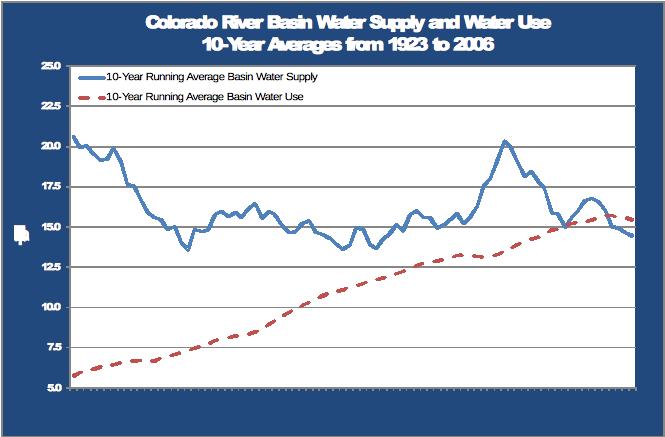
Colorado River Supply and Demand, courtesy USBR

This applies across the southwest, and I don’t mean to single out Phoenix. It’s just a handy example of a big problem, which you can see here in a nutshell (thanks to Terry Fulp at the USBR for sharing the latest version of this graph). You can imagine the trend lines continuing in their respective directions, and Phoenix drying up and being abandoned, dust bowl style.

As I explained over in the comments at Michael’s, here is why I think that is not likely to happen, and what interests me about the current discussion of alternative paths forward.

If one quantifies all the water there is available to the lower basin states, and looks at how that water is now being used, one can a number of solutions short of shutting Phoenix (or Las Vegas, Nev., or Albuquerque) down. We know, for example, that Phoenix could consume far less water per capita. There could be a major shift of water from ag to urban users in Arizona and the rest of the West. We could pursue coastal desalination, freeing up Colorado River water. These things are all too expensive and/or politically painful now to contemplate, but they are far less expensive and politically painful than abandoning Phoenix etc. There will reach a crossover point on my hypothetical cost/pain curve where these solutions, or steps like them, will be implemented.

The question I’m thinking hard about is what the political/policy/institutional/engineering framework looks like that we’ll need to have in place to sensibly handle the transition when we hit that point on the pain curve.

River Beat: Imperial Dam circa 1938

update: An eagle-eyed friend points out that when I grabbed this from the original PowerPoint slide, I clipped off the X and Y axis legends. That’s time on the X axis – 1920ish to 2006, and millions of acre feet on the Y axis.

xxxxx

‘Cause I love the old pictures, and since it came up in the comments. From the Calisphere archives, Imperial Dam, the beginning of the end of the Colorado River, under construction, circa 1938:

Imperial Dam, 1938, via Calisphere

Imperial Dam, 1938, via Calisphere

River Beat: Alligators

I report without comment reports of alligators in the Colorado River (Palisade is in western Colorado, just upstream from Grand Junction):

Wednesday, a group of kids playing near the water at Riverbend Park raised the alarm when they say they spotted an alligator on the bank. They say their parents didn’t believe them, but a bystander did.

“Everybody thought we were crazy. These ladies said we must be blind or seeing things. But this guy saw it too and he saw it go into the water. And he was trying to tell everyone we weren’t being crazy. We really did see it,” says Josie Brumfield.

Stuff I Wrote Elsewhere: On Water and Institutional Structures

Saturday’s post about Phoenix and the need for proper institutional structures to sort out the West’s water problems was really a bit of shadowboxing with a piece I was working on for today’s paper about New Mexico (sub. ad req.) It’s about an ongoing argument here about a proposed water rights agreement between our Interstate Stream Commission and Intel. The agreement was an attempt by the ISC to do something very much outside the normal water management box, and it’s run into a shitstorm of criticism.

I argue that one of its problems is that we lack the institutional framework under which to consider a deal like this:

But it is also clear that, if López and his team are right about the deal’s legality and merits — and there is reason to think they might be — we do not have the political and institutional framework in this state to have a proper discussion of the issues being raised.

There is no institutional forum for the discussion of an idea like this, a place where the major players with skin in the state water game — the big municipal utilities, irrigators, the pueblos, the state regulators and legislators — regularly sit down to discuss our water future.

The Intel deal is just one small item on the long list of possible solutions to our water problems — increased water conservation, desalination of brackish groundwater, sale of water from agriculture to urban use, improved management of dams to reduce evaporation, long-distance transfers from places that have water to those that don’t, changes in endangered species protections.

All involve, to a greater or lesser extent, old law and engineering versus new realities. But without a sufficiently broad statewide forum in which to have the conversation, the best solutions are likely to founder on the same shoals on which the Intel deal has run aground.

Comments welcome – in fact, encouraged.