James Lawrence Powell concludes his otherwise excellent western water history Dead Pool with an apocalyptic vision of the abandonment of Phoenix, “a Grapes of Wrath-like exodus in reverse” as drought saps the Arizona city of its last reserves of water. It’s a vision I don’t buy (hence my “otherwise excellent” tag), because we won’t abandon Phoenix – or Las Vegas, Albuquerque, Las Vegas, Los Angeles, San Diego, Denver etc., the arid climate cities built in the 20th century based on the notion that we could bring rivers to them. The question is not will it happen, but how we will avoid it, and how painful the process will be.
It’s not hard to think up solutions that make hydrologic sense – reallocation of water from current to future uses, conservation measures, extreme growth controls, price-based economic solutions. But it’s also easy to make the case for why those solutions aren’t politically viable.
So what’s our Plan B?
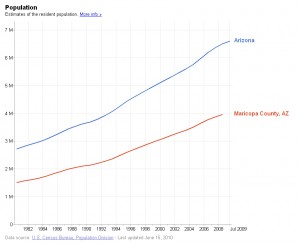
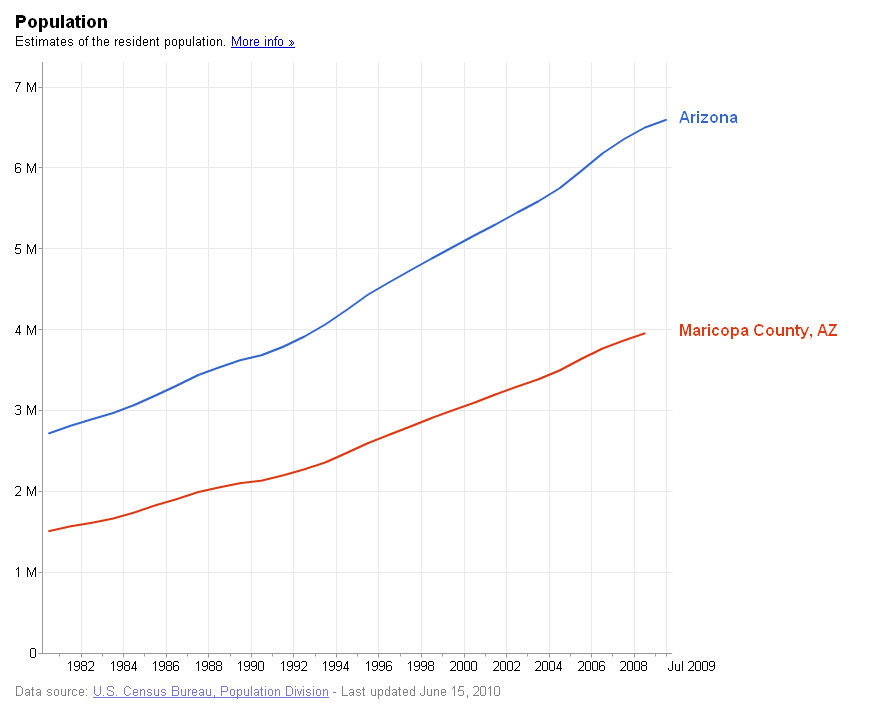
Arizona Population Growth, via Google Public Data
I was thinking about Powell’s end point as I read a terrific piece this week by journalist Jon Talton, late of Phoenix, now settled in considerably wetter Seattle. It’s a fire-in-the-belly response to the way Phoenix is blindly stumbling forward into its arid future:
In general, Arizona’s water issues are stark and simple: The state can’t sustain double-digit percentage population increases every decade, particularly in subdivisions apart from historic urban footprints.
And this:
Here’s what I know: The Colorado River is oversubscribed. It can’t support the population that depends on it now, much less added growth. The paralyzed federal government would not build a second CAP canal (“pork”), as some dream, even if the water was there. The Upper Basin states (and Mexico) will never allow themselves to get fleeced again by California, Arizona and (now) Las Vegas.
And on he goes. His analysis of the problem, honed by his work as a journalist in Phoenix and what he describes as a childhood as son of one of the people who help build the Central Arizona Project, Phoenix’s river uphill from the Colorado, is razor sharp. Go read it.
But his solution is not.
1) Stop all exurban development; 2) Stop all development outside the real urban footprints of cities and towns — that means no more Pinal or Buckeye sprawl; 3) Shrink the state’s population through taxes, “anti-business” regulations and whatever other creative solution someone can reach (the heat may do this anyway); 4) Price water extremely high outside the SRP footprint and a few other quasi-sustainable areas; 5) Start to return much of metro Phoenix’s fringes to natural desert — yes, tear down the crap; 6) Get a real handle on the state’s water resources, based on science, not the venal appetite of the Growth Machine; 7) Fill in the old SRP footprint with high-quality dense development that includes plenty of shade tree and grass oases but also building based on Spanish and Moorish models rather than American tract houses with large expanses out front; also, with much less pavement 8) Tax the fringe areas to encourage migration either out of state or into the dense SRP footprint or other such areas. 9) Shut down any golf course built after 1970; 10) Have statewide, airtight water regulations. Not the least impediment to realizing these solutions would be building an economy based on more than sprawl. So…no chance.
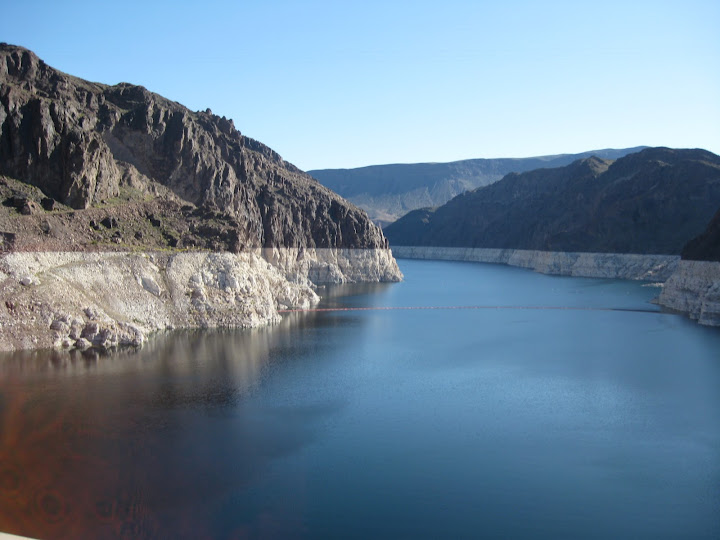
Lake Mead's Bathtub Ring, April 2010
It’s probably not fair to criticize Talton here, because he acknowledges the point I’m trying to make with his “no chance” closer. He recognizes that we’re not going to get Jon Talton as czar of Arizona, with the power to implement all this stuff.
So really, Jon Talton’s solutions to Arizona’s water problems are not going to happen. What’s Plan B?
I believe (and this is at the heart of where I’m heading with my book) that the solution does not lie in specifying a workable hydrologic or legal solution – taking X acres out of ag, reducing per capita household consumption to Y, rewriting the Colorado River Compact, revising the doctrine of prior appropriation, raising prices to Z.
The solution instead lies in creating the institutional framework in which a useful conversation can be held and politically viable solutions can be crafted. The math, how many acre feet of water we need to save here to use there, has to wait.
“So how are you going to do that, John?”
Yeah. I realize that at this point I’m about as useless here as Talton’s politically impossible solution set. I’ll get back to you when I’ve figured out the next step.
But I will suggest a couple of case studies that interest me, where collective action on seemingly intractable common pool water resource problems has happened.
On is Elinor Ostrom’s case study of greater Los Angeles groundwater basin management. (Some previous Inkstain discussion here and here.) The other, which I’m immersed in now, is the 2007 Colorado River shortage sharing agreement.
Other examples come to mind?