
Mexican fans watching Mexico v. Argentina on a giant TV on the waterfront in Copenhagen, June 27, 2010.

Mexican fans watching Mexico v. Argentina on a giant TV on the waterfront in Copenhagen, June 27, 2010.
I just got my copy of my friend Chuck McCutcheon’s new book,What are Global Warming and Climate Change?: Answers for Young Readers (Worlds of Wonder)
I’m headed to Copenhagen next week for a journalism workshop. While the workshop will fill most of my time there, I’ve scheduled a few extra days to play.
Suggestions?
From this morning’s newspaper (sub/ad req), a story about the new paper in today’s Science by Jonathan Overpeck and Brad Udall about climate change in the West. Udall and Overpeck have become fixtures on the western water meeting circuit over the last several years delivering this message, and the paper contains no real surprises. But as the respective heads of the two major federally funded western climate impacts research groups, their standing and choice of venue, I think, makes the paper newsworthy:
The combination of drought and a warming climate pose major problems for Western water supplies in the coming century, according to two of the region’s top climate and water experts.
Climate is changing faster here than anywhere else in the United States, and warming is especially acute in the mountainous region that forms the headwaters of the region’s great rivers, the University of Colorado’s Brad Udall and the University of Arizona’s Jonathan Overpeck wrote in today’s edition of the journal Science.
The paper’s publication comes on the heels of a new report from the U.S. Bureau of Reclamation of another record-setting year of low flows on the Colorado River, the primary water supply for much of the Western United States.
I’ve written in the past about the remarkable fact that, despite the 10 driest years on record on the Colorado River, no one’s had their allocation reduced or cut off.
The first plausible scenario under which that would change happens when the surface of Lake Mead drops to 1,075 feet above sea level. Under the 2007 shortage sharing agreement worked out among the US Bureau of Reclamation and the seven basin states, that’s the point at which lower basin states begin seeing reduced allocations.
The Central Arizona Project announced earlier this week that their hydrologists now calculate that there is a 15 to 20 percent chance of that happening in 2012:
[T]here is a 15-20% probability that in 2012, Lake Mead will have fallen an additional 13 feet to 1075’, triggering a declaration of ‘shortage’ on the Colorado River. Should the Secretary of the Interior declare a shortage, CAP, with the lowest priority to Colorado River water, would have its annual entitlement reduced by 288,000 acre-feet (93 billion gallons) or roughly 18 percent.
But, as the agency notes, “shortage” here does not mean CAP customers would actually see less water immediately. At this point, CAP officials say the immediate effect would be to reduce the amount of water available to the agency for groundwater banking.
Some links:
The book project means I often pay more attention to the Colorado River, at least journalistically, than the river through my own back yard. But via the work blog, you can see that it’s dry over on this side of the continental divide as well:
Over the last 14 years there have only been three years with above average spring runoff into Elephant Butte reservoir, 1997, 2005 and 2008.
(Quote from TAMU monthly drought report.)
The suddenly ubiquitous Bureau of Reclamation Colorado River supply-demand graph showed up today in a helpful Bruce Finley story in today’s Denver Post about the conversation in Colorado regarding the disconnect between shrinking Colorado River supply and growing Colorado River demand:
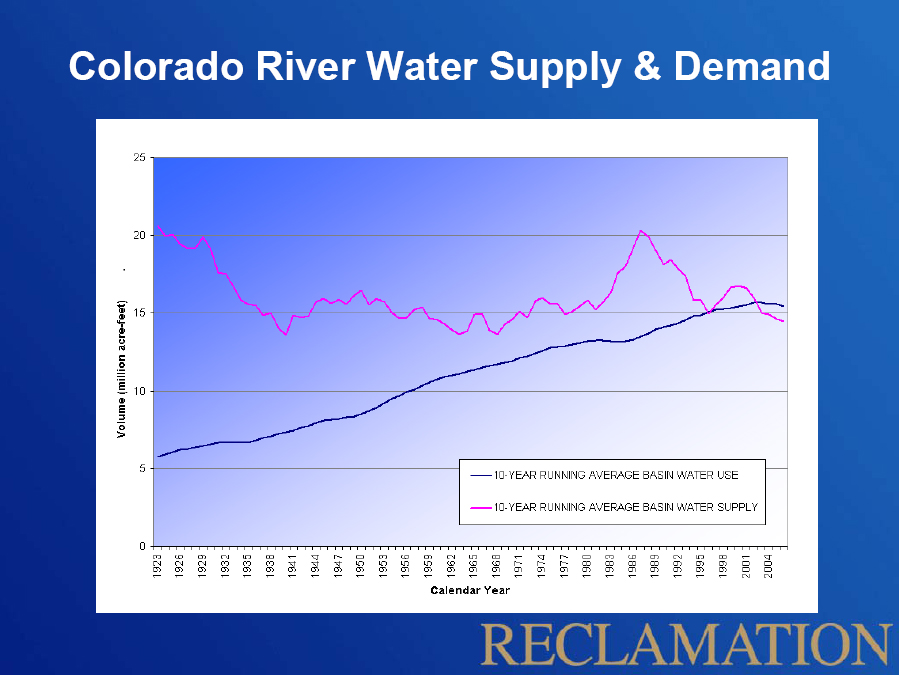
Colorado River Supply and Demand, USBR
Colorado River water consumed yearly for agriculture and by the 30 million Westerners who rely on it now exceeds the total annual flow.
A growing awareness of that limited flow is leading to increased scrutiny of urban development — especially projects that require diverting more water to the east side of the Continental Divide.
“We’re no longer in a surplus situation,” said Bill McDonald, the U.S. Bureau of Reclamation’s deputy commissioner for policy and budget. “The teeter-totter has tipped.”
So we’ve clearly identified the problem. What is the solution? By solution here, I’m not asking for a specification of who gets less water in the future. I’m interested in what the institutional mechanisms might be by which we would solve the problem. Do we just go into court all sharp-elbowed and hope the Law of the River breaks in “our” favor (whoever “we” might be)? Or are their existing problem-solving mechanisms that can allow us to sort this out in a more collaborative way?
updated: Added link to Finley’s story. Oops.
This observation from the first draft of next year’s U.S. Bureau of Reclamation Colorado River Annual Operating Plan should come as no surprise:
Inflow to Lake Powell has been below average in nine of the past eleven years (2000-2010). Although slightly above average inflows occurred in 2005 and 2008, drought conditions in the Colorado River Basin persist. Provisional calculations of the natural flow for the Colorado River at Lees Ferry, Arizona, show that the average natural flow since calendar year 2000 (2000-2010 inclusively) is 12.0 maf (14,800 mcm). This is the lowest eleven-year average in over 100 years of record keeping on the Colorado River.
David Appell triggered an interesting discussion over at his blog about comparing the Gulf oil mess to other ecological disasters, presaging a nice piece by Justin Gillis exploring a lot of the same issues.
As I mentioned over at David’s, this raises what has long been for me a discomfort about the ecological insults we object to, and those we routinely accept without even thinking of them as ecological insults.
The Google map tools people have built to allow you to overlay the size of the Gulf oil spill on your town (If It Was My Home, for example) are a great way to visualize this. Overlay the spill on, say, greater Los Angeles, and you’ll see that the sprawling metro are, stretched along the coastal plan from Santa Barbara to Tijuana, is similar in scale to the spill. That metro area used to hold an entire ecosystem, which was destroyed to create a city. Any city will do here. The point is that we’ve decided some ecosystem destruction is OK (that which we do slowly and deliberately, and from which we comfortably benefit) while other ecosystem destruction horrifies us.
I have bird feeders and some nice plants and water in my backyard, but I shouldn’t kid myself that the existence of my house hasn’t made life impossible for the flora and fauna that used to live here.
update: After looking again at the news story that triggered this, I’m now not so sure when the Georgia debate happened – maybe years ago? So maybe, other than thematically, this post makes little news sense.
original: Here in the West, moving large quantities of uphill or sometimes out of its basin of origin completely has been a way of life for a century. Out by Parker Dam on the Colorado, for example, giant pumps push the equivalent of an entire Rio Grande up to the west to LA. Another set across the river to the east does the same for Phoenix and Tucson. It’s a commonplace in our arid climate water engineering culture.
That’s done much less in wet climates, because you more often get a river that’s so big you can just grab a bit of it as it flows by and there’s plenty left to flow on downstream for the next city. As a result, the institutional culture associated with ginormous water-moving projects is less common. There’s a reason the nation’s great water movers, the U.S. Bureau of Reclamation, is an exclusively western U.S. institution.
But in Georgia, the water moving conversation is underway, as Atlanta’s grim water future forces the discussion:
“Water resources in Georgia are not where the people are,” said Green, who argued the estimated 62 million gallons a day of water from the Coosa basin the metro area will need as the state’s economic engine in 2030 is less than 10 percent of the river’s flow.
“We need a rational water plan that’s based on fact …and now is not the time to take important tools like interbasin transfers off the table,” he said.