Pentagon Pull In Energy Innovation

Will it be the Pentagon’s purchasing power and needs that provide the impetus for the energy technology innovation we need to solve the energy and greenhouse gas problems? Dan Sarewitz, in this week’s Nature, argues thus (sub req I think):

F404 Navy jet engine being tested running on biofuel

F404 Navy jet engine being tested running on biofuel

DOD’s infrastructure includes 500 fixed installations (some the size and complexity of small cities), 546,000 buildings and other structures and 160,000 non-tactical vehicles.

Combine these numbers with the fact that no institution on Earth has anything close to the DOD’s buying power and technical capabilities, and it’s hard not to conclude … that the Pentagon has the capacity to become the world’s most important weapon in the fight to reduce greenhouse-gas emissions.

The Pentagon has full life cycle responsibility for all sorts of infrastructure, from buildings to vehicles, and has enormous efficiency incentives, Sarewitz argues:

National security, climate change and energy economics are convergent rationales that provide the DOD with a potentially huge institutional advantage over other energy innovators. A litre of petrol transported along highly vulnerable supply lines to Afghanistan costs an average of about $100. Enhancing the energy independence of forward-base operations in combat zones — to save lives and money — is thus a powerful short-term incentive for energy-technology innovation in everything from building insulation to fuel efficiency for jeeps, tanks and jets, to renewable power generation and storage. The price at which new technologies make economic and strategic sense is enormously higher than what the energy market — or any plausible cap-and-trade or energy tax scheme — would allow.

Where Are They Getting the Water?

Every time we drove through a new subdivision on the edge of Albuquerque, my Dad used to ask the same question: “Where are they getting the water?”

Tony Davis had a story in the Arizona Daily Star recently that showed the depth to which Arizona has failed to grapple with that question, essentially allowing subdivisions to be built on unsustainable short term supplies with the promise to eventually get more water somewhere, somehow. The proximate cause of the story is legislation authorizing the search for new water and bonding authority to pay for it:

One reason the bill is being seriously considered is that most of these homes have no assured, long-term water supply.

They are being served by a short-term supply that could disappear in a few years to a decade from now because legally, it belongs to somebody else.

The debate on the bill has unearthed some long-simmering issues swirling around the three-county Central Arizona Groundwater Replenishment District.

The district has signed up more current and future housing developments in Pima, Pinal and Maricopa counties than it has long-term water supplies for.

By 2025, it will be legally bound to provide more renewable water supplies to its customers than the city of Tucson would be serving.

The legislation has stirred fears that customers in the district will ultimately be subject to “rate shock” once the water supplies are on line and the bills come due.

Today, no one knows for sure when the district would acquire water, where it would come from, what it would cost or what the repayment terms would be.

Among possible sources are farmers along the Colorado River, treated sewage effluent, desalination of seawater or salty, brackish groundwater, or rural areas that have groundwater supplies.

The only thing that’s clear is that the cost would be higher than the district’s current water supplies from the Central Arizona Project, which uses Colorado River water brought by canal.

(h/t Michael Campana for pointing out the story)

The Cap and Trade Struggle

My colleague Sean Olson had a story last weekend that captured the struggle facing those trying to implement state-level cap and trade regulations in New Mexico (sub/ad req):

Republicans and many Democrats agree that a state cap-and-trade system would be a form of economic suicide for New Mexico.

New Mexico is a member of the Western Climate Initiative, the effort to establish a regional greenhouse gas reduction framework. Efforts to pass implementing legislation have gone nowhere, so state officials are now attempting to use the existing regulatory framework, via the state’s Environmental Improvement Board, to use the state’s Clean Air Act authority to do the job.

Sean notes that every major candidate for governor – both parties – opposes the idea.

Colorado has a new interbasin transfer idea

A bunch of Colorado and Wyoming municipal water utilities apparently hope to gang up on entrepreneur Aaron Million, hatching a pipeline scheme of their own to pipe water across the continental divide to growing front range cities. From Bobby Magill at the Coloradan:

Move over, Aaron Million.

A coalition of municipal water suppliers from the south Denver Metro area and Wyoming announced Thursday at the Capitol that they’re banding together to study a project that could end up competing with the Fort Collins entrepreneur’s proposed Regional Watershed Supply Project and potentially call for new reservoirs to be built in Larimer County somewhere east of the foothills.

Each utility in the coalition will contribute $20,000 to a feasibility study for a massive municipal water pipeline project called the Colorado-Wyoming Cooperative Water Supply Project, which would pipe water for 532,000 people from Wyoming’s Flaming Gorge Reservoir to the Front Range.

To get a sense of the scale here, the pipeline projects would carry something like a quarter, roughly, of the water carried by the Central Arizona Project canal from Parker Dam on the Colorado River to Phoenix and Tucson. Put another way, it’s about a quarter of the water carried by the Rio Grande in an average year through central New Mexico.

The price tag for either Million’s private project or the new municipal alternative, according to Cathy Proctor in the Denver Business Journal, is about $3 billion.

On Moving Water: The Exclusion Problem

I’ve written in the past about the importance of the notion of moving water from where it wants to be. A lot of our problems seem to happen when we do that, because water wants to be where it wants to be, and its powerful urges are difficult to resist.

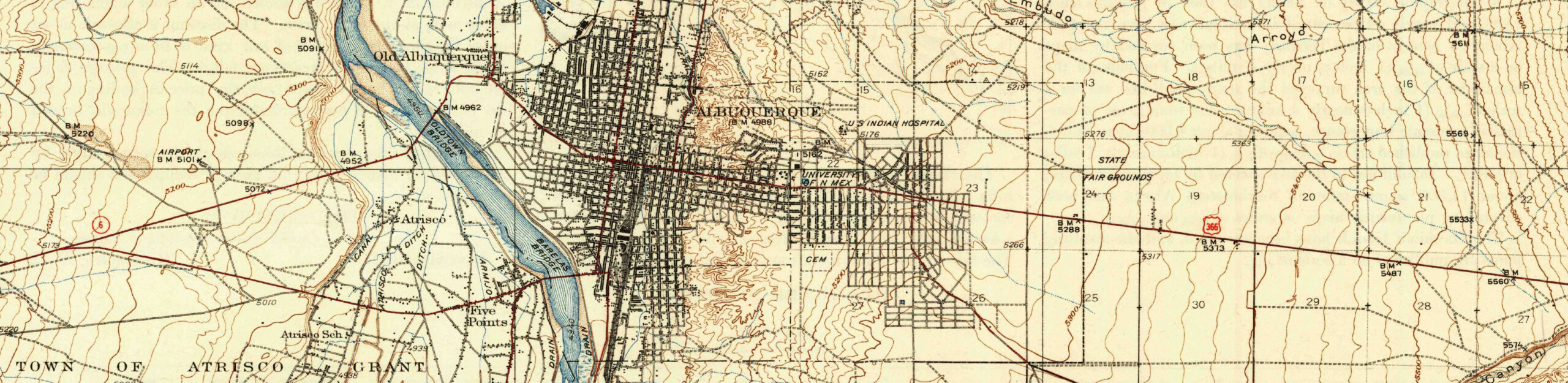
My past discussions have focused on the problems that ensue when we engineer big interbasin transfers. But now that I’ve got this big “moving water” hammer, I’m seeing more nails. This week, it’s a piece for the newspaper about Albuquerque’s levee problems (sub/ad req):

The problem is rooted in the nature of the Rio Grande itself.

Before there were dams and levees, it wandered the entire Albuquerque valley, shifting its bed from one mesa to the other over a course of years. Flood control efforts begun in the 1930s confined the river to a narrow channel, with levees on either side to protect valley bottomlands so they could be turned into farms and eventually a city.

Under high flows, the river can push up against the levees, trying to find its way out across the flood plain.

The topography is subtle here, but we have neighborhoods below the grade of the river. That requires endless engineering in response, because the water in the long run would really prefer the low spot.

Previously: on moving water.

Scientization: Delta Smelt, a Case Study

Friday’s release of the National Academy study on pumping restrictions in the California Bay-Delta system on behalf of endangered fish offers a great case study in “scientization,” the process by which competing political factions repurpose scientific findings to meet their political needs.

Californai Central Valley and Bay-Delta

Californai Central Valley and Bay-Delta

The panel concluded that the pumping restrictions are scientifically justified, a blow for ag interests. But, not surprisingly, both sides found ammunition in the report to support their position, as Matt Weiser and Michael Doyle reported in the Sacramento Bee:

Overall, the panel’s conclusions were nuanced, allowing advocates to read into it, Rorschach-like, their own priorities.

“The report clearly validates the biological opinions,” said Ann Hayden, senior water resource analyst at the Environmental Defense Fund. “It’s time to stop pitting the economic interests of farmers against fishermen and move forward to find solutions.”

Farmers, on the other hand, emphasized the enduring uncertainties, as well as the report’s observation that other problems besides water diversions have a “potentially large” effect on fish. These include water pollution and invasive species.

“Much more analysis is needed on the other stressors, their impact on endangered species and the relative significance of the pumps,” said Tom Birmingham, general manager of Westlands Water District.

This is what Dan Sarewitz is talking about when he describes the way additional science frequently does not settle political controversies of this sort:

[S]cientific uncertainty, which so often occupies a central place in environmental controversies, can be understood not as a lack of scientific understanding but as the lack of coherence among competing scientific understandings, amplified by the various political, cultural, and institutional contexts within which science is carried out.

Or, as the mysterious and terrific California water blogger On The Public Record explained, the NAS report settled nothing. Instead, those whose political values and interests were harmed by the panel’s findings simply busied themselves finding ways to ignore it:

This is what I predicted. The NAS review didn’t change anything about the political landscape here.

Zigs and Zags on the Path to Lower Carbon Energy

A lot of the discussion about the new “Bloom Energy Server,” which is having its 15 minutes of fame, is of the binary “is it or isn’t it” flavor. David Douglas has a more nuanced view of the way in which what happened here is an example of the sort of path forward me might see in the development of new energy technology:

It starts with the US government (as many interesting technologies do), who needed a better way to create oxygen on NASA missions. While this fuel-cell design didn’t meet those needs, K.R. Sridhar, now CEO of Bloom, realized that the fuel cell could also use oxygen as a source and be a potentially interesting source of electricity. Enter Kleiner-Perkins and the venture capital community to fund the effort, followed by key silicon valley innovators looking to try something new to lower their power bills and green their energy supply. Finally, the federal government, accompanied by the State of California, returns to the picture with incentives that help make the technology cost competitive during the early phase as it ramps up.

Douglas also makes the important point that we shouldn’t get too hung up on failures as we head this direction:

Its also important to recognize that, despite its Hollywood feel, this story wasn’t pre-scripted. Things fell into place as the story unfolded, and at each stage there could have been unforeseen roadblocks that stopped the story before the happy ending. In other words, we’ll have to be willing to let lots of these stories play out, understanding that not all will end happily. This is especially important for the federal government’s role, which needs to be repeated in some form in every one of these stories.

Stuff I Wrote Elsewhere: ABQ Water Consumption Declining

Albuquerque’s per capita water consumption continues to drop (sub/ad req):

Albuquerque Bernalillo County Water Utility Authority customers used an average of 159 gallons per capita per day in 2009, down from 252 gallons in 1994, when the community’s water conservation efforts began, according to Katherine Yuhas, head of the utility’s water conservation program.

Yuhas and Albuquerque’s conservation efforts are featured in the April issue of National Geographic as an example of a successful program to reduce water consumption.

For the National Geographic article featuring Yuhas, start here.