Water in the desert, Las Vegas edition II

LAS VEGAS, NEV – Walking up from our hotel to the strip in search of a place to eat last night, battered by neon and flashing lights, my dinner companion commented ruefully on how distant we were from nature. I suppose you could say that in the middle of any city, but in Las Vegas the idea resonates.
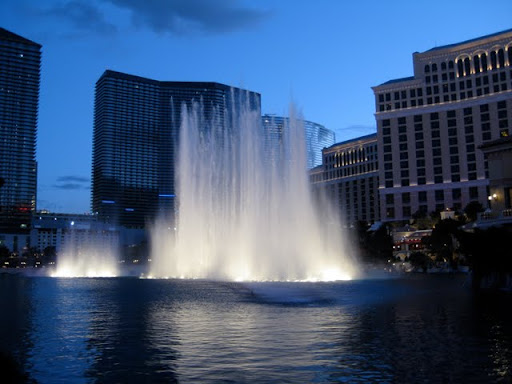
Bellagio Fountain, April 2010

Bellagio Fountain, April 2010

I know I went for the cheap water wonk gag with the Bellagio Fountain thing the other day, but it carries symbolism well beyond the acre feet involved. On the way past the fountain last night after dinner, I could have sworn I saw a couple of ducks in the shadows against the faux Italianate villas, so I went back this evening before dark for a better look. Sure enough, five mallards. They looked completely out of place.

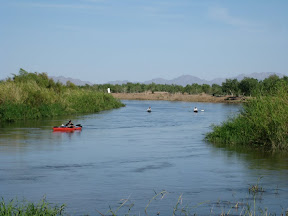
For an alternative take on the Las Vegas water story, I found my way this afternoon to the wetlands along Las Vegas Wash on the east end of town. Clark County’s sewage treatment plant dumps into the wash, which leads down to Lake Mead. It’s an example of a familiar method of western water accounting. Vegas withdraws water from Mead. Some of it  ends up on lawns and gardens and evaporates into the dry desert air. Some of it ends up flushed down to the sewage treatment plant and thence on to Lake Mead. Vegas gets a return credit for that water against its total allotment.
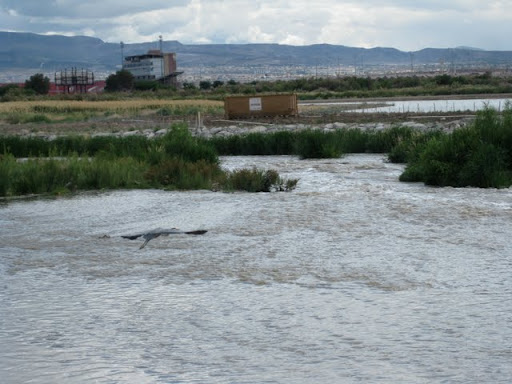
Great blue heron, Las Vegas Wash, April 2010

Great blue heron, Las Vegas Wash, April 2010

As a byproduct of this accounting methodology, you end up with a river running year ’round down Las Vegas Wash, which before human intervention would have only been wet during flash floods. When you add water, nature happens. I saw herons and egrets and an osprey circling overhead, all birds that live around water. They never would have made a place like Las Vegas Wash their home before the advent of modern sewage treatment plants and return flow credits.

An interagency group manages the Las Vegas Wash with facilities intended to improve water quality on its way to Lake Mead, primarily by slowing it down. A series of weirs have created spectacular wetlands, a rare commodity in the desert. Hence the great blue herons. The people doing the project understand the side benefit going on here. They divert some of the water into a wetlands park with a wheelchair-accessible 1.5 miles of walking trails, little ponds and groves of trees and wonderful marsh habitat. They’ve also built trails out to the weirs along the main wash.

It’s gorgeous. The birds were fabulous. I counted 25 species on my walk, 13 of them water birds. Compare that to the five mallards at the Bellagio Fountain.

But is it nature?
Who’s the most desperate for water?

YUMA, ARIZ – On the Lower Colorado River, there are three large municipal water wholesalers behaving with a certain air of desperation in their hunt for long term supplies of water: the Southern Nevada Water Authority (Las Vegas), the Metropolitan Water District (Southern California) and the Central Arizona Project (Phoenix/Tucson). So who wants it bad? Here’s a data point.

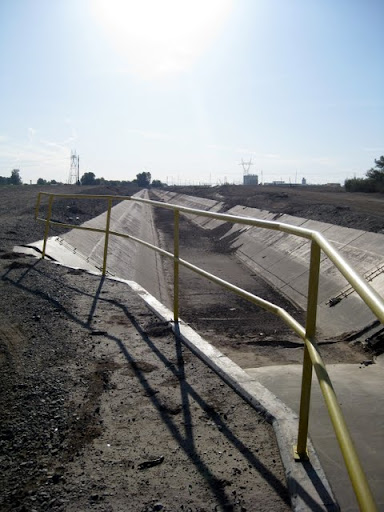
YDP outlet canal

YDP outlet canal

West of Yuma, in the crook of the bend where the Colorado River turns south into Mexico sits the Yuma Desalting Plant. Built in the 1980s, the plant’s purpose was to take high-salinity agricultural runoff, clean it up via a reverse osmosis process, and send it on down to Mexico to meet part of the U.S. water delivery obligation. But for a variety of reasons, it was never really used. An early ’90s flood on the Gila River damaged the intakes, but mainly it was never really needed. The 1990s were a time of plenty on the Colorado, and there was enough surplus sloshing around in the system that it didn’t make economic sense to run the plant.

That has changed. At the request of the three water giants – SNWA, MWD and CAP – the U.S. Bureau of Reclamation is preparing to start up the plant for a test run, to gather data on operating costs, the amount of water that can be produced, etc. Starting May 3, water will start running down the empty concrete drain above and into the Colorado. The water will be used to meet a small part of our delivery obligations to Mexico (something around 30,000 acre feet over the course of a year). The agencies that funded the work will get a credit, and a like amount of water will be stored upstream in Lake Mead with their name attached for their future use.

So here’s the data point. MWD is paying 80 percent of the cost. CAP and SNWA are each kicking in 10 percent. That willingness to pay on the part of MWD tells me something about who needs water the most in the near term.

Water in the desert, Las Vegas edition

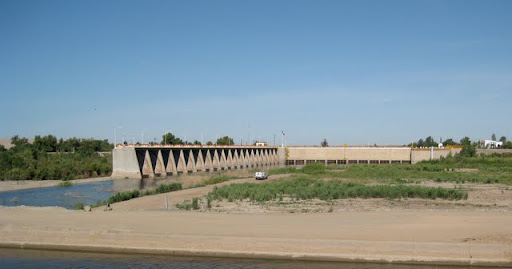
LAS VEGAS, NEV – The distance between Morelos Dam on the lower Colorado and the Bellagio Fountain is profound. Morelos spans the U.S.-Mexico border, with the wheat fields and onions of the Yuma County Water Users Association behind me as I took this picture and Algodones on the far bank. Most years, Morelos is where the Colorado River effectively finishes its now futile run to the sea.

Morelos Dam, April 2010

Morelos Dam, April 2010

You can see a Border Patrol truck in the foreground. They were very attentive to my presence as I drove the levee this morning between Yuma and San Luis, on the U.S. side of the border.

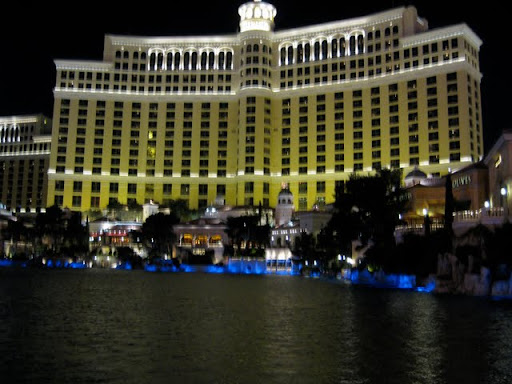
After some more stops to see the Lower Colorado’s plumbing (more pictures later), I made a beeline for Las Vegas. The contrast could not have been more stunning – up through the Sonoran and Mojave deserts, all mesquite and creosote, with occasional glimpses of the river strip in the distance, then through a ridge in the mountains, from quiet desert to this:

Bellagio Fountain

Bellagio Fountain

Apologies for the slightly blurry image, but I just have a little point-and-shoot. It was windy and they called off the show, so it’s really more the Bellagio pond. I’ll try to get back tomorrow. But I just had to go see it.

KGLP and the magic of radio

HOLBROOK, ARIZ – I grew up entranced by radio. There was something about the magic of the disembodied voice, always deep-throated, speaking to me from a world I could only imagine. It was Vin Scully calling a baseball game, or the mystery of hockey play by play (imagine a kid lying in the dark with his little radio who had never seen a hockey game in his life, trying to construct a reality of blue lines and iced pucks).

Courtesy Library of Congress

Courtesy Library of Congress

One of my favorite movies is Vanishing Point, a cheesy muscle car odyssey circa 1971 in which a cat called Kowalski blasts across the country in a white Dodge Challenger with the cops on his tail. The reason I love the film is Super Soul, the blind radio DJ played by Cleavon Little whose patter forms the film’s backdrop:

And there goes the Challenger, being chased by the blue, blue meanies on wheels. The vicious traffic squad cars are after our lone driver, the last American hero, the electric centaur, the, the demi-god, the super driver of the golden west!

When I grew up, I used to love road trips on long dark highways in the West, picking up the big 50,000 watt AM giants up and down the west coast, listening to late night talk radio. Art Bell. Wack job radio.

Now that I’m old and slow and tire more easily, the road trips rarely last past sunset. My days of 24-hour beelines from Seattle to California are long gone. But I got a late start this afternoon, and ended up passing through Gallup around sunset, where I picked up a local disc jockey doing some fabulous soul and funk, real DJ music love stuff, and I was Kowalski there in my Honda Civic for 50 miles or so before KGLP faded into the desert.

So I switched over to AM and started hitting the scan button, and I found a station playing honest to God old Art Bell episodes from the ’90s, UFO sighting and abduction tales, vintage stuff, the magic of late night AM radio.

The Implications of Uncertainty in Administering Upper Basin Shortage

When I first started to seriously cover Colorado River water, I kept going around to smart water people asking the same question: when we finally hit the wall, and there is less water in the Upper Colorado River Basin than needed to meet the states’ needs – a “call”, in the legal lingo – how will the shortage determinations be made?

I’m a bit slow on the uptake, and it took a while for it to sink in that no one really knows. (It’s often questions I assume have obvious answers, but which don’t, that prove the most journalistically fruitful.)

Jennifer Pitt of the Environmental Defense Fund, in her testimony last week at the House Natural Resources Water and Power Subcommittee hearing in Las Vegas, made an important point about the implication of that legal uncertainty:

At present, without well-articulated agreements for how a “call” on the 1922 Compact would be administered among states of the Upper Basin, there appears to be a race among the states to develop the next big use of water, because for water users who don’t get their straw into the system first, their risk of curtailment increases. This ‘race to develop’ increases risk for many water users in the basin. It would be better to slow down on new developments and first work out interstate agreements on what happens in the event of a call on the Compact.

Climate Legislation as Partisan Battleground

There was nothing geographically special about the farmlands surrounding the little Pennsylvania town of Gettysburg. It was an accident of history that Gettysburg was the place where Union and Confederate armies met in the summer of 1863.

The metaphor isn’t perfect, but the epic political struggle over health care is similar. If it wasn’t health care, the partisan warriors would have found another field on which to have their battle.

Well, the warriors are not done, and John Kemp has a nice piece of analysis suggesting the dangers of energy and climate legislation becoming the next field of action. California and other Western Climate Initiative states are seeing the first skirmishes:

In California, Meg Whitman, the Republican Party’s likely candidate for governor in this year’s election has indicated she would delay implementation of the state’s own trading scheme for at least a year to study its likely economic impact. Whitman currently has a narrow poll lead over likely Democratic rival Jerry Brown.

Now the New York Times reports independent oil refiners Valero Energy Corp and Tesoro Corp are backing a petition drive organised by the California Jobs Initiative (CJI), which is trying to collect enough signatures to put an initiative on the ballot in November suspending the state’s climate change law.

Delving into the roots of the California opposition, Kemp argues that climate legislation is rapidly being reframed into the larger anti-government narrative that threatened to overwhelm the details of health care reform efforts:

Cap-and-trade was originally framed as market-based and business-friendly. The contrast with traditional command-and-control approaches was its main attraction. But it is rapidly being reframed by opponents as another example of big government intrusion into the economy.

The more it becomes embroiled in a wider debate over big government and regulation the more difficult it will be to achieve action at any level in the United States — especially in the current climate, where anti-incumbent sentiment is running high and the Democratic Party looks likely to lose ground in both chambers of Congress as well as in state houses across the country in the forthcoming election cycle.

Water, Energy and Economic Development

Intriguing comments by Brian Brady, general manager of the Imperial Irrigation District, during a hearing last week before the House Water and Power subcommittee held in Las Vegas:

Rural areas like ours have their own plans for the future growth and development of their respective regions. Transfer too much water and you destroy your ability to grow the local economy. In Imperial County, renewable energy holds great promise for economic expansion. The county is already the second leading generator of geothermal energy in the nation and is poised to double that generation in the next five years. Having a firm supply of industrial water for these and other renewable energy projects was the impetus for IID to adopt an interim industrial water supply policy that dedicates 25,000 acre-feet for this purpose over the next decade.

25,000 acre feet is not a lot of water, pretty much a rounding error in the IID’s estimated 2.8 million acre feet of use this year. But it’s a reminder that the growing demand on the Lower Colorado has to include energy production, along with the more traditional ag and city use.

Stuff I Wrote Elsewhere: China’s Approach to Green

From this morning’s newspaper, a look at China’s race to capture the global renewable energy market (sub/ad req):

If you want to see how green is done these days, China is where the action is.

With a voracious appetite for fuels to power its rapidly growing economy, China’s energy sector is booming, and nowhere is that more evident than the Asian giant’s pursuit of green energy.

But this is about more than just meeting China’s internal needs, according to Sen. Jeff Bingaman, D-N.M. China sees green energy — wind, solar and the like — as the global growth industry of the 21st century. And it aims to dominate this new global market.

“The Chinese government has determined that this is an area of substantial opportunity for them,” said Bingaman, chairman of the Senate Energy Committee, in an interview last week after returning from a week-long fact-finding trip to learn more about what the Chinese are up to.

If the United States does not respond, we risk losing out on a major global economic growth opportunity, Bingaman said.

Mead: 1082.96 feet

The Bureau of Reclamation Colorado River operations 24-month study (pdf) is out this afternoon, formally confirming what has been clear for some time: that this year’s release from Lake Powell will be 8.23 million acre feet, the minimum under current operating rules.

Based on the current modeling (see page 11 of the pdf), this means that, by the end of September, the reservoir surface will drop to 1,082.96 feet above sea level. If the models hold, this means that, for the first time in history, Mead’s levels will be below the levels of the drought of the 1950s (specifically March 1956, when it dropped to 1,083.57 feet).

That would be the lowest Mead has been since May, 1937, when the reservoir was first being filled.

(Sorry, I know this is my obsession, and may be boring you, but I think it’s historic. Plus, Yulsman is egging me on.)