
I am happy to report that a paper I helped write, The Myth of the 1970s Global Cooling Scientific Consensus, has been included in McGraw Hill Annual Editions Environment 10/11, a collection used as an undergraduate environmental and earth science reader. (Full disclosure: the series editor, Zach Sharp, is a friend.)
Zigs and Zags on the Path to Lower Carbon Energy
A lot of the discussion about the new “Bloom Energy Server,” which is having its 15 minutes of fame, is of the binary “is it or isn’t it” flavor. David Douglas has a more nuanced view of the way in which what happened here is an example of the sort of path forward me might see in the development of new energy technology:
It starts with the US government (as many interesting technologies do), who needed a better way to create oxygen on NASA missions. While this fuel-cell design didn’t meet those needs, K.R. Sridhar, now CEO of Bloom, realized that the fuel cell could also use oxygen as a source and be a potentially interesting source of electricity. Enter Kleiner-Perkins and the venture capital community to fund the effort, followed by key silicon valley innovators looking to try something new to lower their power bills and green their energy supply. Finally, the federal government, accompanied by the State of California, returns to the picture with incentives that help make the technology cost competitive during the early phase as it ramps up.
Douglas also makes the important point that we shouldn’t get too hung up on failures as we head this direction:
Its also important to recognize that, despite its Hollywood feel, this story wasn’t pre-scripted. Things fell into place as the story unfolded, and at each stage there could have been unforeseen roadblocks that stopped the story before the happy ending. In other words, we’ll have to be willing to let lots of these stories play out, understanding that not all will end happily. This is especially important for the federal government’s role, which needs to be repeated in some form in every one of these stories.
Stuff I Wrote Elsewhere: ABQ Water Consumption Declining
Albuquerque’s per capita water consumption continues to drop (sub/ad req):
Albuquerque Bernalillo County Water Utility Authority customers used an average of 159 gallons per capita per day in 2009, down from 252 gallons in 1994, when the community’s water conservation efforts began, according to Katherine Yuhas, head of the utility’s water conservation program.
Yuhas and Albuquerque’s conservation efforts are featured in the April issue of National Geographic as an example of a successful program to reduce water consumption.
For the National Geographic article featuring Yuhas, start here.
Confusing metaphorical warfare with policy substance
Matthew Nisbet, in Slate today, gives thoughtful voice to my growing frustration with the way my friends in the science community have been approaching the climate politics and policy discussion of late:
The problems begin when scientists overestimate the influence of climate skeptics and their corporate backers. When legislation and international treaties fail, and polls show a decrease in public concern about the environment, the “climate deniers” take the blame. Yet the efforts of James Inhofe, Glenn Beck, et al. represent just a few of several factors shaping public doubt and policy inaction. More important, perhaps, are the poor state of the economy, competition for political attention from the heath care debate, and confusion over colder weather. We’re also faced with a widespread distrust of government that makes explaining complex cap-and-trade proposals that much more difficult. And it doesn’t help that long-standing rules in Congress allow individual members to block substantive legislation.
Given these factors, it’s not surprising that communication researchers, including me, have their doubts about the relative impact of Climategate on public opinion.
My frustration is that some of the smartest and most talented people in this discussion seem obsessed with the warfare right now, with smacking down every thing said on the Internet that they view as wrong, as if a) they could somehow succeed in ending bunk, and b) if all bunk ended, then their preferred political/policy solutions would follow.
I think both “a” and “b” are wrong. Bunk is Darwinian, and will always be there as long as the potential solutions to a given problem conflict with the values and interests of some part of the body politic. And even if bunk was somehow banished, the underlying values that spawn its existence (see “the Darwinian nature of bunk“) would still play a central role in the pursuit of political/policy solutions.
Concerns About New Colorado River Study
From today’s newspaper, my story (sub/ad req) about a Senate hearing earlier this week that touched on a study of water supply and demand now getting underway in the Colorado River Basin.
The story’s brief, but the hearing raised what I think is a very interesting question:
While individual states have looked at their own water supply and demand situation, the basin lacks a comprehensive study of the overall water picture, said John Entsminger of the Southern Nevada Water Authority, the agency that provides Las Vegas with its water.
The study, which is just getting under way and is expected to take two years to complete, drew some criticism. Groups concerned about the need to leave water in rivers for ecosystem preservation have been largely left out of the discussions about the study, said Melinda Kassen of the environmental and sport fishing advocacy group Trout Unlimited.
Expect to hear more about the extent to which environmental flows get a seat at the table as the study is being done. (More on the details of the study via USBR.)
San Joaquin River Flowing
It is a testament to the nature of rivers in the arid western United States that this is news:
The San Joaquin River is flowing from Friant Dam near Fresno to the Delta….
That’s Alex Breitler writing today in the Stockton Record. If you follow the link, he gives a pretty good accounting of why this is a big deal, but I found an even better one in a delightful exchange on Wikipedia’s San Joaquin River talk page. First, here’s how the Wiki article describes the geography:
The river flows west to the Central Valley, where it is joined by the Sierra’s other great rivers and then at Mendota Pool flows north to the Sacramento-San Joaquin Delta and then San Francisco Bay.
Parried nicely on the the talk page:
That vague and confusing section gives a false impression. In fact, except in rare flood years, there is no hydraulic continuity or “flow” to the delta or ocean. This is due to water diversions. Long stretches of the river are dry. Due to court battles, and related, some may wish to paint a pretty ecological picture not there.
Per Breitler’s article, for a shining moment, the original Wiki article is sorta right. But the talk page is clearly on to something more fundamental.
Juncos: On the Importance of Absence

courtesy Noel Zia Lee
In my second spring of actually writing down the birds I see, I’ve encountered a hole in my data. Dark-eyed juncos have been a steady and heavy presence all winter, first showing up in mid-October. But I was a slacker last March, so I don’t have data on when they leave. Through the winter, I typically have had at least five in the yard every morning. Yesterday, there were only two, today I’ve only spotted one.
Another sign of spring.
On the Darwinian Nature of Bunk
The existence of bunk when science lumbers into the political sphere with what to some are uncomfortable observations seems to be a remarkably resilient feature of our landscape. I learned this more than a decade ago when I spent a good deal of time reading the work of quasi-scientific young-earth creationists.
The arguments raised by Dan Sarewitz in his recent Slate piece offer a hypothesis for why this might be. When mainstream science conflicts with values, people hunt for outlier science that doesn’t create so much cognitive dissonance. In any sufficiently interesting science, there will always be genuine research lying some distance from the mainstream to choose from, which will end up being of relevance to the policy debate as people with different values choose points on the scientific spectrum that tend to support their value position. That’s the point of Sarewitz’s Yucca Mountain example:
For example, varying estimates of the amount of ground water flowing through the rocks at the site were central both to claims that Yucca Mountain was safe and that it should be abandoned.
But genuine bunk also will emerge for Darwinian reasons. For people whose values are in genuine conflict with the implications of the science, it meets a need. If this observation is correct, then the enormous effort by a committed and energetic segment of the pro-science community to stamp out bunk is doomed to failure.
Drought, Dams and Border Tension
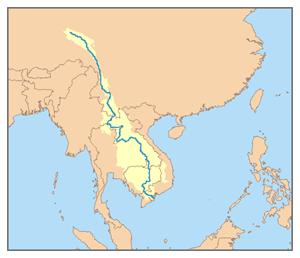
As drought grips the Lancang-Mekong basin in Asia, tensions are growing over China’s dam, according to Richard Stone, writing in Friday’s Science (sub req):
courtesy Wikipedia
The drought’s effects have spilled across China’s borders, stoking tensions with neighbors and prompting scientific debate. Rice yields in Thailand are expected to take a big hit, and the Mekong River—the name for the Lancang south of China—is in many stretches less than a meter deep, its lowest level in decades, making it impassable to tour boats and cargo ships. Researchers worry about how the low water level may affect fisheries and critically endangered species such as the Mekong giant catfish, which in the coming weeks would normally spawn in the upper Mekong.
Environmental groups in Thailand and elsewhere lay at least part of the blame on China’s doorstep. They claim that China’s management of a series of dams on the Lancang has aggravated the unfolding crisis. The Thai media has helped stir up emotions; one editorial in the Bangkok Post last month was headlined “China’s dams killing Mekong.”
This is not the only such case. Stone notes that China shares 110 rivers with 19 neighboring countries.
On Moving Water and Spreading Risk

John F. Kennedy dedicating the Fryingpan-Arkansas Project, 1962. Courtesy National Archives
In theory, one of the benefits of interbasin water transfers is spreading risk. One basin may have drought while the other does not. But for folks on the Arkansas River in Colorado, that may not work out so well, based on new tree ring analysis by Jeff Lukas and colleagues. Chris Woodka of the Pueblo Chieftain explains:
“It has always been thought that if you are bringing in water from both sides of the Continental Divide, you have protection. That is not the case,” said Jeff Lukas, of Western Water. “While they vary from year to year, the dry years and wet years in both basins show a strong correlation.”
The Fryingpan-Arkansas Project delivers 63,000 acre feet per year from the Colorado River Basin through nearly 30 miles of tunnels to the Arkansas River Basin on the east slope of the Rockies. It’s one of the smaller water projects on the Colorado. To get a sense of scale, the Metropolitan Water District of southern California moves about 20 times as much water annual through its Colorado River Aqueduct, which is one of the largest interbasin transfers on the river.
In addition to supplying water for irrigation and municipal use, “Fry-Ark,” as they call it, also has one of the coolest names of any water project in the West.