
A Clarification on the Mead-Powell Data

A lack of precision in the way I worded a post last week on reservoir levels in Lake Powell and Lake Mead seems to have led to some confusion.

I was writing about the rising levels in Lake Powell as Lake Mead was dropping, and suggested this was the result of a management decision rather than natural forces. But I did not mean to imply, as David argues, that this is the result of the two reservoirs being managed by two different Bureau of Reclamation offices.

Under the Colorado River Basin Project Act of 1968, the Secretary of the Interior is given the responsibility for joint management of the two reservoirs in a coordinated fashion. Operating rules have been developed for the joint operation of the two reservoirs, most recently codified in the Record of Decision for the 2007 shortage sharing agreement. That document sets the triggers for how much water is kept in Powell, and how much released to Mead. It’s operation under those rules, which Pat Mulroy and the other lower basin stakeholders helped develop, that has led to the see-saw of rising Powell and dropping Mead.

The disconnect is not in the river’s management, but in the resulting political conversation. In thinking about the river as a whole, it is most useful to think about the total amount water stored in both reservoirs. But in building a sense of urgency in Las Vegas, it is in Pat Mulroy’s interest that her community focus on Mead’s dropping levels.
Desal Tough Nut to Crack

Here in the Albuquerque metro area, there’s been a great deal of discussion about desalination of waster from deep brackish aquifers to provide new sources of supply. A lot of talk. But not much action, other than an interesting pilot-scale project now underway west of the community of Rio Rancho. The area is growing rapidly, but as the state’s newest city, it is last in line in terms of water rights. So the area’s county government, with financial support from developers, has drilled a well and is trying to develop the technology to make a go of it. But as my colleague Rosalie Rayburn reports (sub/ad req), the folks working on the project are trying to cope with some really tough problems:

Sandoval County officials are bullish on a brackish aquifer west of Rio Rancho.

They believe tests on desalination technology will show that the aquifer could be a catalyst for urban and rural economic development.

But they face big challenges.

The water has high levels of dissolved salts and minerals. Desalination to render it potable is an energy-intensive and costly process. Disposing of the waste byproducts is pricey, too.

While coastal desal is becoming increasingly important in the United States, the only other large inland desal plant (at least that I’m aware of) is in El Paso. Some of the same folks who did the El Paso plant are working with our project, and they note that the concentration of contaminants here is far higher:

CDM has engineering experience at a desalination plant in El Paso which can process 27 million gallons of water daily. But the Rio Puerco water has higher levels of salts and contains high levels of arsenic and radio-nucleides.

“I think it’s fair to say that the waste product at El Paso, the brine, is probably slightly higher quality than the water we’re starting with here,” CDM senior vice president Paul Gorder said.

On Groundwater, Look to Kansas?

Wayne Bossert is amused at the wailing emanating from California about the notion that someone should start keeping track of the water they pump from the ground:

For the Californians in the audience, I’d like to offer that Kansas has been monitoring water use since the mid 1970s, took significant strides to improve that monitoring in the late 1980s, and began metering all non-domestic wells in selected areas in the late 1990s.  Today, Kansas has some of the best (most complete and accurate) water use reporting – especially for irrigation and municipal water use – in the country.

A Very Dry Decade on the Colorado

With the 2009 “water year” just completed, it’s time to take stock. The decade just completed, 2000-2009, is the driest 10-year period in the Colorado River Basin in the record, according to preliminary data in the latest draft of the Bureau of Reclamation’s Colorado River Annual Operating Plan, a compendium of past data on the river and plans for the coming year:

Provisional calculations of natural flow for the Colorado River at Lees Ferry, Arizona, show that the average natural flow since calendar year 2000 (2000-2009, inclusive) is 11.933 maf (14,719 mcm), the lowest ten-year average in over 100 years of record keeping on the Colorado River.

Recall that the Colorado River Compact assumes 16.5 million acre feet (maf) average flow on the river, divided 7.5 maf for the upper basin states, 7.5 maf for the lower basin states, plus 1.5 maf for Mexico. For the last decade, the river has averaged just 72.3 percent of that amount.

Hume: Fleck is Right

I have to commend Bill Hume for his op-ed in yesterday’s Albuquerque Journal. (Really, I do have to. He agrees with me!)

Clearly, municipal and state growth planning that includes a hard-nosed recognition of water realities is the only strategy for confronting the offset water tap-out. And, new sources of water or new technologies for stretching the use and reuse of existing supplies are mandatory. The introduction of San Juan-Chama project water is one such new source, but it cannot be easily expanded.

The Water Assembly’s concerns about the sustainability of current water consumption in the Middle Rio Grande are totally valid.

But he’s taking the argument farther than I have in the work I’ve written to date on this. Given the lag between past pumping and future surface water depletions, what happens here in New Mexico when there’s a collision between those ongoing depletions and the surface water rights available to retire via whatever mechanism we’ve got available at that point?

Groundwater Tiff Stalls California Water Deal

Fascinating Greenwire story in today’s New York Times on a provision for statewide groundwater monitoring potentially sinking California’s massive water legislation deal:

Then groundwater monitoring reappeared and slowed momentum in the chamber. A bill that would require statewide monitoring of water pumped from the ground — as opposed to more relaxed local control — was defeated under pressure from agribusiness groups and water districts, just as it was rejected earlier this fall.

California faces the same huge problem that we have in large areas of the country: overdrafting groundwater. But this story makes it look like the complex water deal taking shape in California depends for its solution on continuing to ignore the groundwater problem there. (h/t Michael Campana)

Storage In Mead and Powell

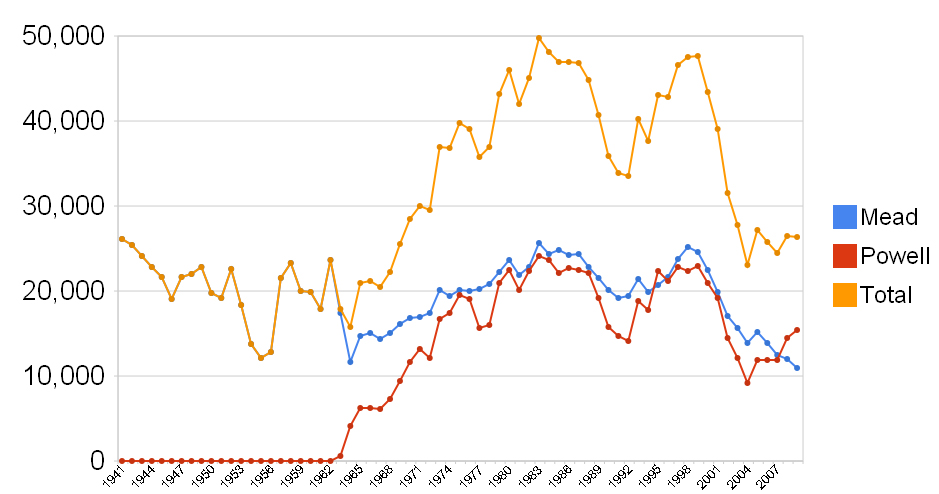
Total storage in Lake Mead at the end of September (the end of the western “water year”) was lower than it’s been since they first filled it in the 1940s. But this is a bit more complicated than that stark statement might appear.

Storage in Lakes Mead and Powell

Storage in Lakes Mead and Powell

If you click through to look at a larger version of the graph (numbers on the Y axis are thousands of acre feet of water), you’ll see that total storage in lakes Powell and Mead, the two huge rivers on the main stem of the Colorado River is pretty much the same this year as it was last year. Mead has been dropping while upstream, Lake Powell has been filling. In other words, what we’re seeing here on the short time scale of a single year is the result of a management decision, not a change in the overall supply of water available. It’s worth noting that the last time we saw something similar – Powell rising while Mead fell – was in 1964, after the completion of Glen Canyon Dam, when water was being held back to fill Powell for the first time.

I made the graph over the weekend from a couple of U.S. Bureau of Reclamation datasets because I’ve been having a hard time visualizing how the whole system works. Because of the legal and political distinctions between the Upper Basin and Lower Basin water management systems, much of the discussion involves separate conversations about one of the lakes or the other, not both taken together. And FYI, this is just a quickie analysis, I haven’t done any quality control on the data, so this is not publication quality information.

Oh wait. I guess I just published it, didn’t I?

Stuff I Wrote Elsewhere: The Wonder of it All

The Albuquerque Journal is engaged in a strange new experiment in running a front page column every day. There is a stable of three regulars, writers who are solely columnists, and a couple of us who are otherwise straight reporters share the remaining slots.

This is the most interesting journalism I’m doing right now, but it’s a weird experience. The normal trajectory of a story involves news happening – an event, an issue, an idea – that provides a news peg, and I figure out how to “storyize” it, then I write it and go into newsroom marketing mode. The columns are different. I’m handed a 600 to 800 word slot on the front page once every few weeks to do what I want with.

It’s a joy.

Today’s was a science riff, about observations done by the Very Large Array (and many other telescopes) about the most distant object ever seen. An ordinary story would peg this off of the news here: an exploding star, the epoch of reionization, understanding the early universe, etc. But the really cool thing here is how incredibly cool it is that humans can look back that far in time. The column format gives me the elbow room to play with that theme:

No human has ever seen an object as distant as the tiny dot of light that showed up in telescopes April 23.

“Thrilled” is how Socorro astronomer Dale Frail described his emotions the day the Very Large Array radio telescope first spotted the dot.

The image had been traveling 13 billion years to get here. Which means that, for Frail, the VLA is a sort of time machine, conveying the great privilege of allowing him to look back to the very dawn of time.

Frail’s a lucky man, and he knows it.

On How to Have a Useful Conversation

I’ve not been posting on climate change much here at Inkstain recently for a couple of reasons. Most importantly, I’m trying to marshal all of my spare time (and Inkstain is a spare time gig) to think about western water.

Second, the whole climate blogothing has seemed to be increasingly less than helpful, where all the people playing have already made up their minds, and spend all their time trying to win the argument they’re having with all of the other people who have also made up their minds, and it’s all a colossal waste of time.

(a bunch of climate blogo insider stuff to follow – click through if you’re one of the five readers who cares)

Continue reading ‘On How to Have a Useful Conversation’ »