Could Global Warming Be Good for Colorado River Flows?

Pasadena, CA, blogger Wayne Lusvardi, who sometimes writes about that city’s water problems, had a post recently suggesting that global warming might lead to increased flows in the Colorado River.

This would, of course, be excellent news for Pasadena and others who use Colorado River water (thought it does conflict with some of the literature – see for example here, here, here, here, here, here, here, here, here, here, here, here and here). So it’s worth looking at how Wayne arrived at his conclusion.

As it happens, he’s using some data I assembled recently from the U.S. Bureau of Reclamation on storage in Lake Powell and Lake Mead, the two big main stem reservoirs on the Colorado River. Comparing my graph to a graph of global temperatures since 1995, Wayne said… Well, I’ll let him explain:

There appears to be a rough correlation between global warming and more water storage along the Colorado River.

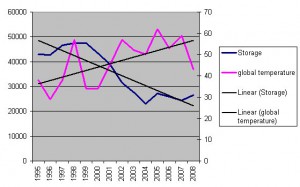
Wayne did this by eyeballing my graph and a 1995-present global temperature graph. I’m not sure where he got the temperature data, but since I’ve got the data for the first graph, and NASA’s GISS data is easily available, I took the step of overlaying global temperature and Colorado River storage on the same graph, just to make the eyeballing easier. As a bonus, I added linear trend lines to make it easier to see the painfully obvious.

The temperature data is the anomaly from the 1951-80 base period. The storage number is total acre feet of water in Lakes Mead and Powell combined. Now, I would not begin to argue this is a reasonable way of evaluating the question. Total storage depends on both annual inflow as well as consumptive use in the seven basin states. In addition, each year’s storage data is significantly dependent on the amount of storage in the system the previous year.
Wayne's World

But let’s just take Wayne’s methodology on its face and see if there’s anything to the argument he is making anyway. Hmmm. Looks like the data seem to be doing rather the opposite of what Wayne seems to be suggesting. As temperature rose, storage went down. A little mathemagic shows, in fact, that the correlation is negative. This should be obvious. Temperature has been going up. Colorado River storage has been going down. It’s in no way statistically significant, but if you want to make the argument Wayne offers up, it’s worth noting that such an argument comes to the opposite conclusion. Gotta follow the data where they lead, Wayne!

But perhaps I’m not being fair. As Wayne said, “The charts … are only suggestive and should not be construed as valid science.” Thank goodness for that.

Poem of Protest

This picture of student protests at UCLA, which came across the twitter today, reminded me of one of my all time favorite bits of graffiti:

It must have been 1975 or ’76, and I was at UCLA with my dad to see art. In the parking garage elevator was this poem, written in black felt pen:

smoke dope

fuck in the streets

smash anything

that looks elite

Peak Frozen Waffle?

Is this how it begins?

Kelloggs said today production problems have led to a shortage of its popular Eggo frozen waffle products.

Eggo

Eggo

They say they will be able to restore full waffle production by the middle of next year. Of course that’s what they’re going to say – that it’s all OK, that this is just a short term hiccup in the supply of this vital global resource, and that a booming supply will return, and our lives can return to normal.

But will they? Or is this the beginning of the end of the era of cheap frozen waffles?

Arizona Returns to the Desert

This weekend, I ran across a terrific piece Matt Jenkins wrote for High Country News back in 2005 about Phoenix’s water problems. It holds up well: much of the core issues he’s describing are still problems, especially the quirky loopholes in the water laws that were intended to ensure groundwater sustainability. But there’s a new variable in the equation that Jenkins could not have possibly foreseen:

That’s monthly housing starts in the greater Phoenix area. The water shortage we’ve all been expecting to serve as the southwest’s come-to-Jesus moment isn’t responsible for the shape of that curve. It’s the collapse of the housing market Ponzi scheme.

Just for grins, here’s Las Vegas:

(data courtesy St. Louis Fed)

Upgrading Hoover Dam

Henry Brean observes that Hoover Dam’s ability to generate electricity is down 20 percent with low lake levels, a reminder of the tight integration of water and power questions along the Colorado River. The history of the big dams on the Colorado River, and the question of who gets their water, is inextricably linked with questions of who gets the power.

Hoover Dam

Hoover Dam

In a sort of a policy-based perpetual motion machine, a lot of the power generated by the dams’ big hydro plants is used to pump water uphill to farms and cities – down through the dam, then up again through big pumping plants to Phoenix and LA. Only, like most perpetual motion machines, the durn thing didn’t really work when they were building the last link in this chain, the Central Arizona Project. So they built a big coal plant instead which, as Shaun McKinnon recently reported, has turned out to be somewhat problematic.

Anyway, back to Brean, who notes that technology will save us, at least a little bit, with upgrades underway at Hoover Dam aimed at generating more electricity (which we seem to need) with less water (which seems to be what reality dictates in the long run):

The dam’s power customers plan to spend millions of dollars in the coming years to squeeze more electricity from the same amount of water and compensate for a loss of power capacity as a result of the shrinking lake.

The surface of the reservoir dropped 120 feet in the last decade, as the Colorado River came under the grip of the worst drought on record. The resulting loss of water pressure — known as power head — has reduced the dam’s power generating capacity by 20 percent.

The dam and its power customers can’t do anything about the lake level so they are trying to squeeze as much power as possible out of the water pressure they do have.

It’s About the Evaporation

Daniel Collins (via haiku!) notes the important point that water folks are increasingly raising about climate change: it’s not just whether rainfall goes up or down. Increased evaporation and transpiration as the climate warms is the critical water supply variable. From Cai and others in GRL – since 1950, nearly half the reduction in soil moisture in Australia’s Murray Darling Basin can be attributed to increased temperatures:

A relationship exists between soil moisture and temperature independent of rainfall, particularly in austral spring and summer. Annually, a rise of 1°C leads to a 9% reduction in soil moisture over the southern MDB, contributing to the recent high sensitivity. Since 1950, the impact from rising temperature contributes to 45% of the total soil moisture reduction. In a warming climate, as the same process also leads to an inflow reduction, the reduced water availability can only be mitigated by increased rainfall. Other implications for future climate change are discussed.

In the long emergency, how far will we ship our lettuce?

A couple of months ago, Coco raised a great question when I was riffing about the amusing implications of shipping lettuce from the Imperial Valley to Albuquerque so I could feed it to ants:

Not enough water to grow lettuce in the Middle Rio Grande? Maybe someday. Depends.

Someday, not enough cheap oil for schlepping lettuce from the imperial Valley. That’s more certain.

lettuce

lettuce

So here’s my lazyweb question. What portion of the cost of a head of lettuce at the local UberMart can be attributed to the fuel needed to ship it from California to Albuquerque? And how sensitive, therefore, is the cost of that lettuce to, say, a doubling of the cost of that fuel?

(image courtesy U.S. Department of Energy)

The Book


The Book

Originally uploaded by heinemanfleck.

So here’s the book. Box arrived today.

I’d wrestled with its words and pictures separately, seen the proofs, but there’s something about holding it in my hands….

Available for pre-order on Amazon (click the link in the right-hand rail) if you’ve got middle-school aged kids in your orbit who you think might get excited by a book about some science that’s all around them.