
On Saving the Salton Sea

The Salton Sea is a fascinating case study in the cultural ambiguity of “nature”. Created in 1905 when the Colorado River found a hole in a poorly constructed irrigation intake and flooded low-lying California desert, the Sea has been sustained – sort of – by agricultural runoff. So it’s not at all “natural” by one clear meaning of the word. But it’s there, and its continued shrinkage as a result of evaporation poses huge problems, as detailed in a piece in today’s edition of the Desert Sun:

Sport fishing was first promoted at the Salton Sea in 1907, according to the authority. The sea became a playground for Hollywood stars and others who loved boating and fishing.

Tourism has declined with fish die-offs and the smell created by occasional emissions of hydrogen sulfide. But the area still gets about 150,000 visitors a year.

“It could be such an economic boon,” Larson said.

While the recreational possibilities and visions of shoreline development are intriguing, the biggest reason to be concerned about the Salton Sea is the growing threat to air quality in the Imperial and Coachella valleys.

As the sea level declines and the shoreline recedes, more areas of dry lake bed, or playa, are exposed. The playa is covered with fine sediments deposited at the bottom of the lake. When the winds kick up, particulate matter goes airborne.
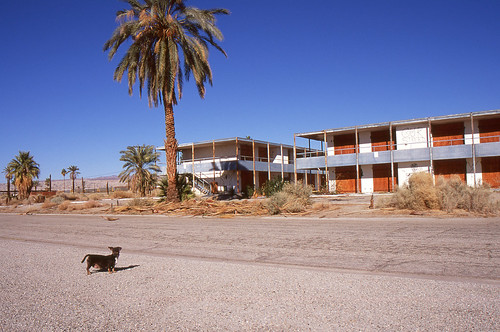
The estimated price tag to fix all of this, via a grandiose scheme of hydraulic engineering, is $9 billion, a number so large that it’s almost not worth a serious conversation. If you listen to the rhetoric of the community supporting action, clearly part of the argument is an unwillingness to abandon this crazy notion that we’d have a Riviera in the desert there, if only….

But given the unreality of state or federal spending that large, what should or can be done?

(photo courtesy Omar Omar, licensed under Creative Commons)
Stuff I Wrote Elsewhere: Seismic Risk at Los Alamos

From the morning paper (sub/ad req.):

Los Alamos National Laboratory could expose its workers and neighbors to a massive and potentially deadly radiation leak in a major earthquake, independent federal safety auditors concluded in a report released Tuesday.

Such earthquakes are rare — one every few thousand years in the Los Alamos area, according to a lab seismic study. But the consequences could be catastrophic, according to the Defense Nuclear Facilities Safety Board.

The safety board’s report calls on the National Nuclear Security Administration, which owns and oversees Los Alamos, to take immediate steps to reduce the risk of an accident.

Water News

Some accumulated links to recent water news:

Stuff I Wrote Elsewhere III: ABQ Water

Also from this morning’s paper, a brief report (business model, ad/sub yada) on yesterday’s Middle Rio Grande Water Assembly meeting. I tried to balance the progress made on water conservation with the grim message I’ve been pushing in my recent work on this regarding the supply-demand deficit in New Mexico’s heavily populated middle valley:

Water users along the Middle Rio Grande have made major strides in responding to our water deficit, experts said during a meeting Saturday in Albuquerque. But there is much more to be done if we are to avoid long-term problems because of our continued unsustainable water use, they said.

“We need to do more,” said Steve Hansen, a staff member of the U.S. Bureau of Reclamation and one of the founders of the Middle Rio Grande Water Assembly.

I’m curious whether y’all think “sustainable” is a good word here. Its plain English meaning is relatively straighforward, and it clearly applies here: the numbers show that we’re using more water each year than nature supplies, depleting ancient reserves in the process. But has “sustainable” acquired fuzzy baggage, a political context that has moved its connotations beyond its plain English meaning in a way that weakens its ability to make a straightforward point?

Stuff I Wrote Elsewhere II: Birds, warming and the desert

More blathering from the morning paper, this the tale of the fascinating work of Blair Wolf (sub/ad yada yada) a University of New Mexico biologist who studies the water consumption of desert birds:

The smaller a desert creature, the more water loss matters, and little birds like verdin are especially vulnerable, Wolf said. Sometimes, that teaspoon is not enough. On the hottest days, small desert birds can lose 5 percent of their body weight an hour to evaporation in a desperate struggle to cool off. If they cannot keep up, they die.

That rarely happens, but new research by Wolf, a University of New Mexico biology professor, suggests heat waves because of global warming will make survival far more difficult for desert birds.

This is in part a global warming story, because that was the narrow point of the paper at hand. But mostly, it was a chance to riff on Dr. Wolf’s work on how creatures survive in extreme desert environments. In particular, I found some fun parallels between the verdin Blair studies and the Bushmen of the Kalahari, which I happened to be simultaneously reading about in James Workman’s excellent Heart of Dryness. From the story:

The verdin, a bird that typically weighs less than a third of an ounce, for example, hunts insects in the cool of morning and evening, and sits still during the heat of the day, using shade whenever it can.

The technique is not that different from the approach used by people who live in the same environment, noted James Workman, an author and expert on desert water use by human societies.

For on-the-go 21st century Westerners, the techniques described in Workman’s book “The Heart of Dryness,” about the bushmen of the Kalahari desert in Africa, might seem odd.

“If you’re not in motion,” Workman said of the Western approach to living, “you’re wasting your time.”

But like Wolf’s desert birds, Workman notes, the bushmen have become extraordinarily adept at sitting still during the heat of the day and doing absolutely nothing.

They keep their mouths closed to avoid evaporation in their breath. Their only movement, Workman said in an interview, comes as they shift with the angle of the sun to stay in whatever bit of shade is available.

I’ll be doing a more full review of Workman’s book at some point soon (both here and in the newspaper). It’s a great read if you’re interested in water.

Stuff I Wrote Elsewhere I: Big Think Nukes

Lots of accumulated blathering from me in this morning’s newspaper. First up, a fun thumbsucker on the Obama administration’s rhetoric regarding zero nuclear weapons (sub/ad req.) and what it might mean in practice:

Supporters of a world without nuclear weapons, who include prominent hawks like former Secretary of State Henry Kissinger, argue the world would be a less dangerous place.

Critics of the idea say the horrific nature of nuclear weapons prevents conflict between nations that possess them. “The likelihood of war goes up, not down” in a world without nuclear weapons, Robinson argued in an interview.

Ag Water in the West

Shaun McKinnon has a must-read story for those interested in western water in today’s Arizona Republic about the discussion in his state about the future of agricultural and municipal water use:

As Phoenix grew, the land available for farms shrank and water use shifted. As recently as 1965, 80 percent of the water delivered by Salt River Project was used by agriculture. Today, that number is just 15 percent.

Converting retired agricultural water supplies to urban uses helped Phoenix grow without the water issues facing Las Vegas, where there were never many irrigated fields. The canals that move water – particularly the Central Arizona Project canal, which taps the Colorado River – could help fuel more population growth if farmers were to give up some of their water.

But if farmers go out of business, the crops they sold in Arizona would be imported from another state or country. As their water is claimed by new development, cities would lose the backup water source, which would become more important if droughts worsen as climate scientists predict.

I recommend reading the whole thing, which lays out the dilemma(s): To what extent do we need to keep growing food with that water? To what extent is ag the most economically beneficial use? What are the policy mechanisms that might be used to manage what ag-urban transfers we make?

And while Shaun’s story focuses on Arizona, the exact same situation holds across the border in California, where the Imperial Irrigation District is the largest single Colorado River water user. At yesterday’s meeting of the Middle Rio Grande Water Assembly here in Albuquerque, the ag-municipal question was on everyone’s mind.

Birding the LA River

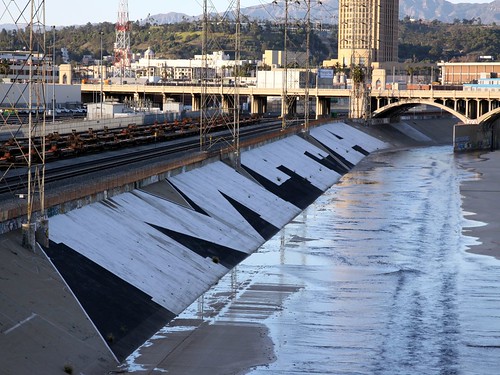
I used the Los Angeles River’s famed concrete as a bit of a stalking horse in a piece I wrote earlier this week. But Albuquerque birdwriter Judy Liddell points out that the concrete is not all there is to the old water course:

As it flows through central Los Angeles, it reverts to the concrete arroyo. However, as it approaches Long Beach, the river accumulates silt, allowing vegetation to grow in places. And by time it reaches Willow Street, the river becomes soft-bottomed, forming an estuary. At this location, the freshwater of the LA River begins to interact with the saltwater of the Pacific Ocean and is affected by tidal action. It also is a migratory stop-over and wintering grounds for a multitude of shorebirds, waders and waterfowl.

When I checked the Los Angeles Rare Bird Alert prior to my most recent visit, I kept noticing sightings at the Willow Street crossing, which I discovered was near my friend Carole’s new home in Long Beach. After our visit with Carole, my friend Sue and I spent two hours enjoying this gem of a location.

LA River

LA River

For me, Repo Man is what first comes to mind when I think of the LA River. Judy’s piece suggests another image as well.

(Picture CC, courtesy jondoeforty1)

$1,000 an acre foot

I’m always intrigued at the chance to see the price of a water transaction in the West. Usually it’s hidden, but a transaction being discussed among some Colorado River Communities offers this glimpse. From Jim Seckler’s story in the Mohave Daily News:

George said the plan would be for the MCWA to keep 500-acre feet of water for industrial use and sell 1,000 acre feet to Bullhead City, Lake Havasu City and the MVIDD, who would each pay $1,000 per acre feet or $1 million for the water.

Limbaugh, Revkin and the Blues

I wasn’t sure what additionally needed to be said about Rush Limbaugh’s shameful attack on Andy Revkin the other day, in which he suggested the New York Times reporter might help the planet by committing suicide. (Charlie Petit has a nice rundown on the various things being said about it.)

But I thought the issue noteworthy as an example of he poisonous atmosphere surrounding the media-politics-policy-science interface on the issues Andy covers. So I downloaded David Folkenflik’s excellent NPR piece onto my laptop yesterday to play for a UNM class I was speaking to.

I noticed this morning on the laptop that iTunes had categorized David’s piece as belonging to the musical genre “Blues”. That seems somehow appropriate.