Water in the Desert: West of the Pecos

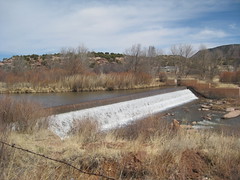
Dam on the Pecos

Dam on the Pecos

L and I took a drive out on the eastern side of New Mexico’s central mountains today, up the Pecos River through the little villages of Villanueva and Ribera. You can think of the Pecos as a dividing line between the country’s great flat middle and the broken geology of the southwest. The phrase “west of the Pecos” serves as a catchy TV Western shorthand for a reason.

But in terms of the Pecos itself there is also an interesting north-south dividing line between the northern farming villages like Villanueva and the big, muscular farming of the Carlsbad Irrigation District down south. CID has all the hallmarks of early 20th century concrete water management, a product first of failed entrepreneurship and then federal intervention. It serves something on the order of 25,000 acres. Hemmed in by steep slopes as the Pecos cuts its way through the mesas of northern New Mexico, Villanueva does not sprawl. It has all the hallmarks of an earlier era, when farming was done on tight little plots immediately adjacent to western streams, in the flood plain, with all the risk and reward that entails. You can see the traces of family inheritance on the land today – long narrow strips of land, each touching a ditch at one end and the river at the other, the resdult of family subdivision over time.

In the spirit of Daniel Collins’ entreaty to consider transboundary issues, there’s a story here worth fleshing out, but I don’t know enough yet to do it justice. The boundary here is primarily cultural, rather than jurisdictional. There is a tension in New Mexico between the new and old ways of using water. In the old Spanish villages of northern New Mexico, acequias are a community project, requiring community labor to keep them functioning. The water rights embodied in them are also an asset. Senior water rights are worth lots of money now in New Mexico, and selling them is a reasonable option for landowners. But if too many of an acequia’s members sell their rights – to a city hungry for the water rights to enable growh, or to a large-scale downstream farmer – the community irrigation system breaks down.

The dam in the photo above is a small concrete structure that serves as the diversion point to start water into acequias. It’s still early in the season, but the main ditches were running in a number of places as L and I wandered today. There was still ice in the shadows on the Gallinas Creek, above Las Vegas (the New Mexico LV, on the far southern tip of the Rockies), but the snow line is currently quite high, and folks in LV were complaining how dry it is. The March 1 forecast calls for runoff this year in the 70 to 80 percent range in the Gallinas (which serves Las Vegas) and the Pecos.

Transboundary Water Issues

Daniel Collins at Crikey Creek has a great suggestion for folks in the water blogging community:

In the spirit of World Water Day, and in an effort to contribute towards transboundary cooperation, I propose that all us waterbloggers (and other bloggers too!) dedicate one or more of our posts that day or beforehand specifically to transboundary water issues.

World Water Day is March 22, and in the spirit of Daniel’s suggestion, and time permitting, I’m going to try to devote a bit of time over the next couple of weeks to his suggestion. This is a useful exercise in part because here in New Mexico we face a number of important transboundary water challenges, some of which I’ve not thought about closely because of the somewhat arbitrary nature of our political boundaries and the water law that goes with them.

A list of transboundary issues here to get my thinking unclogged:

  • Whither the Colorado River Compact and its encrusted legal barnacles, a body of law that is clearly unsuited to 21st century problems. The transboundary issues here exist at a number of scales – states, nations (US/Mexico), basins (out-of-basin transfers, upper-lower basin transfer).
  • Ditto the Rio Grande Compact, which faces similar issues.
  • Transboundary groundwater basin issues at the U.S.-Mexico border.
  • The Ogallala Aquifer, where groundwater pumping across a variety of political jurisdictions poses problems.
  • More subtly, we face a host of interesting issues within the Middle Rio Grande involving use and transfer of water among and across local government jurisdictional boundaries. While not “transboundary” in the tradiational sense, the problems therein share a great deal of similarity with more traditional transboundary issues.
  • The Bellagio Treaty, an effort to come up with a model treaty for dealing with trandboundary water issues. This is one of those interesting things that I’ve long wanted to learn more about. Now’s my chance.

Why We Ride

Scot, on his commute home yesterday in some sort of dry hurricane:

I came very close to being simply swept into a car waiting alongside me at the light at MLK and Broadway. My teeth were sandpaper by the time I got home, and my face a circle of pitted dark encircling the clean patch of where my sunglasses had been.

It was crazy. Damn it was funny. And I’d do it again in a second, especially if I can keep my brain from realizing that I had a better than half-decent chance of being killed by a giant hunk of flying sheet metal or large, wind-blown cow yesterday.

We’re number 1!

Theme, title and all subsequent material stolen from William Connolley, who notes that George Will has helped launched our BAMS paper on the 1970s global cooling myth to the top of the charts. More interesting, however, is William’s analysis of what draws readers to the strange and wonky world of American Meteorological Society journals:

Conclusion: the current AMS download list reflects what the general public is interested in more than what professional met. folk are reading. Which I suppose might be good – if the public are actually reading any of the content they download.

Let ’em build in LA

palm trees

palm trees

Economist Edward Glaeser (based on work he’s done with Matthew Kahn) argues in the LA Times for the environmental benefits of relaxing anti-growth measures in Southern California’s temperate climes:

Much of America struggles with cold winters and hot summers. Making such difficult climates comfortable for humans requires a lot of energy. By contrast, much of coastal California is pretty pleasant year-round, requiring far less energy. The natural implication is that to reduce carbon emissions, more Americans should live in temperate California.

On Line vs. Driving to the Store

Via Green Inc., the answer (sorta) to a question I posed a while back:

Shoppers sitting in their living rooms and ordering items like hair-dryers or cameras online used 35 percent less energy, the study found, than people who shopped the old-fashioned way.

“Customer transport” — in other words, driving to and from the mall — accounted for 65 percent of energy and emissions from the brick-and-mortar shopping method.

Click through for caveats. Lots of them.