Shutting Down PlanetFleck

Just an FYI, PlanetFleck will be shutting down within a day or two. I post this here because there seem to be four or possibly five people reading it regularly, but I only know who two or three of them are (and one of those is me).

Its original purpose was to give me an aggregated feed of the blogs I read, something available wherever I happened to be sitting (i.e. either here at home, or while at work). Google Reader now admirably handles that task, with more bells and whistles, so the technical and social hassle of maintaining my Planet no longer seems worth the trouble.

Scientists, the Public and Risk

Richard Kerr has an excellent article in today’s Science ((Pushing the Scary Side of Global Warming, Science 8 June 2007: 1412-1415, sub. req.)) looking at the discomfort scientists face in going beyond the IPCC’s conclusions on the extent to which sea level might rise over the next century. The problem here is how to approach public communication and public policy in an area where the science is moving considerably faster than the consensus-identification process of the IPCC:

Continue reading ‘Scientists, the Public and Risk’ »

Quenching Front Range Thirst

Via Coco, another scheme (this one with private money) to get water from the sparsely populated western Colorado side of the continental divide to the heavily and rapidly growing east:

Time will tell whether Aaron P. Million’s plan to bring water from Flaming Gorge Reservoir to the Front Range will make him a legend in Colorado water lore or just another wild-eyed, big-talker with a water scheme.

Million’s $3 billion project, which he says will be completed in three to five years, would move up to 250,000 acre-feet of water annually from the reservoir on the Utah/Wyoming border.

Water would be pumped through a 400-mile pipeline across southern Wyoming along Interstate 80 to Colorado’s Front Range – serving up to 650,000 homes.

Big Toe in Chinatown


Big Toe in Chinatown

Originally uploaded by heinemanfleck.

Big Toe met up with us while we were in San Francisco. Before he came to Inkstain, he worked for some time for a jade importer in Chinatown, and he spent a few hours showing me around and introducing me to some of his old friends. The whole thing is a bit mysterious to me, but I have my suspicions. Big Toe’s copious knowledge of paleontology remains unexplained, but is entirely consistent with the possibility that the “jade merchant” was really a front for illegal importation of Chinese dinosaur fossils.

Sometimes it’s best not to ask.

Putting Porn (and a T-shirt) on the American Express


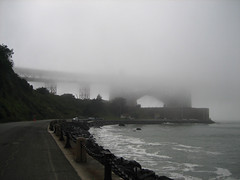
Fort Point

Originally uploaded by heinemanfleck.

Postmodernism is a notoriously tricky thing to define. Standing on Fort Point, poking out into the Golden Gate, looking for the place where Kim Novak jumped into the water in Vertigo, trying to commit suicide (Or was she?), only to have Jimmy Stewart fish her out, is a clear enough example.

Or the plaque in Burritt Alley:

ON APPROXIMATELY THIS SPOT
MILES ARCHER.
PARTNER OF SAM SPADE,
WAS DONE IN BY
BRIGID O’SHAUGHNESSY

Or the House on Montgomery Street, down the Filbert steps from Coit Tower, where Humphrey Bogart shacked up with Lauren Bacall in Dark Passages. One of the people who lives there now has a life-sized cardboard cutout of Bogie in the window. He’s smoking what seems to be a postmodern cigarette. Continue reading ‘Putting Porn (and a T-shirt) on the American Express’ »

Albuquerque’s Water

Christie Chisholm has a great overview in this week’s Alibi of the city of Albuquerque’s San Juan-Chama water project. What I liked is the way she captured the complexity of this project. No easy answers, no free lunch when it comes to New Mexico water:

Even though the city wants to drastically cut pumping from the aquifer, the effects on the river will still be seen for many years. Also, as less groundwater is pumped, less water from the aquifer will be discharged to the river as municipal effluent, which is currently treated and sent downstream to irrigators like Robert. Over time, reduced pumping could help replenish the aquifer, but it will mean less water in the river for downstream users.

On My California Roots

Lissa and I are making a quick trip to California, which has me musing on my roots.

Joan Didion described those who created California as “not the self-satisfied, happy and content people, but the adventurous, the restless, and the daring.” I am anything but restless and daring (I hate moving across town), and I am no longer a Californian. But I can wax nostalgic.
On my mother’s side, I am second generation Californian, the child of a native. Her grandparents and parents helped with that strange frenetic (I was going to say “heroic” but didn’t) building of something from nothing that was the history of Southern California. I grew up in the literal shadow of old orange trees gone lemon. The oranges were grafted onto a lemon root stock, and when the grove came down and our house went up in the 1950s, the trees left as landscape architecture grew lemon branches from below. The town of my childhood was laid out as an “irrigation colony” by a Canadian born engineer named George Chaffey who laid out a grid of streets with a grand boulevard down its center and arranged for the irrigation water that brought forth citrus from the ground.

When I was young, we would visit our friends the Flemings, who still ran an orange grove, and on winter evenings everything would stop at 6 p.m. while Dick would listen to the fruit frost warnings on the radio. The Flemings lived in a grand old grove house (those beautiful grove houses were of a type). The last time I was out there, it was still standing, surrounded by tract homes, something new created from nothing where the something old (a grove) had been created from nothing still.

One could probably apply this line of thinking to any human built environment, any city, and see the something from nothingness of it, and it’s always a grand tale. But for personal reasons I am especially attached to the something from nothingness of my California ancestors. Los Angeles is a city that has no business being there. San Diego, San Francisco, Portland and Seattle all have ports. They all have a reason for being where they are. Los Angeles? It had no port, so they built one. The notion of an agricultural empire on the semi-arid coastal plain made no sense – until they brought the water. “There it is,” William Mulholland is said to have said as the first imported (stolen?) water came cascading down into the arid San Fernando Valley. “Take it.”

It’s at least of metaphorical relevance that the industry of make believe is called “Hollywood,” which is really just a made up place of only vaguely defined geographic identity – a sign on a mountainside (it originally read “HOLLYWOODLAND”) identifying a housing tract that hadn’t yet been built.

We’re going to San Francisco, which is California too, but quite different. They had a port and a gold rush and some intrinsic reasons for the place to exist. To Californians the distinctions between north and south make all the difference. If one is a Southern Californian, one still boos at the mention of Juan Marichal’s name. But from a distance I can see the chutzpah in San Francisco’s story too. There is something about the pressure of San Francisco’s geographic compactness that has created a very different version of the same story. They are Californians in ways my forebears were.

Dangerous Climate Interference

James Hansen and company have a new paper attempting to define “dangerous climate interference” and suggest where we currently stand relative to their chosen standard. Their answer? Close:

We examine potential criteria for dangerous climate change assuming that humanity wants to preserve planetary conditions similar to those in the period of civilization, thus near the range of climate in the present interglacial period, the Holocene, which has existed almost 12 000 years. Even with such an assumption, various uncertainties make definition of the dangerous level imprecise and imply that estimates must be continually refined as knowledge improves.

Nevertheless, we can conclude that the world is already close to the dangerous level. The sharpest criterion is probably maintenance of long-term sea level close to the present level, as about one billion people live within 25m elevation of today’s sea level.

There’s also a news release.

On the Mosquito and the Minnow

minnow in a plastic bagStuff I wrote elsewhere:

Mosquitoes feasted Tuesday morning on dignitaries who gathered in the Rio Grande bosque to commemorate the release of the millionth Rio Grande silvery minnow.


The minnow release was a celebration of efforts to save the fish from extinction. The mosquitoes were a reminder of an especially wet spring— nature cooperating with the minnow restoration effort.