It’s Melting

Greenland melting mapNew NASA data shows accelerated snowmelt in Greenland:

To understand why these trends are important to track, Tedesco explained one of the consequences of melting snow. “Although wet and dry snow look similar at first glance, wet and re-frozen snow absorb more of the sun’s radiation, reflecting only 50-60 percent back into the atmosphere. Dry snow, on the other hand, reflects about 85 percent of the sun’s radiation,” he said. “In other words, melting snow absorbs three to four times as much energy as dry snow, greatly affecting Earth’s energy budget.”

Security in the Student Ghetto


Boo Radley House

Originally uploaded by heinemanfleck.

Concerned by what I read in the comments on Duke City Fix, I dispatched Big Toe to Nora’s new neighborhood this afternoon to evaluate the security situation. Before he turned to science, BT trained with one of the famous Malaysian pirate ninjas, and he holds a black belt in Juhitsmo. Here he’s surveying the old Boo Radley house, which according to neighborhood lore has been home to some dastardly shenanigans.

I feel safer knowing BT is on the job protecting Nora.

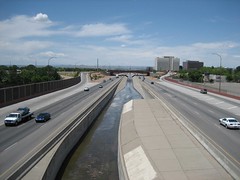
Crosstown Traffic


Crosstown Traffic
Originally uploaded by heinemanfleck.

I had a friend years ago in California, Victor, who was fun to talk to because he was so bafflingly smart. Among his many interests (he also imagined the Internet before there was one) was the way we map our personal geographies of the world around us.

I was thinking about Victor today as I took a shambling bike ride around Albuquerque.

When I started riding, an old-school roadie named Jim (they called him “the wedge,” a nickname that played up the cognitive dissonance between his apparent body type and his ability to ride) taught me some fine tricks for getting around, and for nostalgia’s sake I sought out some segments of Jim’s old routes.

Continue reading ‘Crosstown Traffic’ »

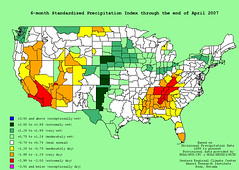
Drought in the Southeast

Not exactly what you’d expect from an El Nino winter, when the typical pattern is to have wet anomalies across the southern tier of states in the continental U.S. and drier weather to the north.

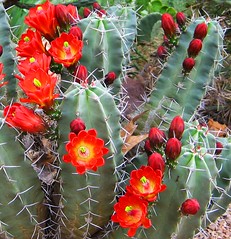
As obsessed as I am with southwestern climate, if you judge by the news flow, the real action is in the southeastern U.S. Maybe it’s just that we westerners are more accustomed to aridity, so it’s less of a big deal. The important bit here is that drought is not a specific amount of water. It’s a lot less water than you’re used to. So if we’d gotten 17 inches (43 cm) of rain from Nov 1 through the end of April here in Albuquerque, our cactus would really be blooming. 17 inches in northern Alabama is at or near the driest on record. You can see the results in the latest round of headlines from around the region:

Another Google Map Attempt

Last Sunday’s bike ride, and this is almost certainly invalid HTML, but if a map shows up, I’ve been victorious!


Carless in Albuquerque

J.A. Montalbano has been doing a delightful series this week in the Albuquerque Tribune on his adventures of going a week without driving his car. Today is telecommuting. My favorite bit of business was from day two at the bus stop:

I left the house at 11:25 a.m. and got to the Rapid Ride stop outside Presbyterian Hospital on Central two minutes later. The message board at the stop promised a bus in five minutes, and it was right on time.

That brief window, though, let me witness a transaction among three men involving some sort of tobacco product that, apparently, when used properly, made tiny cigarettes.

Global Warming or Climate Change

There’s a longstanding debate about whether we should use “climate change” or “global warming” in describe the global climate change-warming thingie. In that regard, this data from Google’s new search terms trends monitoring tool:
Google trends graph

This is the relative use by people searching on Google of the terms “global warming” (blue line) and “climate change” (red line). It suggests the general public searching on Google uses “global warming” far more often. It validates a technique I’ve used in my work. I believe “climate change” more accurately describes what we’re talking about, because many of the relevant issues involve things other than merely rising temperature. On the other hand, “global warming” is the buzz phrase people will have already heard. So I try to use both, talking primarily about “climate change” but at least once, early in a story, invoking the phrase “global warming” to clue people in to what I’m talking about using language they’re already familiar with.

The bottom graph is espcially instructive. That’s the relative frequency of the two phrases as used in the news media searched by Google News. You can see they match up quite closely, suggesting the media is using the two phrases interchangeably.

Climate Change and the Colorado River

Brad Udall at the Western Water Assessment has written an extremely helpful summary of the history of research into the effects of climate change on the Colorado River. It is interesting to note a  consistent message in nearly 30 years of work on this question: the sign is nearly always negative. There’s not a whole lot of reason to think the Colorado River, which provides water for seven states in the western U.S., is going to get wetter over the coming century, but much reason to think it could get drier.

In particular, Brad includes an accessible discussion of the latest work by Niklas Christensen and Dennis Lettenmaier at the University of Washington. Their modeling shows a decrease of 6 to 11 percent in Colorado River flow over the next century on average, a change dominated by temperature increase.