No Doubt a Coincidence

Roger Pielke Jr. notes a remarkable coincidence between the text written by Bjorn Lomborg in the Guardian earlier this week and something Roger wrote last month. First Pielke:

Imagine, by contrast, if the Director of the U.S. Central Intelligence Agency, another organization with an agenda to be “policy neutral,” were reported in the media to say of the agency’s latest assessment on Iran, “I hope that the report will shock people, governments into taking more serious action.”

Now Lomborg:

Imagine if the director of the CIA published a new assessment of Iran, saying: “I hope this report will shock people, governments into taking more serious action.”

“Not a huge deal,” Roger writes, “and maybe just a simple coincidence.” I think he’s being generous.

Kids Today

Much interesting discussion today about the issue of “framing” in the politics of global climate change – see, for example, Ellen Goodman’s column in the Boston Globe, along with useful discussion by Matthew Nisbet and Tom Yulsman. Useful stuff, but ignores the “sleeveless tops in February” frame. 🙂

From the Fix:

What’s with the weather lately? I mean, I know global warming is very bad because it melts the polar icecaps and will cause the demise of civilization, etc, but I can’t say I mind being able to wear sleeveless tops in February. Also, being able to feel my legs after I get back from going somewhere on the scooter is definitely a plus.

Fun With Science

For the last six months or so, Journal photographer Marla Brose and I have been hanging out with University of New Mexico grad student Mel Strong, watching him do science:

To the lay outsider, science can look like an edifice of fixed knowledge— the facts in textbooks.

The day-to-day business of science is different, a tangle of unanswered questions. Where, for example, does New Mexico’s summer rain come from?

Much of the work done to answer those questions is carried out by an army of Mel Strongs— bright, energetic, young grad students, the grunts of science, dashing about on rooftops catching rain.

Marla’s photoshow

My story

Adios, El Niño

This’ll probably come as good news to my drought-plagued Australian friends. El Niño’s just about done. For us here in the U.S., the precipitation pattern – dry in Arizona, wet in Seattle – suggests that no teleconnection really got engaged in any sort of a big way, reflective of either how weak it was, or maybe just noise in the system. Dunno.

It’s worth noting that, despite such a weak El Niño, January was bonkers warm globally, according to the NASA Gistemp crew, warmest Earth has ever been, according to their numbers. No doubt Earth timed this to coincide with the release of the IPCC report. Clever planet.

Northern Flicker

Flicker

Our most spectacular neighborhood bird, the Northern Flicker, paid a visit to the backyard pond this morning. The pond is really a stock tank whose purpose, in addition to the entertainment provided by its undirected ecosystem, is to serve as a watering hole for neighborhood birds.

Last weekend, Lissa banged through the ice and within a couple of hours there were half a dozen robins there drinking. This morning, our flicker popped down from the telephone pole along the back fence for a drink. I didn’t think he’d be able to get any, as the pond’s been frozen over lately. (Global warming? What global warming?) But he found a little bit of water showing over on one edge and plunked down on the ice for a long drink.

Water in the Desert


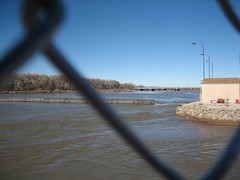
Alameda Dam
Originally uploaded by heinemanfleck.

John Wesley Powell would be proud. From his 1878 “Report on the Arid Lands“:

There are two methods of storing the waste waters. Reservoirs may be constructed near the sources of the streams and the waters held in the upper valleys, or the water may be run from the canals into ponds within or adjacent to the district where irrigation is practiced.

We’ve had dams up the Rio Grande for some time, but Albuquerque is just now, more than a century later, getting its first dam. Lissa and I were out walking today along the river, and for the first time saw the dam raised. It’s a modest affair, design to create just enough head to divert water into a intake structure on the Rio Grande’s east bank, from which it will be pumped to a new treatment plant now under construction.

Those who revere Powell as the great proto-environmentalist would do well to note his language. “Waste water” was water humans weren’t using. The West’s natural resources, Powell believed, were there for the exclusive use of humans – and European immigrant humans at that. He’s revered because he understood, more than those of his days, that there were limitations to the exploitation of the West’s resources. But it’s important not to miss his central purpose, which was to squeeze every bit of human use possible out of West.


Hayduke Returns

If you want to understand the contradictions of life in 21st century west, there are two books you must read: John Wesley Powell’s Report on the Arid Lands, and Edward Abbey’s The Monkey Wrench Gang. You also must understand that both were deeply insightful, and that both were also full of crap, and thinking through the contradictions within and between the two books is essential.
Coco points out that the Durango Herald points out that the Desert News points out that they’re making a movie of The Monkey Wrench Gang. It’s hard to imagine how one might make a film of the Report on the Arid Lands, but it’d make a terrific double bill.

IPCC Precipitation Map


IPCC Precipitation Map

Originally uploaded by heinemanfleck.

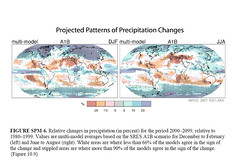
By what seems like a series of coincidences (or not?), I’ve been reading and writing and trying to write lately about maps – the information in them, the things cartographers leave out of them, their implications for understanding things about the world around us, and also the choices we make about what we don’t need to understand. So I’m launching a new category today on Inkstain: maps.

Today’s entry is Figure 6 from the IPCC report released yesterday. Given the frequent use of the phrase “global warming” as shorthand for this complex thing we all talk about, much of the attention ends up focused on temperature. This is reasonable, given that globally averaged temperature is an area of relatively greater understanding. But we don’t live globally. We live “here”, wherever “here” might be. And central to our life “here” is how much precipitation falls from the sky. Figure 6 in the new report attempts to convey in a visually understandable way what is known and not known about this centrally important issue.

The map’s color choices are obvious: brownish means dry, blueish means wet. (As an aside, I was at a talk yesterday where a guy used the opposite color scheme on a climate map – the red end of the rainbow for wet anomalies, blues and greens for dries – very confusing.) But beyond wet and dry, there’s a second kind of information that we also need to know, which is the confidence of the forecast. Places with no confidence are just left white. Places with higher confidence get a little stippled overlay.

I found this map very useful yesterday as I was writing about the IPCC report.

Skiing in Bolivia

Who knew there was skiing in Bolivia? Not any more, apparently:

Their pride in the ski resort here, the only one in Bolivia, soon gives way to a grim acceptance that the glacier that once surrounded the lodge with copious amounts of snow and ice is melting fast.

Attributing the melting to the growing emission of greenhouse gases causing global warming, scientists say Bolivia’s skiing tradition could be extinguished when Chacaltaya’s modest ski run disappears forever in a few years.