
Daybook

art: Apropos of nothing except that I happened to have just listened to it, a marvelous old NPR piece from a few years back on Edward Hopper’s 1942 painting “Nighthawks”.

paper of the day: Multi-Century Tree-Ring Reconstructions of Colorado Streamflow for Water Resource Planning, by Connie Woodhouse and Jeffrey Lukas. The tree ring people have a story to tell of greater variability than the limited historical record suggests.

weather: Crap. Looks like rain tonight. (Not here, in St. Louis. The only place left with baseball to be played.)

word of the day: profiterole – It’s a pastry, and I love the word’s origin. From the WikiPeople: “Profiterole comes from the French diminutive of profit and originally meant a small gratuity.”

On DOE’s Polygraph Decision

Al Zelicoff, on the Department of Energy’s decision to back away from screening polygraphs:

First proposed in 1999 by Gov. Bill Richardson — then secretary of energy — during the uproar over alleged spying at the national labs, the lie detector policy elicited the derision of scientists everywhere. The American Psychological Association, the Federation of American Scientists, the Senior Scientists at Sandia Labs and the National Academy of Sciences uniformly rejected the Richardson’s contention that polygraphs would improve security.

Eeek!

With drought in Australia, snakes are on the move:

Although snakes don’t need water because they don’t sweat, Mr Neindorf said they rely on food to keep their fluids at a reasonable level, meaning more of them were on the ground in search of a meal.

“Because conditions have been so dry for such a long time, food is scarce compared to previous years, meaning snakes this year are likely to be more active than in previous years in their search for food,” he said.

(Actually, this is a bit of a bait and switch. Headline notwithstanding, the story actually tells people to expect snakes on the move, but doesn’t seem to offer any evidence that it’s actually happening.)

Population Growth v. Climate Change

I ran across an old paper this morning by Vörösmarty and colleagues about the relative importance of increasing water demand vs. climate change over the next quarter century. Their conclusion is that human population growth etc. swamps any possible climate change effect. I’ve blogged about this before, but I was struck by this wonderful sentence fragment: “the socioeconomic equivalent of the Mauna Loa curve, namely, rapid population growth and economic development.” (link added by me)

Drought in Afghanistan

Afghanistan map

Reuters reports famine in Afghanistan because of drought:

Some 2.5 million drought-stricken Afghans across much of the country have lost their crops and are facing acute food shortages, international aid group Christian Aid warned on Wednesday in the capital, Kabul.

An assessment carried out by the aid group in 66 villages in the provinces of Badghis, Farah, Faryab, Herat and Ghor, mainly in the northwest, found that many people have lost 70 to 80 percent of their rain-fed crops following too little rain last winter and spring.

It’s worth recalling Mickey Glantz’s observation:

Although many people have been led by their governments and the media to believe that droughts are the primary cause of famines, closer scrutiny of most famine situations uncovers a multistressed political environment, of which drought was but one factor.

Let’s see…. Afghanistan. Multistressed political environment. Hmmm.

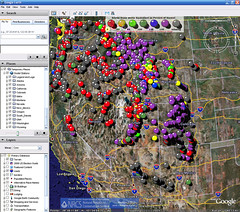
Google Earth Snotel


Google Earth Snotel

Originally uploaded by heinemanfleck.

As winter progresses, snowpack is one of the key western U.S. drought variables to monitor. Snowpack is an important leading indicator of hydrologic drought (see here for a discussion of various drought definitions and measures) in the coming year. Snow that builds up in the mountains during the winter season becomes a sort of storage reservoir for summer irrigation and water supply.

Tom Pagano at the Natural Resources Conservation Service in Portland, Ore., has spent a lot of time developing useful tools for monitoring snowpack. Last year, he developed a terrific Google Earth tool that provides a window into the NRCS Snotel data. The Snotel stations are telemetered, automated weather and snowpack condition monitoring sites – how much snow has just fallen, how much is on the ground there now, etc. You can pull back and get a good region-wide idea of what’s going in, or zoom in to the particular mountain range of interest to you.

It’s too early in the season for this data to be very meaningful, but by December or January the Snotel data is worth watching. And it’s fun to watch even now.

The Business Case

In a New York Times interview, Peter A. Darbee, CEO of Pacific Gas and Electric in California, makes the business case for getting on board with his state’s greenhouse gas reduction initiative:

Rather than sitting there and denying that global warming is a problem and climate change is a problem, my reaction was to accept it and to go with the flow to understand the trend, and then say, how can I position PG&E to deal with that challenge, and then how can I turn a challenge into an opportunity.

Darbee points out the historical folly of the argument that emissions standards in California will weaken the state’s economy:

In the past, California has stepped out and been a leader on environmental legislation, and its economy has continued to grow probably faster than the average state economy in the United States. California will find a way to continue to grow, notwithstanding this piece of legislation.