The “Left” Does It Too

One of my arguments against Chris Mooney’s thesis (“The Republican War on Science“) is that all disputants in scientized political debates cherrypick. Chris has argued from the specific – Well-documented examples in which conservatives have done this. – to the general – The problem is that conservatives do this.

My view is that we have a different problem to cope with: the fact that both sides in most interesting science-politics-policy debates do this, and we’ve got to call bullshit on it wherever it happens. With that in mind, I’ll call bullshit on this:

Oceans worldwide are projected to rise as much as three feet this century, and much higher if the Greenland ice sheet melts away. (emphasis added)

It’s from an op-ed in the Washington Post by Mike Tidwell of the U.S. Climate Emergency Council, “a nonprofit organization dedicated to rigorous grassroots action in the fight to stop global warming and promote a clean energy future.”

People who want to do what Tidwell is advocating – use climate change science as a basis for energy policy action – can, if they are careful, speak from the high ground, basing their call to action on a strong scientific consensus on climate science. But as soon as they cherry-pick science that goes beyond the consensus, they are implicitly justifying all such cherry-picking, and we devolve into a he-said she-said argument with the Roy Spencers of the world.

So what’s the best available consensus statement on the subject of sea level rise? From the IPCC:

Global mean sea level is projected to rise by 0.09 to 0.88 metres between 1990 and 2100.

As you can see, Tidwell has picked the most extreme sea level rise scenario identified by the IPCC (“.88 meters” ~ 3 feet). This is epistemologically identical to picking the other end of the IPCC range and arguing that sea level rise will be negligible and can therefore be ignored. Sea level rise is a significant issue, and it’s important to incorporate the best available science in underpinning the discussion, including a recognition of the genuine uncertainties. As soon as Tidwell picks an outlier on one extreme, he sanctions his political opponents’ choice of the opposite, and gridlock is ensured.

(Hat tip Roger Pielke Jr. for the link, with a lot more interesting discussion there.)

Cricket Brawl

Dave and I have been pondering the possibility of brawls breaking out at cricket matches, and knowing that some Inkstain readers come from cricket-enabled nations, I thought I’d throw the question out here. (Plus, I thought it’d be pretty cool to come in the top 10 Google searches for “cricket brawl.”) Do they head butt at cricket matches? Any history of bench-clearing brawls?

Water in the Desert


jones_arroyo

Originally uploaded by heinemanfleck.

Another sight from Saturday’s bike ride: This is the Jones arroyo (and by “arroyo,” I mean “concrete channel”) that Coco wrote about last week. If you click through to the big version of the picture, you can see where they whacked out the bridge’s concrete sidewalls to let the water through during a big rain storm Aug. 6. Coco suggests some, uhh, engineering issues upstream are to blame for the sand that clogged things up.

Miguel and I rode up into the neighborhoods being built upstream, in the northwest Corrales sand hills. Tons of erosion problems.

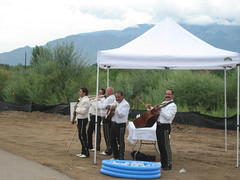
Mariachis


mariachis

Originally uploaded by heinemanfleck.

I have ridden my bicycle in and around Albuquerque, New Mexico, for many years, and I can confidently say that yesterday was the first time I have ever been serenaded by mariachis as I rode. (Miguel and I were riding past the Alameda Open Space Saturday, where a bunch of folk were putting on some sort of water-related fiesta.)

More Stuff I Wrote Elsewhere

On our summer monsoon

Winter droughts apparently bring summer rains in New Mexico. That, dumb luck and a bit of mystery are scientists’ best explanations for this year’s prodigious monsoon, which looks like one for the record books.

“We’re on track for our wettest summer ever,” said Charlie Liles, head of the National Weather Service’s Albuquerque office.

Whether the luck counts as bad or good depends on whether you’re enjoying the rainy respite— or digging mud out of your living room.

Stuff I Wrote Elsewhere

The New Mexico Office of State Engineer (the water people) issued a report last week looking at climate change impacts and vulnerabilities. From the story by Tania Soussan and myself:

Global warming is likely to increase the risk of drought in New Mexico over the next century, and mountain snowpacks anywhere south of Santa Fe could be a thing of past by the late 21st century.

Those are among the conclusions in a new analysis by the state Engineer Office, which offers a detailed New Mexico perspective on the international scientific community’s latest projections of climate change induced by greenhouse gases.

Farmers, ranchers, wildlife and city water supplies could all suffer, according to the report.

More from Dessler

Andrew Dessler adds a helpful coda to his comments in my newspaper story of a couple of weeks back:

I agree with Pielke Sr. that assessments have to include the range of opinions held by the majority of the scientific community. If half of the community says one thing and the other half says something else, then a good assessment will include both views. My sense is that the recent AGU assessment on hurricanes failed in this regard (see also this Prometheus post).

However, we have to be careful about including views that are “too diverse.” The goal of a scientific assessment is to let policymakers know what the scientific community thinks on an issue. If 99.9% of the scientists think one thing (e.g., the Earth is warming), then should the assessment include a dissenting view held by 0.1% of the community? I would argue not. Policymakers are often unable to discern a 99.9% position from a 0.1% position, and they look to expert assessments to do just that. If they don’t, then the assessment has essentially abdicated its responsibility to clarify the science for the policymakers.

Santa Ana Winds and Climate Change

Last February, Kit Stolz blogged about evidence that California’s fire-bringing Santa Ana winds (SAO is the acronymic jargon) were shifting later in the year. There’s a new paper in GRL suggesting a link between climate change and the shift:

This initial analysis shows consistent shifts in SAO events from earlier (September–October) to later (November–December) in the season, suggesting that SAOs may significantly increase the extent of California coastal areas burned by wildfires, loss of life, and property.

(My previous blogging on the subject.)

Water in the Desert

The always insightful* Coco offers some helpful backstory to the institutional arrangements responsible for sucking water out of Albuquerque’s low-lying neighborhoods:

One of the strongest reasons behind having growth management is to plan public infrastructure investment to assure adequate funding for replacement and repair of things like aging infrastructure that serves existing neighborhoods – like storm drainage pumps near Martineztown.

She’s talking about Dan McKay’s excellent story in this morning’s paper explaining how the pumps in Martineztown didn’t work over the weekend – and why.

* except when she’s capping on the Journal, then she’s totally not insightful 🙂