National Precipitation

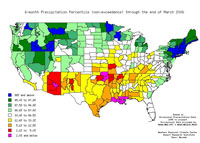
David comments on how wet it’s been in Oregon, prompting me to find a national map:

national six-month SPI map

(From the Western Regional Climate Center’s excellent Standardized Precipitation Index page, where you can pick your starting point and the most useful way to display the data.)

Wet up north, dry down south. To first order, a classic La Nina winter, except that this is a pretty piss-poor La Nina – late to the party and no great shakes once she finally got here.

Notes from the Ballyard

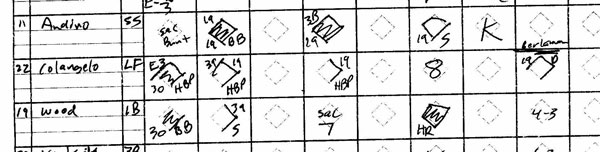
There is almost certainly some special place in purgatory reserved for me, but I was rooting in the 8th inning last night for Jason Bergman, the New Orleans Zephyrs relief pitcher, to hit our Mike Colangelo.

Scorecard segment

You can see from my scorecard that Zephyr starting pitcher Andrew Good was having a bit of trouble with Colangelo, plunking him in the first, second and fourth innings. I didn’t know for sure, but I figured it was reasonable that no one had ever been hit four times in a single Pacific Coast League game, and I love nothing more than to witness an obscure baseball record.

Such is a night at what Miguel lovingly calls “the lab,” home of the Albuquerque Isotopes, the only baseball club ever named after a fictitious team in a Simpsons episode. Such is Triple A ball.

Continue reading ‘Notes from the Ballyard’ »

Stuff I Wrote Elsewhere

Just in from Ethiopia:

A team led by a Los Alamos scientist has emerged from the deserts of Ethiopia with new evidence for the evolution of our first upright-walking ancestor 4 million years ago.

The bones of Australopithecus anamensis capture a moment in pre-history when our ancestors were emerging from the woods on two legs, freeing up their hands for the evolutionary adventure that led to modern humans….

Scientists say that an evolutionary split in eastern Africa about 6 million years ago sent chimpanzees down one branch of our family tree and the hominids— our ancestors— down another.

In a couple of million years more, our ancestors had begun walking upright, freeing their hands and leading to a flurry of evolutionary change that included dexterous hands, large brains, and eventually space flight and the Survivor television franchise.

Last Freeze?

I’d been meaning to look at this a while ago, because all climate change is ultimately local, but just got around to it today. The last time we had a freeze in Albuquerque was March 23, and it’s reasonable to think that’ll stand as the last freeze of spring. We won’t know for sure for a while – we’ve had freezes as late as May 27, but in recent years the average has been April 1. That’s two weeks earlier than the long term average. A number of things have changed that might explain the warmer overnight temperatures, including the increasing urbanization of Albuquerque and increasing concentrations of atmospheric greenhouse gases.

And while we’re on the subject of the climatological spring of 2006 in Albuquerque, we’ve had 0.28 inches of rain since Nov. 1. The record driest Nov. – April (this is based on data back to 1914):

  1. 0.38 – 1939
  2. 0.58 – 1996
  3. 0.72 – 1947
  4. 0.80 – 1967
  5. 0.85 – 1925

I know of no particular explanation, except that we’ve got a weak La Nina and shit happens, but there’s two weeks left, and I’m a-dancin’.

Desert Island Funk

Back in the day, we used to haunt the cutout bin in the record store at the mall in Walla Walla. One of us, I don’t remember who, picked up an album by Funkadelic because someone said they had some wicked guitar music. (I don’t think they actually said “wicked,” but you get the idea.) It was a pretty great album, but it didn’t really fit into my music life, and it was only lately I realized – hey, wait, I like funk.

Back when I was a kid listening to Top 40, there was Curtis Mayfield. Then there’s the obligatory funk song on each of Bonnie Raitt’s albums, and some vaguely funky Steely Dan backbeats that I always liked. But I’m slow on the uptake, so I didn’t quite get it until I stumbled into a live performance of the Felonious Groove Foundation (go buy Paper Tiger please) and thought – hey, wait, I like funk.

Thing is, I don’t know anything about it, so consider this a lazyweb request. What’s your favorite funk?

Yet More on Hansen

A comment worth pulling out and highlighting (even if it is somewhat critical of me). Mickey Glantz, whose ideas about climate science and policy and politics I greatly respect, takes me to task for airing Jim Hansen’s draft ENSO paper:

You know that Hansen’s paper was just a draft…. Anyone could (and some did) jump on a bandwagon that was still parked in the barn.

So was it appropriate to air this thing in public, given that Hansen himself was clear that it was just a draft, subject to revision? Or is Mickey right? On balance, I think these discussions are most useful and interesting in full view. But it’s a close call. Comments and discussion encouraged.

More Hansen

Via Roger Pielke Jr., reference to a new draft from Jim Hansen that usefully clarifies the El Nino discussion of last week:

Present version should make clear that what we are saying is: Global warming has increased the east-west equatorial temperature gradient and that should increase the probability of a super El Nino. It is still a crap shoot, so it requires many rolls of the dice for empirical verification. Even in the last 30 years there have been only two super El Ninos.

Cherry-Picking Your Starting Point

Steve McIntyre approvingly cites a piece in the Daily Telegraph by Bob Carter arguing that the planet has not warmed in the last eight years. And if you pick the El Nino year of 1998 as your starting point, that’s true, making this a rhetorically powerful argument. But there’s a problem. Given the variability in the temperature record, in any given year, even with a continuing upward temperature trend, you are likely to be a bit cooler than the previous record year – until you set a new record. So by cherrypicking the previous record year as your starting point, you can argue most of the time that things are really cooling off, not warming. This is what Carter has done. But the really interesting thing here is the evidence offered by Tim Lambert that Carter himself has complained, in other contexts, that the extreme El Nino year of 1998 is an outlier that you shouldn’t use to establish a temperature trend.

update: Dave Dardinger accurately points out that Steve’s post was neutral, rather than approving, of Carter’s piece. I stand corrected.