Erdos, Lambert and Fleck

Re the degrees of separation game, Tim Lambert points out that he’s got an Erdos number of three: Lambert – Stanton – Stinson – Erdos.

If you really bend the rules*, I’ve got an Erdos number of five: Erdos -> Peter Palfy->Jan Saxl->Pavel Etingof->Alexander Kirillov. Which means I’ve got a Lambert number of – what – eight?

Lambert – Stanton – Stinson – Erdos – Peter Palfy – Jan Saxl – Pavel Etingof – Alexander Kirillov – John Fleck.

Gavin’s won the beverage of choice with chain with four degrees of separation between McIntyre and Mann, and I’m still awaiting someone with the patience and energy to find the William Connolley-Luboš Motl links.

*And by “bend the rules,” I mean “make up a completely new set in order to allow this to happen”. Back in 2000 and 2001, I was volunteering on the GNOME project, and Sasha Kirillov and I co-wrote the GNOME users guide. To make this work, you’ve got to allow software documentation. But, as I said before, it’s my game. I get to make up the rules.

Go Brandon!

A comment worth pulling out onto the front page, about the latest success of New Mexico’s own Brandon Leslie (this is distance running for those not familiar with the jargon):

Well it just keeps getting better for Brandon, He ran in the USA Mens X-C Championships on Feb 20 in the Bronx, NY, with bitter cold windy. He passed Abdi who dropped out and then placed 4 seconds behind Mat Garbielson to take 7th place, When it was all said and done and winners decided not to double, a spot on TEAM USA opened up for Brandon for the World XC Champiopnships to be held April 1-2 in Japan.
Go Brandon, We are all running in your shoes with you every step to the GOLD!

Daybook

weather: That storm, she’s a flirt, but it’s pretty clear she’s not going to put out. I’ve probably mentioned this before, but there’s a story somewhere in the crazy psychotic way the dry weather is making us feel. Two days of measurable precipitation in Albuquerque since Nov. 1. Two.

music: The podGoober project’s gem of the day is John Coltrane’s A Love Supreme. Bonus gem is some lovely tenor saxophone work by Joe Henderson.

style: “Use the word not as a means of denial or in antithesis, never as a means of evasion.” S and W (I think I am not good about following this rule.)

word: obsequious: “obedient or respectful to an excessive degree”- This is a good way to characterize our bemused politeness Sunday on our bike ride toward the strange man in the white pickup who stopped to wait for us to cross. And wait. And wait.

spring: Not sure why, but the subject of Candy Maldonado came up the other day at work. A lifetime .254 hitter, he’s not the sort of ballplayer whose career one normally follows, but Lissa and I were living in LA and falling in love and going to Dodger games in the mid-80s when Maldonado was there. Lissa had a special secret Dodger stadium parking place, outside the ballpark on a side street. We used to go early and watch batting practice.

Eight Degrees of Separation

Steve McIntyre has been playing a fun sort of “degrees of separation” game, identifying members of climate science’s “hockey team” based on coauthorship of paleoclimate papers and using their team membership to disparage their work. I’ve not found it to be a particularly useful or persuasive argument, and Tim Lambert has pointed out the inconsistency with which McIntyre applies it.

But I’ve always been fascinated with the whole Erdös/Kevin Bacon degrees of separation thing. So for a lunchtime exercise, I thought I’d see the shortest path I could find between McIntyre and Michael Mann, the two main characters of climate science’s long-running soap opera.

There’s only one rule in my game: No use of IPCC chapter co-authorship.*

Herewith, then, are the eight degrees of separation between Steve McIntyre and Mike Mann:

  1. In 2005, Steve McIntyre and Ross McKitrick published “Hockey sticks, principal components and spurious significance” in GRL
  2. McKitrick and Pat Michaels have worked together on several projects. We’ll go here with their 2004 “A test of corrections for extraneous signals in gridded surface temperature data.”
  3. In 2003, Michaels and John Christy were among the coauthors of a “Test for harmful collinearity among predictor variables used in modeling global temperature.”
  4. Last year, Christy and Roger Pielke Sr. wrote a critique of a paper in Science by Jim Hansen.
  5. In 2004, Pielke Sr. and Craig Allen were coauthors of a really interesting PNAS paper entitled “Cross-scale interactions, nonlinearities, and forecasting catastrophic events.” (In fact, rather than wasting your time on all this hockey stick war stuff, I suggest you go read this paper.)
  6. In 1999, Allen, Tom Swetnam and Julio Betancourt wrote “Applied Historical Ecology: Using the Past to Manage for the Future” in Ecological Applications. (Julio’s not technically necessary for this list, except that a) he’s one of the most interesting scientists I’ve had the pleasure to know, and b) it’s because of him that I knew enough about these fields to find a path through the literature.)
  7. It would be remarkable to not find a Swetnam-Malcolm Hughes link. I was sitting in Tom’s office a couple of summers ago interviewing him about tree rings and drought and he asked, “Are you going to talk to Malcolm? You must talk to Malcolm,” and took me upstairs and introduced us. I guess I’ll go with Hughes/Swetnam/Diaz – “Tree Rings and Climate: Sharpening the Focus,” published in EOS in 2004.
  8. Which brings us, of course, to Mann, Bradley and Hughes, co-authors in 1998 of “Global-Scale Temperature Patterns and Climate Forcing Over the Past Six Centuries”.

* I made up this rule ex post facto, because it made it too easy. Mann and Christy were co-authors of Chapter 2 in the last IPCC report, which short-circuits a whole bunch of interesting people. What can I say? It’s my game, I get to make up the rules.

update: In the comments I detail the discovery of a five-degree chain between M and M. For the first person to beat that (without using the IPCC chapter), I’ll buy a beverage of your choice the next time we happen to be in the same city at the same time.

Bonus points for anyone who can make a chain of any length linking William Connolley and Luboš Motl .

Sunday Services

Sunday mornings are for riding, and I like to joke that the saddle’s my church. Moreso, it turns out, than I realized.

In the Jan. 28 New Scientist, evolutionary psychologist Robin Dunbar has an essay about the physiological dimensions of religion. She discusses the physical side, from singing and dancing to the intensity of serious meditation to the extremes of self-flagellation:

Religions bond societies because they exploit a whole suite of rituals that are extremely good at triggering the release of endorphins.

And there is a a group component:

In particular, it makes you feel very positive towards other group members. It creates a sense of brotherhood and communality.

I don’t wanna get all squishy about this, but if you ride (or hike or run with groups), you know what I mean. There’s a special bond among riding buddies.

Bowling Ball Larceny

Trying to delete a comment spam, I accidentally deleted the following, which was a favorite post, and which I therefore reprise now by reposting:

Dec. 12, 2004

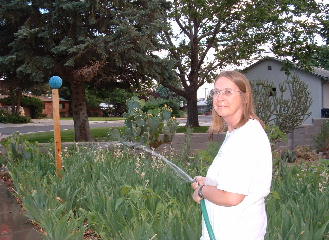
Wife Lissa, who is something of a goofball, installed a large post in the front yard – a 4×4 set in concrete – with a bowling ball as a finial. It is both amusingly decorative as well as functional: when she’s thinning cactus or iris, the post serves to display her “Free Iris” or “Free Cactus” sign. (You can see it in the background in this June 2003 photo. Mark this Exhibit A.)

About a month ago, someone stole the bowling ball. She quickly replaced it. (Any thrift store worth the name has a big box of bowling balls for cheap.) This week, we were again bowling ballglarized.

Lissa watering iris with bowling ball in background

It’s a bit of a dilemma. One hates to give in to the forces of darkness, but how many times will she need to replace it? Are the thieves hoping to collect enough balls to start their own alley? If so, where will they get the shoes?

Nora suggested coating the next ball with itching powder. I suggested one of those bank robbery exploding dye packs, though the engineering details are a bit murky in my own mind, so perhaps that’s not practical.

Suggestions are welcome.

Christmas 1976

I’ve always liked relics.

I don’t remember whose house we were at Dec. 11, 1976, but it was our ritual to gather to watch Saturday Night Live. I do remember the episode: the killer Christmas trees and the horrifyingly hilarious holiday carole: “Let’s Kill Gary Gilmore for Christmas.” And Santi-Wrap. It must stand as one of the television program’s greatest episodes.

I remember Frank Zappa as one of the killer Christmas tree’s victims, and as the slime oozin’ out of our TV. It is almost certainly not the first time I’d ever heard Frank, but it’s the first time I really noticed him. (I was all, like “ELP are so bitchin'” ‘n’ stuff back then.) So I’m a little sad that I don’t remember hearing Peaches En Regalia that night. In the years since, I acquired a number of different recordings of the song, which FZ seems to have put to vinyl over and over.

Tonight I added the live SNL recording of Peaches En Regalia to my podgoober.

The epilogue came the morning of Jan. 17, 1977, when Gary Gilmore was executed. I was eating poached eggs at the moment he uttered his last words: “Let’s do it.”

Drought, Food, Africa

In keeping with Kevin Vranes’ dictum that “it’s up to the bloggers to highlight the papers that didn’t make Science, Nature, JAMA or NEJM” because those half-wits in the mainstream media won’t, here’s an interesting paper on climate variability and food in Africa.

Leif Christian Stige of the University of Oslo and colleagues used crop production records and satellite data to conclude that reduced food production during El Niño years in Africa is the equivalent of “the nutritional requirements of (approximately) 20 million people”. Yowza. Kinda puts our worries about the New Mexico ski season this year into perspective. The big loser is corn in southern Africa, something documented a dozen years ago by Mark Cane. So the broad story here is already well known. It’s the 20 million number that jumped out at me.

Stige et al. spin a global warming tale to go along with this:

Results suggest reduced African food production if the global climate changes toward more El Niño-like conditions, as most climate models predict.

As I’ve written before, I don’t think the science is there to head very far down the global warming->El Niño path. But regardless of those details, there’s something we clearly do know about drought variability in Africa and elsewhere. Regardless of the imprint left by anthropogenic climate change, we know there is drought variability – wet times and dry times and then wet again and then dry again.

The real damage (see here for a longer discussion of this) happens when people don’t pay attention during the wet times to the fact that it’ll get dry soon enough. I recently read a great book chapter by Mickey Glantz entitled “drought follows the plow” (apparently there’s a whole book) that discusses what happened in the Sahel beginning in the late 1960s. Glantz argues that people moved north into the southern edge of the Sahara during the unusually wet 1950s and ’60s. When the pendulum swung back to dry in 1968, they were screwed.

It’s not unlike people building growing cities in the paths of hurricanes, and then being surprised when the waves wash over them. Climate change may be one variable here, and is clearly worth paying attention to, but changing societal vulnerability dominates the risk.

Dry

Some stuff I wrote elsewhere on how dry it is (sub. req.):

If we don’t get any rain in the next week— a good bet— the past four months will go into the record books as the driest winter in Albuquerque history.

With 0.14 inches since Nov. 1, Albuquerque is on the verge of shattering the old November-February record of 0.30 inches in the winter of 1903-04, according to Deirdre Kann of the National Weather Service.

A huge hat tip to Deirdre and Chuck Jones at the Weather Service for digging through the old data for me.