
In which my buddy Steve gets a blog.
WikiFun
I’m taking a class on drought from Dave Gutzler at UNM this semester. Last week’s topic was the strengths and weaknesses of the Palmer Palmer Drought Index, the widely used standardized measure of drought. It’s a graduate seminar, which last week meant me leading the discussion on Palmer. Since I did a bunch of work preparing, I updated the Wikipedia entry on the topic. Leveraging the commons includes giving when it’s something you’ve got that can easily be shared.
Sinned Again
Forgive me, Dano, for again have I sinned.
Sen. Wonk, D-N.M.
I say this with the greatest affection. Jeff Bingaman is a wonk.
From Cornelia Dean’s story in yesterday’s New York Times on a briefing on Capitol Hill attempting to explain what science is:
(T)he briefing’s subject apparently struck a chord. More than 100 committee staff members, Congressional aides and at least one senator, Jeff Bingaman, Democrat of New Mexico, crammed into a basement meeting room.
Voodoo Science
Well down in a tortuous thread, a commenter asks why a new and different explanation for surface warming of our planet is not being considered in our ongoing global discussion of climate change.
I won’t begin to try to detail the explanation, but at the risk of being unfairly pejorative in my description of it, I’ll simply say that the only place it seems to show up is on a Geocities page and in the frankly marginal journal Energy and Environment. (By “marginal,” I mean that E&E is not a scientific journal at all, is not peer reviewed by scientists, and is, by the editor’s admission, a vehicle for her political agenda.)
In my work as a science journalist I am frequently confronted with ideas of this sort. They involve a bright individual who approaches me with an insight that suggests that the conventional scientific understanding of some question – gravity is the most common – is completely wrong. Sometimes it’s the scientist him or herself that approaches me, and sometimes an enthusiastic supporter.
It is possible that these new ideas will turn out to be useful. But invariably, upon scrutiny by a scientist with expertise in the field (remember I am not that person), they turn out to have missed or misunderstood something fundamental.
It is my way to try to be polite. As a journalist, I have an obligation to listen to as many people with as many different ideas as I can. But there has to be a cutoff point, or I’d waste a lot of time on this stuff. Here’s my simple way of triaging: has this new idea gained any traction in the scientific community? If it hasn’t, then I’m not going to waste much time on it.
Four years ago, at an American Physical Society meeting, I listened to a talk by Los Alamos physicist Emil Mottola offering a radically different explanation for how black holes work. After the talk, one of the physicists in the audience followed him into the hall excitedly and said, in essence, “I think you’re completely wrong, but this is really interesting!” And a cheerfully spirited exchange ensued. If the statistical proporties governing radical new scientific ideas are to be believed, the odds clearly favor Mottola being wrong. But at least he’s out there gaining some small amount of traction among the folks working on the question.
Life is short, and there are far more than enough useful challenges to the scientific orthodoxy that do gain enough traction to be interesting to spend time on those that don’t.
Schwarzenegger, California and Climate
There’s an op-ed in the 21 January New Scientist from California Gov. Arnold Schwarzenegger laying out his case for action on greenhouse gas reductions:
In California, we are already seeing potentially severe impacts: shrinking of our snow pack in the Sierra Nevada mountains, which reduces our annual water supplies; erosion of our coastline; flooding of farmlands in the Central Valley; and a wide variety of health impacts related to changes in seasonal temperatures.
The snowpack/temperature piece of is being ably explored by Phil Mote and his various coauthors (see here for a bunch of Mote’s other work). But Schwarzenegger’s comments on flooding popped out because of a new paper in GRL by Edwin Maurer of Santa Clara University on the effect of warming on conditions in California during an El Niño.
Othello
Playing Othello with Nora is pretty much a win-win for me.
If I win, I get the visceral pleasure of victory. If she wins, I get the pride that comes with watching your child succeed.

To be honest, I much prefer kicking her ass. She played white this evening, and of course I’m a very proud parent.
Drought Numbers
Not much chance of rain over the next week, which means we’ll end the month with 0.04 inch in Albuquerque for January. With 0.10 in December, that puts us (by my quick back of the envelope calculation) at the fifth-driest Dec.-Jan. in history. 1966-67 was the worst, with 0.02 inch.
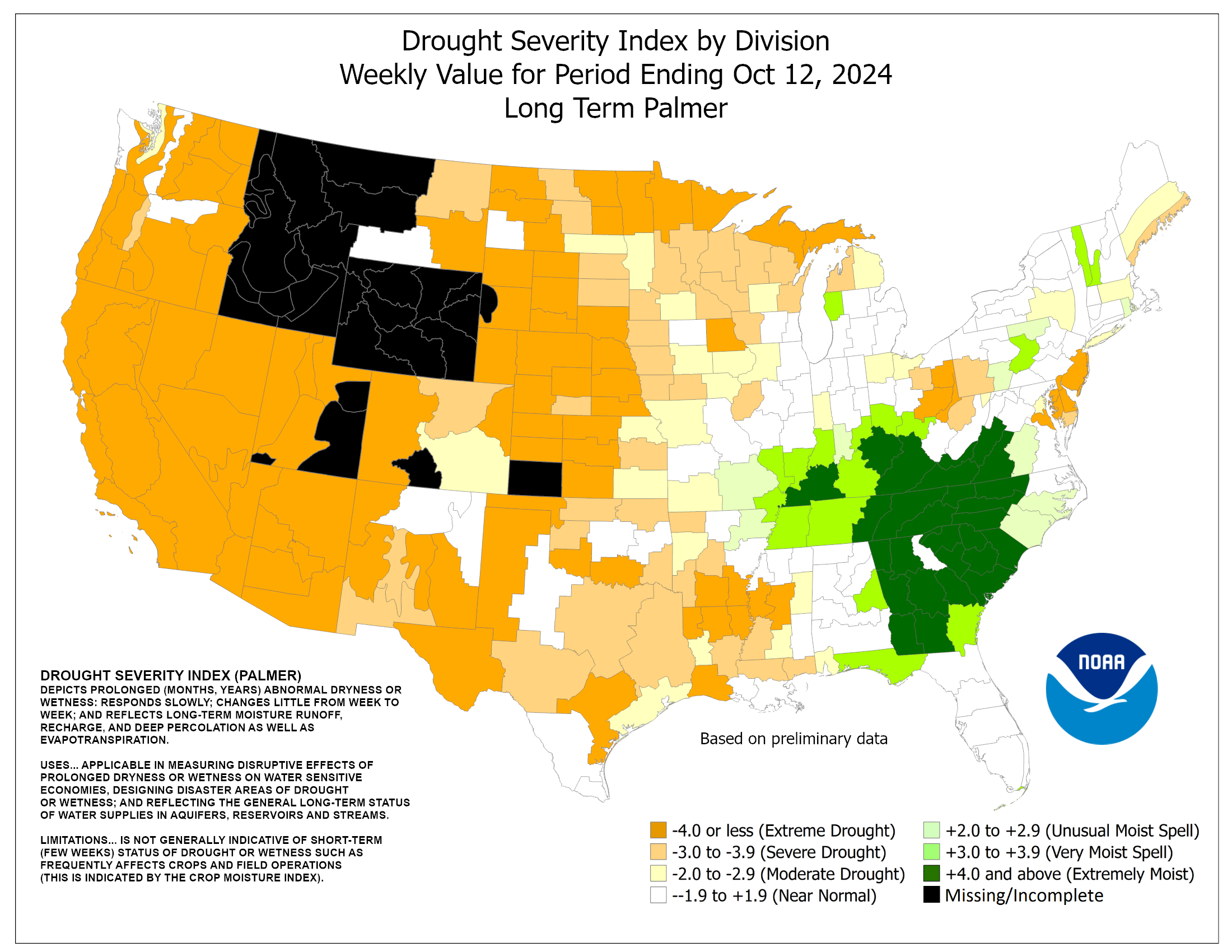
The Palmer Drought Index says we’ve got near normal conditions. Compare that to the snowpack map. This is an example of why a lot of folks don’t put much stock in Palmer around these parts. But then, I guess it depends on what you mean by “drought.”
More on 2005
Good discussion on Island of Doubt about the significance of the 2005 temperatures.
Peak Oil
I had a dream the other night about a shortage of jet fuel. Someone handed me a piece of paper with a list showing which flights were allowed to go, and which were grounded. I couldn’t figure out how they’d decided which was which.