
George Deutsch, the 24-year-old J-school political appointee working in NASA public affairs whose 15 minutes of fame included trying to explain the Big Bang “theory” to the space agency, never graduated from Texas A&M, as his resume had claimed, according to Andrew Revkin.
Surprises
Here’s a result that runs counter to the conventional wisdom:
The largest study ever to ask whether a low-fat diet reduces the risk of getting cancer or heart disease has found that the diet has no effect.
Big study, therefore strong result. I love surprises.
Daybook
health 1: So the whole reason for all this blogation today is that I’m home sick. I’m not in terrible shape, but took a clue when a friend at work yesterday covered up his mouth and backed away uncomforably as I hacked.
health 2: I hurt my knee Saturday. My bad knee on which I’ve spent so much frickin’ time and energy. I hurt it at a math competition. I was a spectator. There’s a joke in there somewhere. I pretty much freaked out completely. Now I’m in an uncomfortable netherworld between denial and hypochondria. I think it’s fine.
reading 1: Jared Diamond’s The Third Chimpanzee. Diamond’s funny. Collapse took some key ideas in Guns Germs and Steel and ran with them. Guns Germs and Steel, in turn, took some key ideas from The Third Chimpanzee. It’s like he keeps writing the same book over and over again, slowly zeroing in. (I like all three books.)
reading 2: For class tomorrow, Pacific and Atlantic Ocean influences on multidecadal drought frequency in the United States, by McCabe, Palecki and Betancourt. They use statistical magic to connect drought in the United States with decadal-scale ocean patterns in both the north Pacific and the North Atlantic. Their bottom line is that the current pattern of both matches up nicely with conditions that in the past have included widespread U.S. drought.
word of the day: mufti – I’m thinking of the second definition, i.e. civilian garb worn by a member of the military.
A Little Help from One’s Friends
If you can’t help a friend now and then set up a trail of Google crumbs to pediatric care in North Carolina, then there’s really no point in having a blog, is there?
Answering Roger’s Question
Roger Pielke Sr., in a post about the climate models’ difficulties in getting clouds right, poses this question:
How can international climate protocols, such as Kyoto, be established when the climate response to human climate forcings (and even natural forcings) is not adequately understood?
The short answer is that we make decisions all the time, large and small, in the face of uncertainty. We do it based on our understanding of the uncertainties, which we hope scientists have done a good job explaining to us. And we do it based on other values and considerations. The science can help us here, but it’s not the only input into the process.
Continue reading ‘Answering Roger’s Question’ »
More Floods, More Droughts
Gao et al. in a study this week in GRL modelling precipitation in Europe under increased greenhouse gases:
Changes in extreme precipitation events and dry spells suggest not only shifts, but also a broadening, of the precipitation distribution, with an increased probability of occurrence of events conducive to both floods and droughts.
Stuff I Wrote Elsewhere
Lest readers of this blog think my only journalistic avocation is climate: LANL May Begin Building Nuke Pits
By John Fleck And Michael Coleman
Journal Staff WritersWASHINGTON— Federal officials on Monday proposed expanding nuclear weapons manufacturing at Los Alamos National Laboratory, part of a sweeping plan to develop new nuclear weapons for the first time since the end of the Cold War.
By 2012, they hope to be able to make 30 to 40 new plutonium nuclear weapon cores per year, according to the Bush administration’s fiscal year 2007 budget request.
The government’s top nuclear weapons official cautioned that the new program remains primarily a research effort for now, aimed at finding ways to build safer and more reliable nuclear weapons. But the spending plan delivered to Congress on Monday includes, for the first time, a long-term spending plan for moving the weapons from the drawing board to production.
(Michael was the one in Washington. I just have a telephone, a pdf reader and an inordinate fondness for federal budget documents.)
Land Use and Climate
Some old literature I was reading the other night carried shades of Roger Pielke Sr.’s argument that land use changes are important to climate change:
Notwithstanding the apparent uncertainty of the seasons, it is found that the mean temperature of particular localities is very constant, provided we compare observations made at different periods for a series of years. Yet, there must be exceptions to this rule, and even the labours of man have, by the drainage of lakes and marshes, and the felling of extensive forests, caused such changes in the atmosphere as raise our conception of the important influence of those forces to which even the existence in certain latitudes of land or water, hill or valley, lake or sea, must be ascribed.
That’s from Charles Lyell’s “Principles of Geology,” published from 1830-1833. Lyell was a leader in the community of geologists trying to make sense of why there were fossilized sea creatures on the tops of mountains, and why there was fossilized jungle flora and fauna in places were no jungles today exist. He therefore spent a lot of time trying to understand how climates could change. He ascribed the changes in climate to changes in physical geography – sea basins pushed up to form mountain ranges, for example. That, he assumed, drove climate change, and did so on vast time scales. (Lyell, like Darwin, was part of that first generation of scientists who realized they had “deep time” to play with, and busied themselves making the most of the opportunity.) Anthropogenic land use changes notwithstanding, Lyell didn’t expect climate to change very quickly:
(H)owever great, in the lapse of ages, may be the vicissitudes of temperature in every zone, it accords with our theory that the general climate should not experience any sensible change in the course of a few thousand years, because that period is insufficient to affect the leading features of the physical geography of the globe.
Deutsch on the Big Bang
From Andrew Revkin’s story in yesterday’s Times:
The Big Bang is “not proven fact; it is opinion,” Mr. Deutsch wrote, adding, “It is not NASA’s place, nor should it be to make a declaration such as this about the existence of the universe that discounts intelligent design by a creator.”
It continued: “This is more than a science issue, it is a religious issue. And I would hate to think that young people would only be getting one-half of this debate from NASA. That would mean we had failed to properly educate the very people who rely on us for factual information the most.”
Monthly Report
Everybody’s yammering about the warm January in the U.S., with the entire country seeing positive temperature anomalies (hat tip Mike Mann for graphic and discussion of global climate change implications of all this)

If you look at the map linked above, you’ll see that Albuquerque, at 3.8 degrees F above average, is in a region that saw smaller anomalies than most of the nation. We tied for 14th in National Weather Service records going back to the 1880s. Seven of the warmer Januarys have come since 1990.
The map of January precip anomalies looks a bit different, but downright dire here. No single month matters completely, but a look at the 90-day map should be enough to startle you:


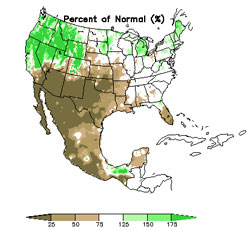
(Source: Climate Prediction Center, NOAA)
Expect more of the same. The CPC announced yesterday that we’ve officially crossed the La Niña threshold as a result of cooling in the equatorial Pacific. La Niña, which has really been lurking in the wings for a while, tips the odds toward the sort of map you see above – dry across the southern US and Mexico.