
Kevin Vranes at his new scienceblogs home (note to self – update many links in various places to all the people what just moved there) has a couple of posts that circle around a favorite topic of mine: being afraid of the things that will really kill a lot of people, and not about the things that sound scary but won’t. He makes a good case that bird flu and the other disease-of-the-day scares are not worth big bother. And if his discussion on the earthquake threat in Caracas doesn’t scare the crap out of you, you’re not paying attention. Apparently we also should be very afraid of this Paul Epstein chap.
Leslie Fourth
Congratulations to Albuquerque distance runner Brandon Leslie, who scored a fourth place finish Sunday at the U.S. half marathon championship.
Daybook
drought watch: You have to squint to see it, but my favorite Snotel station, at Chamita up near the Colorado border, got 3 inches of snow in the last 24 hours. That’s about a third of an inch of snow water equivalent, which is not a whole lot, but is better than having a lit cigar stuck up your nose.
not drought: No rain yesterday in Seattle, ending the streak at 27 days. In Olympia, it’s not over.
word: sipid – The Wordsmith this week is removing prefixes with amusing results.
cycling: All hail The System. Handed down by the New Mexico cycling priesthood from guru to acolyte, The System is the worthy way to prevent goatheads (Tribulus terrestris, the spawn of Satan) from puncturing your tires. The System involves cutting the wire beads off an old tire and using it as a liner inside your tire. I tried it Sunday, and am converted. Early in the ride, I heard a “clinkclinkclink” of metal from my back wheel, stopped, and found a one-inch piece of heavy wire, the thickness of a finishing nail, poking out of the tire. But no flat. All praise The System.
Golden Dining
Nora’s golden menu.
Land Use Changes
My story on Johannes Feddema’s paper on the global effects of land use changes finally ran in this morning’s paper. Forgive the headline. I tried to play the bait and switch game in the story and I guess I didn’t get away with it – at least with the copy editor who wrote the headline. The bait was the model’s tantalizing suggestion that deforestation in the Amazon could make New Mexico’s summer’s wetter. The switch was the caution from Feddema that the study was less a prediction than a sensitivity analysis, suggesting big effects from land use changes without being too specific yet about what they might be.
You probably shouldn’t buy another umbrella right away. The research is preliminary, said Johannes Feddema of the University of Kansas, who led the study.
But the complex daisy chain of continental-scale atmospheric changes in his simulation is a clear indication that large-scale land use changes have the potential to change climate around the globe, Feddema said.
Drought in the Amazon
In the comments over at RealClimate, Bradfield Lyon posted links to a couple of excellent global drought monitoring resources:
- Global Weighted Anomaly Standardized Precipitation indexes, and
- Global Standardized Precipitation Indexes
Rasmus had discussed the potential for global warming to have been implicated in the current drought in the Amazon, and I had asked the underlying question of how much of a precipitation shortfall there had been. It’s a key question in understanding drought, because much of what we think of today as “drought” is in fact a relatively modest shortfall in precipitation, combined with substantial population growth and therefore huge increased water demands.
You can see that, by both indices cited by Lyon, the shortfall over the past year in the Amazon is substantial.
(FYI, SPI for the United States is available on the Western Regional Climate Center web site, sliced up a number of different useful ways.)
Fumento’s Not So Full Disclosure
Our old friend Michael Fumento back in the day chastised me for being a lowly blogger while he was widely published in newspapers.
No more. Tim Lambert points out that Scripps Howard, which used to carry Fumento’s column, has sacked the conservative pundit for writing about the glories of Monsanto’s biotechnology without disclosing that he had previously accepted money from Monsanto. Editor and Publisher has more.
It is a beaver dam
As I’ve mentioned before, the coolest aspect of my job is having carte blanche to call up smart people and make them explain stuff too me. Today’s case in point is Paul Polechla, the University of New Mexico’s aquatic mammals expert. When I saw what I thought might be a beaver dam a couple of weeks ago in the bosque, I followed a trail of bread crumbs to Paul’s door. We ended up making the short trek Thursday morning, and Paul confirmed that they are beaver dams – two of ’em in a few hundred yards of bosque drainage ditch, right in the middle of the city.
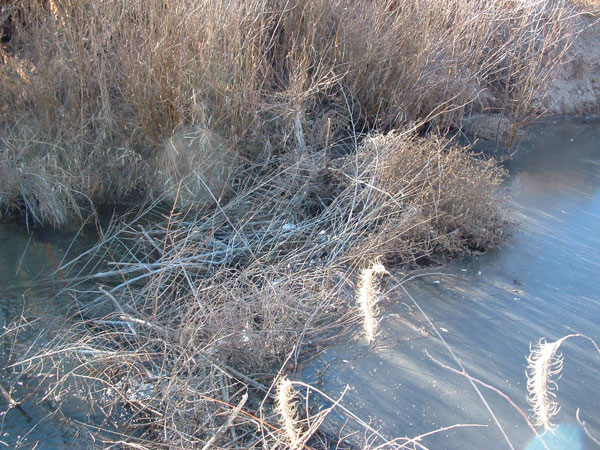
The sticks that I thought had been too neatly cut were, in fact, the beavers’ work. Paul showed me the teeth marks, and they’re amazing – incredibly neat work. And the dam was amazingly sturdy. It looked like a flimsy stick pile to me, but Paul just walked right across it.
More on Xu and Peiser
Benny Peiser, in the comments below, suggests I am misleading my readers and asks that I set the record straight. So let me quote from both Benny’s CCNet email and the Xu et al. paper.
First Benny’s CCnet subject line:
NEW STUDY: “SOLAR ACTIVITY IS PRIMARY DRIVING FORCE OF CLIMATE CHANGE”
Now Xu et al., which includes several variants on that quote. I’ll try to get them all. First:
Our study reveals that quasy-100-yr fluctuations of solar activity are possibly the primary driving force of Chinese temperatures during the past 6000 years. (emphasis added)
Then later:
Comparisons between temperature variations and solar activities indicate that both temperature trends on centennial/millennial timescales and climatic events are related to solar variability, suggesting that solar variability is possibly a primary driving force that influences temperatures. (emphasis added)
And again:
Quasi-100-year fluctuations of solar activity may be the primary driving force of temperature during the past 6000 years in China. (emphasis added)
Benny, in his comments, suggests that in his subject line he was “simply quoting the authors themselves.” But he wasn’t. The authors used qualifying words. Benny dropped them from his subject line.
Benny asks me, “How do you know what I was thinking?” My answer is that I drew an inference based on three things: first, your decision to drop those words from your headline, second, your failure to point out that the study had no relevance to the warming of the past century, and third your well-documented skepticism of the consensus view regarding the anthropogenic component of current warming.
My apologies if I inferred incorrectly. Perhaps, Benny, you might clarify what significance you think this paper does have, if any, for our understanding of changes in global climate over the past century?
Plants and Drought
There are essentially two ways societies can respond to drought.
One is societal adaption – stored water and food (or water and food trading), limits on growth during wet times, or mobility to move from dry places to wet places.
The other is to just ignore reality (or not understand the reality) and then get screwed when things dry up.
Mobility seems to have been the preferred option in pre-Anasazi Four Corners cultures, for example – moving to higher, wetter country when things got dry. The growing season was shorter, so it was sub-optimal, but the tradeoff worked. Populations tended to stay small, as well. The Anasazi opted for food trading, spreading their risk across a larger area. This worked , but failed when drought hit the whole region simultaneously. The population was too large for the mobility option to work – they already lived everywhere.
The post-Anasazi Puebloans followed by the Spanish and Mormon immigrants, followed by Arthur Powell Davis and the U.S. government, developed ever more sophistiticated water storage and diversion technologies. Today, we live (and farm) essentially everywhere and we have stored water and we have complex food trading networks.
All this is rambling prelude to a great plant metaphor in a new paper by a team of geneticists led by Patrick Achard at the John Innes Centre in Norwich, UK.