Stuff I Helped Write Elsewhere

With Tania Soussan, the latest (sub. req.) on our meager snowpack and prospects for the future. The current conditions:

The upper Rio Grande, Rio Chama, San Juan and Cimarron river basins have less than a third of the normal snow water equivalent for this time of year, according to the Natural Resources Conservation Service’s Snotel network.

The Sangre de Cristo Mountains are at 24 percent of normal, the Jemez at 15 percent and the Gila at 9 percent.

“If you look historically, this is a real slow start to the season,” said Tom Pagano, a snowpack forecaster at the Natural Resources Conservation Service in Portland, Ore.

The forecast:

With a growing La Niña in the Pacific, federal forecasters say odds favor dry weather across the Southwest for the next several months.

More Hurricanes

The question of whether global warming is bumping up hurricanes gets another good airing in today’s Nature, with two strong arguments against the suggestion that Kerry Emanuel made in August in Nature (sub. req. for the Nature links) of a global warming-hurricane link.

Just as Emanuel’s initial work was seized upon by the left (“As this season’s hurricanes slam into our coastlines, MIT scientists have hit us with a dose of reality: global warming is to blame.”) I expect this new bit of work questioning the global warming-hurricane link to be seized upon by the right. (My prediction: a new Tech Central Station piece coming soon to supplant their previous discussion.)

But this is really too important for cherry-picking. The scientific back-and-forth suggests this is really very unsettled, and the political opportunists on both sides ought to back off. Further study is clearly needed.

Continue reading ‘More Hurricanes’ »

Weapons of War

From the “50 and 100 years ago” feature in this week’s Nature (sub. req):

A recent survey shows that the study of physics in American public high schools has been declining for more than half a century… why [does our youth] turn away from a career in science? We can only grope for the answer. Perhaps they sense, better than their elders, that too much of our scientific talent is engaged in the unproductive task of developing weapons for war. Is there much inspiration to devote one’s life to this end, when we are rapidly approaching the borderline of total destruction?

That is from a 1955 plea by Milton W. Rosen of the Naval Research Laboratory on behalf of human space flight.

Live Long and Prosper

The holiday ritual of indeterminate origin returned to the Heineman-Fleck household over the weekend with the hanging of a small rubber chicken, at least two plastic bananas and other assorted traditional family remembrances. “Where’s the pickle,” Nora asked as soon as the lights went up. And so the pickle launched this year’s Yule festivity.

Nora hanging ornaments

I was given the privilege of hanging the family’s favorite ornament:

Shuttlecraft Christmas tree ornament

It plugs into the string of lights and when you push a little red button on the ship’s belly you hear:

Shuttlecraft to Enterprise. Shuttlecraft to Enterprise. Spock here. Happy holidays. Live long and prosper.

Drought on Two Continents

Two drought-related things crossed my desk today. The first was the CLIMAS southwest outlook, documenting growing drought conditions where I live.

The second involves drought in Niger. Drought’s a complicated thing, and it’s worth remembering that climate is not the only driver. A society’s resiliency is key, and Niger clearly has just about no margin when rainfall declines. But it was humbling to remember that when a “drought” happens here in the southwestern United States, people don’t die.

James Annan Critiques RealClimate

This critique of RealClimate by James Annan resonated with me:

More recently, they have plucked a couple of fairly minor papers out of relative obscurity and thrust them into the limelight for no apparent purpose other than to tear into them …. The authors’ crimes? In each case, they included a throwaway phrase which appears to pose some sort of challenge to the “consensus” view. In both cases, the papers make some valid points, and I don’t find the RC rebuttals entirely convincing. But it’s not so much the science I’m objecting to, as the tactic itself, which I don’t think is really warranted. With RC’s dominant influence on the web comes a responsibility to treat people – and the issues – fairly. They risk looking more like a playground bully than an honest broker.

I had the same reaction that James did. In one of the two cases (Cohn and Lins), I’d just read the paper and found it interesting because of my own adventures in trying to understand the effect of persistence on drought.

Rasmus’s criticism looked as though his primary goal was to quickly knock the legs out from under a bit of work that might otherwise be of use to “the skeptics.” That’s different than trying to help readers untangle the very difficult problem of distinguishing persistence from genuine trends, which is a difficult and important problem in climate science.

Local Warming

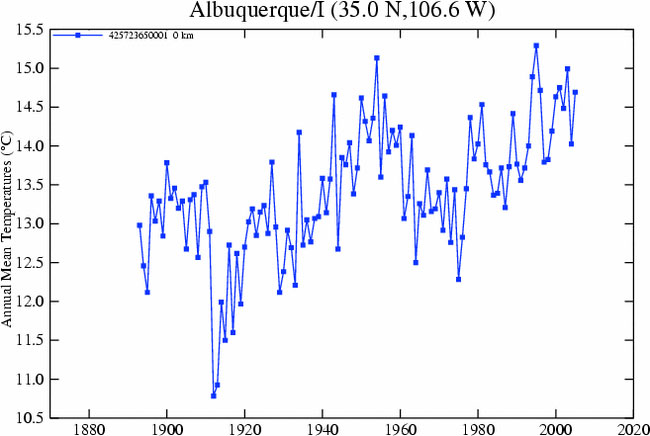
It occurs to me that if I really believe that the regional-scale climate change question is relevant, I should offer up the Albuquerque temperature numbers. 2005, according to the GISS data (adjusted to try to remove an urban bias), is the seventh warmest in history. Seven of the ten warmest years here have come since 1995 1994:

Albuquerque temperatures

The 10 warmest years in Albuquerque:

  1. 1995
  2. 1954
  3. 2003
  4. 1994
  5. 2001
  6. 1996
  7. 2005
  8. 1943
  9. 1956
  10. 2000

(It’s a fun game! Click on the map where you live to hunt for local warming!)

2005 Temperatures

The various analyses of global surface temperature are up for 2005. Realclimate has a rundown. The map from the NASA GISS folks is instructive:
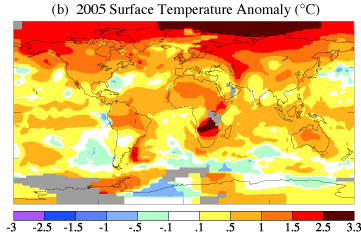
NASA GISS global temperature map
By the GISS measure, 2005 is the warmest year since reliable temperature measurements have been available. By the measurement of the World Meteorological Organization and Climatic Research Unit group in the UK, it’s the second warmest year gobally in history (MSWord document).

Roger Pielke Sr. has some comments questioning the numbers. Given that I don’t really understand his wind and warm bias argument, I’ll pass on that one. But he also questions the sparseness of data. I’d be curious about his comments on Duffy et al.’s conclusion that the sparseness is likely to cause an underestimate of the surface temperature warming, rather than an overestimate.

For those who would like to revisit the question of whether the numbers merely reflect warming in cities where the thermomenters are located, I’ll refer you to Hansen and Ruedy, wherein the urban corrections used in the GISS data are discussed.

As for the monthly debate over whether globally averaged surface temperature is of any relevance, I’ll refer y’all to the map I cribbed above. I’d agree that a single global number isn’t terribly meaningful except as a sort of abstract marker for we journalists to hang a headline on. But the regional variability is of some use to those of us ’round the world curious about what’s happening where we live. And I’ll remind y’all that the planet’s surface is, after all, where we live. You’ll note that Michael Crichton’s going to have to work hard hard to get his fictional characters to the few spots on the globe that were cooler this year than the 1951-1980 average. Looks like they’ll need a boat, which is actually not a problem, since it’s fiction. He can just conjure one up.

Fresh Eyes

Riding down New Mexico 313 through Sandia Pueblo this afternoon, I was reminded of how beautiful New Mexico is. I was riding with a woman who’d just moved here from Tucson (no slouch of a city in terms of its desert beauty), and she kept noticing things I took for granted – a trio of horses munching in a mown alfalfa field, grey cottonwoods, leafless with that muted palette that makes the river valley so soft yet rich this time of year, the looming presence of the north flank of the Sandias. OK, that’s one thing I never take for granted – the looming presence of the Sandias. But it was fun seeing all this through her fresh eyes.

We live in a beautiful place.