Daybook

stuff I wrote elsewhere: 2005 Duke City’s 6th Hottest Year:

Albuquerque is getting warmer.

The year ends as one of the wettest and warmest years in history here. The warmth is a trend, while snowless mountains suggest the wet is not.

readings: An interesting window into a world I don’t travel in: Teenagers Mix Churches for Faith That Fits.

music: One of the CD’s lost in last year’s car burglary was my Best of the Velvet Underground. I just discovered that I’d loaded a bunch of the songs onto my Palm. Sweet.

Daybook

book: I’m rereading bits and pieces of Rivers of Empire, Donald Worster’s 1985 book about water and the west. When I read it 20 years ago, I was sympathetic to Worster’s argument that the concentration of power required for great irrigation works defined the social and political structures of the west. Not entirely convinced, but sympathetic. At the time, I was living in LA and spending a good deal of time writing about water politics. I’m still not entirely convinced, viewing the guarantee of an available water supply a necessary but not sufficient condition for the political and social structures I see around me today. Which brings me to my….

Quote of the day: “The idea that nature has something to do with the shaping of culture and history is an idea that is both obviously true and persistently neglected.” – Donald Worster, see above.

word(s) of the day: “slow-worm,” a legless lizard. (You can tell the difference by the eyes. Lizards have eyelids.)

days: Our saint-of-the-day is Thomas Becket, who got whacked in his own cathedral by four knights (“Will no man rid me of this turbulent priest?”) 835 years ago today, causing everyone to feel so bad that he was sainted two years later. This is also Admission Day in Texas, commemorating its membership in The Union. Various people were whacked in the leadup to that event as well.

Music: A certain Christmas elf (who shall remain nameless because of questions involving federal copyright law) gave me a great mix CD with Bob Dylan, k.d. lang, Kenny Wayne Shepherd and a rockin’ version of “Mustang Sally” by Buddy Guy.

Getting Lit Up

While we here in Albuquerque were busy this holiday season setting ourselves alight, the residents of Tokyo appear to have tried a different approach. We had fun here. James suggests the Tokyo version is not worth the bother:

This picture really doesn’t do them justice – they were much more boring and inconsequential than they appear. Folks, save yourselves the bother, look at the posters on the trains, and stay away.

Worst Pitcher Ever?

Wandering through my newly acquired baseball encyclopedia, I was looking at the records of some of baseball’s greats, and it got me wondering about baseball’s worst. Who, for example, is the worst pitcher in baseball history? It’d be easy to pick on someone like Bill Abernathie, who pitched two innings for the Cleveland Indians back in 1952, gave up four hits and three runs, and disappeared from major league baseball. But that’s cheap. The problem is that there’s a long tail on the right side of the curve of ballplayers who never made it to the major leagues. What I’m really interested in is the worst good pitcher – good enough to stick around. So what should be the benchmark? Ten seasons? 200 games? I found a discussion on a baseball message board that suggested 1,000 innings. What do you think?

Daybook

weather: Looks like this morning’s overnight low of 40 set a record for Dec. 26 – 5 degrees F warmer than the old record of 35. It got down to 37 at my house, according to my new Christmas weather station. (update 10:19 a.m. – Doh! It’s the 27th, the record’s 40 set in 1923, so we just tied it.)

book: Who is/was a better pitcher – Roger Clemens or Sandy Koufax? No question my my nostalgic mind – “Swung on and missed, a perfect game!”. But according to to the stats gremlins of the ESPN Baseball Encyclopedia, who calculate an adjustment based on home park and offensive production of the day, it’s Clemens.

word(s) of the day: “loose box” – it’s a British phrase for “a stable or stall in which a hourse is kept without a tether”. (source: Oxford Dictionary of Current English)

Suburbs?

Coco explains why Corrales et al. weren’t really suburbs of Albuquerque back in 1750.

Suburban-style development grew around existing villages after the first and second world wars as agriculture declined and land was sold or lost to taxes.

Beavers in the Bosque

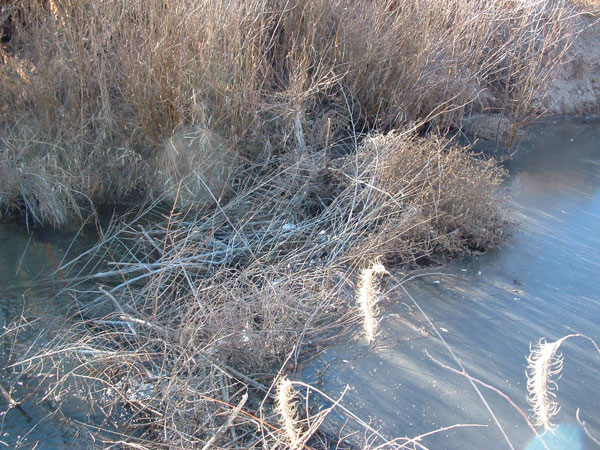
My friend George, who commutes to work by bike very early in the morning, has seen beavers in the bosque a couple of times, at dawn on the west end of the Alameda Bridge where the Corrales drain empties into the river. I’ve never seen ’em, though I’ve seen gnawed tree trunks many times. But today, riding along the river trail down near the botanical gardens, Joe and I saw this:

possible beaver dam?

It’s in the drain along the east side of the river, and I could have sworn it was a half-assed little beaver dam.

Lissa and I went back this afternoon with camera in hand for a closer look, and now I’m not so sure. I want it to be a beaver dam. I could see some bits of wood sticking out of the water that looked gnawed, but up close there were clearly some sticks that had been cut off cleanly, like with a clippers.

Our Festival of Getting Lit Up

There’s been much curiosity in our household about this Festival of Illumination thing. How will we certify that Albuquerque really has lit up 3 million (5 million?) luminarias to convince those Guiness World Record sticklers? Some sort of Santa-borne spy satellite? The honor system? Isabel Sanchez has the goods (sub. req.) in this morning’s paper:

The London-based accountant of extremes— and measurer of yodels and rodent mail— rejected the festival’s application because Guinness doesn’t have a category for luminarias.