Is There Anything Google Can’t Do?

Last night I raised the question: Is there anything Google can’t do?

Yes.

Years ago, at a seminar on investigative journalism, a veteran reporter suggested that the most underrated tool for digging out information is the phone book. Everyone’s in there, more or less. For years I took that to heart. But lately Google has proven much more valuable for the same sort of thing.

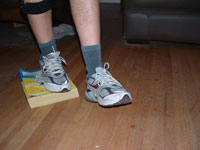
But in my recuperation from knee surgery, I’ve needed a book of a certain heft. It has to be the right height to stand on, stepping up and down over and over to strengthen my quad.

stepping on and off the phone book

Google can’t do that.

Daybook

music: Paper Tiger, the Felonious Groove Foundation. I am so tragically unhip that it was only recently that I grasped my own fondness for the funk. Plus, you’ve gotta love an album dedicated to Malcolm Gladwell and John Denver.

book: Just finished Lee’s Ferry: A Crossing on the Colorado, by Evelyn Brack Measeles. How to say this politely…. There are many times when I’m taken aback reading, thinking, “I wish I’d written that.” This was not one of those occasions. But it did give a good overview of the basic facts of John D. Lee’s establishment of the river crossing, with some fun stuff about the intersection of Lee’s and John Wesley Powell’s paths in 1872, when Powell was preparing for his second run through the Grand Canyon.

books: Been playing with Google Print, their digitized library project. There’s clearly no way to read a book this way, but it seems a potentially useful research tool. Is there anything Google can’t do? (Well, yes. More on this later.)

science: For a story I’ve been working on at work, yesterday I read the famous 1935 Einstein-Podolsky-Rosen paper. I am not a physicist, so it’s not easy going. But, equations aside, the paper’s central point is made with remarkable clarity. But there was this moment when I read one of the key paragraphs, and looked up at the author’s name. Einstein wrote this. Shivers. From his brain to mine. Insanely cool.

Whose Ferry?

I’ve been reading about Lee’s Ferry, and puzzling over the different ways to refer to it. It’s the spot on the Colorado River just downstream from Glen Canyon Dam that today is the put-in for Grand Canyon river trips. It used to be the only reasonable river crossing for hundreds of miles in either direction, a ferry crossing set up by old John D. Lee back in the 1870s. It also is marks the line between upper and lower basin states for the purpose of division of Colorado River water.

My confusion: on maps and in books it’s alternatively “Lee’s Ferry” or “Lees Ferry” or “Lee Ferry.” Found an answer of sorts this weekend in “A Crossing on the Colorado: Lee’s Ferry” by Evelyn Brack Measeles:

The name was officially declared to be Lees Feery (no apostrophe) in the Sixth Report of the United States Geographic Board.*

* Rusho, W.L. “Living History at Lees Ferry,” Journal of the West, Vol. VII, No. 1, Jan. 1968

So it’s officially “Lees Ferry,” but Measeles doesn’t like it. “His has always been the pervading presence,” she writes, “no matter how many other people touched it.” So she give’s it the posessive. I agree.

A Family’s Anguish

We’ve been pretty fixated as a community here in Albuquerque for the last month on the trope of “John Hyde, evil cop killer.” (For those of you outside Albuquerque, Hyde is a schizophrenic man chaged with shooting two cops and three other people over the course of Aug. 18.) That’s why Leann Holt’s story in this morning’s Journal is so powerful (I’m really sorry to say you’ve got to pay for this. What are those idiots at the Journal thinking?)

Leann shares the wrenching, tragic story of Hyde’s family as he went through a downward spiral and they desperately tried to get help. It’s a part of the story that’s incredibly important, and had not been told. Money quote:

“As long as we can dehumanize the mentally ill, we never have to deal with it,” Bauman said. “Until we own them as members of our society, nothing will change.”

The Other John Fleck

FYI, this is not me:

Religion and art ? A June 19 Opinion article said performance artist John Fleck received taxpayer money for a piece featuring a toilet with a picture of Jesus on its lid. The National Endowment for the Arts denied Fleck funding in 1990, and the Supreme Court upheld its decision in 1998.

Annual Heartbreak

The urban wetland that Mark and I have been so lovingly documenting (see also here and see here for a satellite picture) is about to disappear.

The big machines were out this morning beginning their anual scooping of the dirt, cleaning it out to bare concrete. As a journalist by both inclination and profession, I can of course make the argument for the other side in this: the boys at the flood control authority have a mandate to prepare the city for a 100-year-flood, so they have an engineering design specification for the channel’s capacity. The dirt that piles up at the bottom, enabling the lovely wetland, reduces that capacity.

But that knowledge made the plaintive cries of three killdeer this morning, standing helplessly on the concrete bank as their home was bulldozed, no less heartbreaking.