Wet

For my one reader who lives in the neighborhood, a weather update: 0.41 inches of rain overnight. That brings us to 1.63 inches for the month – the fourth straight month in which we’ve received more than double our normal rainfall here in Albuquerque.


New Mexico Central Valley rain graph

That’s precipitation for the first three months of the year for New Mexico’s central valley climate division. You can see rather a spike for 2005. April will certainly push the spike up farther once that data is added in. (Data courtesy Western Regional Climate Center.)

The Good and the Not

As a regular visitor to a minor league baseball stadium, I have always been curious about the difference between those who will make the big leagues and those who will not. In rare cases it is obvious. I was in awe the day I say Pedro Martinez make his AAA debut in Albuquerque. I had never seen a change-up like that here. But usually, to my not-very-cultivated baseball eye, it is not at all obvious.

In today’s New York Times magazine, Michael Lewis has a piece that wanders in quietly – almost like a baseball game, I suppose – through the question:

As Paul DePodesta, general manager of the Los Angeles Dodgers, puts it: ”A very small percentage of the players in the big leagues actually are much better than everyone else, and deserve to be paid the millions. A slightly larger percentage of players are actually worse than players who are stuck in the minors, but those guys usually aren’t the ones getting the big money. It’s the vast middle where the bulk of the inefficiency lies — the player who is a ‘known’ player due to his major-league service time making millions of dollars who can be replaced at little to no cost in terms of production with a player making close to the league minimum.” Just beneath a thin tier of truly great big-league ballplayers is a roiling inferno of essentially arbitrary promotions and demotions, in which the outcomes are determined by politics, fashion, misunderstanding and luck. Put another way: the market for most baseball players is hugely speculative, more like the market for, say, new Internet stocks than the market for stocks in companies with healthy earnings. The investors don’t know how to value the assets.

big-ass wings

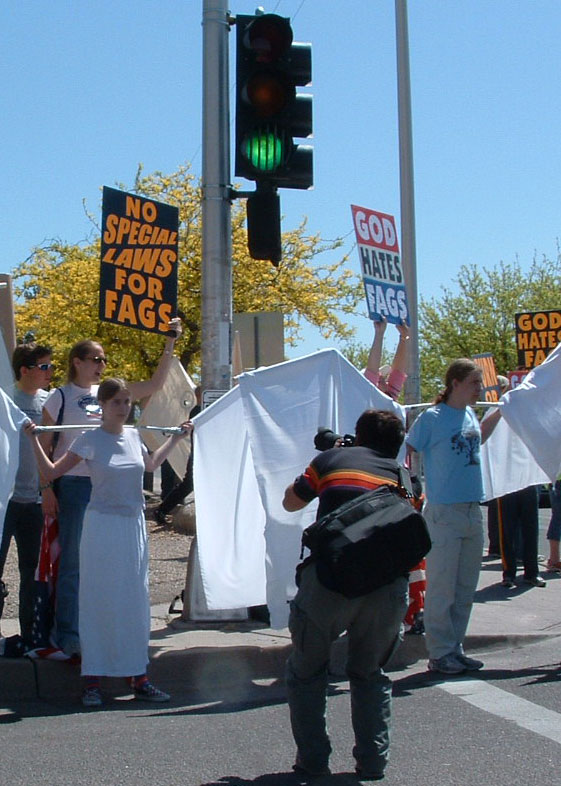
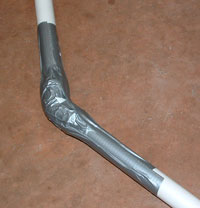
Kids with the moral fire and mischief of youth. Nothin’ like it.


angels

The angel on the left is my daughter, Nora. The angel on the right is her friend Kelsey. The people behind them are – well, I’ll let you judge for yourself. I think not angels.

The backstory dates to October 1998, when Matthew Shepard was beaten to death in Laramie, Wyoming. When Fred Phelps, the notoriously hateful homophobic preacher, brought his bile to Laramie to protest at Matthew’s funeral, people were dumbfounded. When he returned to protest again at the trial of one of Matthew’s assailants, Romaine Patterson was ready:
(click through for more)
Continue reading ‘big-ass wings’ »

5,000 CFS

Typical flow on the Rio Grande this time of year is about 1,000 cubic feet per second (cvs), but our gangbuster spring has the river flowing about five times average right now. That’s nothing compared to a real river. The Mississippi River at Thebes, Illinois, is flowing at 247,000 cfs right now, and that’s low for late April. But in the desert, we take what we can get, so Lissa and I went up to the Alameda river crossing at sunset this evening to take a look.

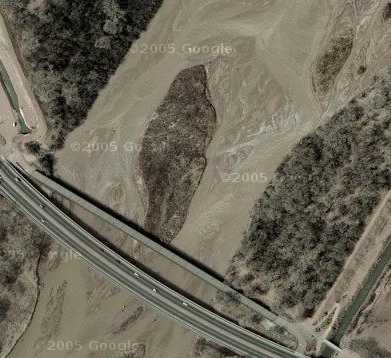
Rio Grande at Alameda

Thanks to Google Maps, that’s the Alameda bridges across the Rio. The bottom one, the one that curves, is the new road bridge. They one above it in the picture is the old bridge, which they closed to cars but kept for walkers and bikers and such. It’s the best spot to look at the river, because of the way it hovers over that island in the middle. Only this evening, it wasn’t an island. It’s mostly entirely under water, and the sand bar that you see in the top right of the picture is gone. It’s lovely.

Tendonitis

After ignoring pain in my right knee for a couple of weeks, I finally stayed off the bike this weekend. In the last two years, the only weekends I’ve gone without riding came when I was traveling and had no bike. Or when I was in bed with the flu.

This is not necessarily a bad thing. There are far fewer weeds in the garden, and a bunch of other necessary chores have been completed. And my knee feels a lot better. But I’m still jonesing for a ride. I’m going to the doctor tomorrow.

Those Wacky Welsh Rugby Fans

New Scientist has a story about some research by Vaseekaran Sivarajasingam at Cardiff University into violence on game days at the local pitch.

Sivarajasingam looked at emergency room admissions for assault from 1995 to 2002:

On non-match days, the number of assault victims averaged 21 per day, and on match days when Wales lost this rose to 25. But the situation was worse after a win, with 33 admissions per day on average.

Suggested avenues for further study: drunken revelry. From the paper: “Winning prompts celebration, a key component of which is alcohol consumption, and prompts the formation of crowds of intoxicated individuals, making interpersonal physical assertiveness more likely.”

We Can’t Predict the Weather a Week in Advance….

It’s an old chestnut of those who would argue against relying on computer models to try to understand the trajectory of climate over the next century. ” We can?t predict the weather a week in advance. How can we do it 100 years in advance?”

William Connolley has an excellent explanation of the way in which the argument glibly misunderstands the issue:

A better analogy is with throwing a (fair) die: you can’t predict whether the next throw will be 1, 2, 3, 4, 5 or 6; yet you can be fairly sure that if you throw it 1000 times you’ll get very bored. Sorry: If you throw it 1000 times, the average throw will be close to 3.5. And to pursue this a bit more, if you make the die a bit unfair (by, say, making the 6 twice as likely to come up) then you still can’t predict what the next throw will be. But you can be sure that the long-term average will go up to… thinks… about 4 1/3.

But I wondered: is this just a straw man? Does anyone really make this argument? Not to worry. Tech Central Station (in the person of none other an eminence than James Glassman himself) comes through again:

We know how difficult it is to predict the weather for tomorrow; so, how are we going to predict the climate 100 years from now?

Thanks, Jim.

update: In rereading this, I realize another point that needs to be made. I’m not trying to use this as a defense of climate models. There are plenty of good reasons to think carefully about the use of climate models in formulating public policy. You’ve got to be careful in understanding both their strengths and limitations. This is merely meant to point out the vacuousness of one particular rhetorical trick used in an attempt to knock them down.