First Hummer

Let the record reflect the first Heineman-Fleck hummingbird sighting of the season: 10:43 a.m., April 16, 2005.

Lissa and I were sitting on the front porch snacking. The little guy zoomed up to the hummingbird feeder hanger. No feeder yet, but he was makin’ the rounds. Think about it. This guy has been to Central America for the winter, all the way back, no Mapquest, no Google Maps, and a very small brain as well. But there he is.

Lissa immediately went in and filled the feeder, then began calling friends and family to report.

Daybook

Cycling: Played hooky from work, allowing a leisurely ride in the bosque. My right knee’s a bit tender, so “leisurely” was a must.

Baseball: There was a moment during the sixth inning this afternoon at the ballpark when Paul leaned over to ask if I’d ever seen a shutout here. I’m pretty sure the answer is no. The score at the time was Omaha 9, Albuquerque 0. Not to worry. It’s AAA ball at 5,000 feet elevation. The pitching’s, uh, uneven, and the ball flies outta there. Final: Omaha 10, Albuquerque 6.

Reading: I’ve been fascinated by the back-and-forth between Roger Pielke Jr. and the RealClimate guys over at Prometheus about the role the RealClimatists are playing. See especially this discussion. I’ve been thinking about what it might mean for my role as a journalist. More to come.

Garden: Weeds much the fewer out by the driveway.

Drought in the Amazon

Erik Stokstad has a story in Friday’s Science (paid sub. req.) about a research team creating artificial droughts in the Amazon to try to understand the implications of climate change on the rain forest:

What’s worrisome is that when drought lasts more than a year or two, the all-important canopy trees are decimated. Everyone knows that a lack of water eventually kills plants. But by pushing the tropical forest to its breaking point, researchers now have a better idea of exactly how much punishment these forests can withstand.

These kinds of data will be indispensable for predicting how future droughts might change the ecological structure of the forest, the risk of fire, and how the forest functions as a carbon sink, experts say. Given that droughts in the Amazon are projected to increase in several climate models, the implications for these rich ecosystems is grim, says ecologist Deborah Clark of the University of Missouri, St. Louis, who works at La Selva Biological Station in Costa Rica. The forests are “headed in a terrible direction,” she says. What’s more, the picture includes a loss of carbon storage that might exacerbate global warming.

Garden in Spring

Charlie Liles, the head of the local National Weather Service Office, has done a good job of tracking freeze dates in and around Albuquerque. It’s one of his most visible functions, keeping the gardeners informed.

apple blossom

His data pretty clearly tracks the trend: what the climate wonks call the “shrinking diurnal temperature range,” which translates as “it doesn’t get quite so cold at night any more,” which is one of the hallmarks of greenhouse-driven climate change. Here in Albuquerque, the average last frost date over the long term is April 15, but for the 1991-2004 period it’s April 1. A little bit of consistent change in the overnight temperatures can push those last freeze of spring and first freeze of fall dates around quite a bit.

I guess global warming’s good for the garden.

This year we got down to 32 degrees April 10. My money’s on that being our last freeze, and with the rainfall we’ve had this spring (more than four inches since Jan. 1, by far a record since 1890-something and more than three times average), the garden’s all of a sudden busting out.

iris

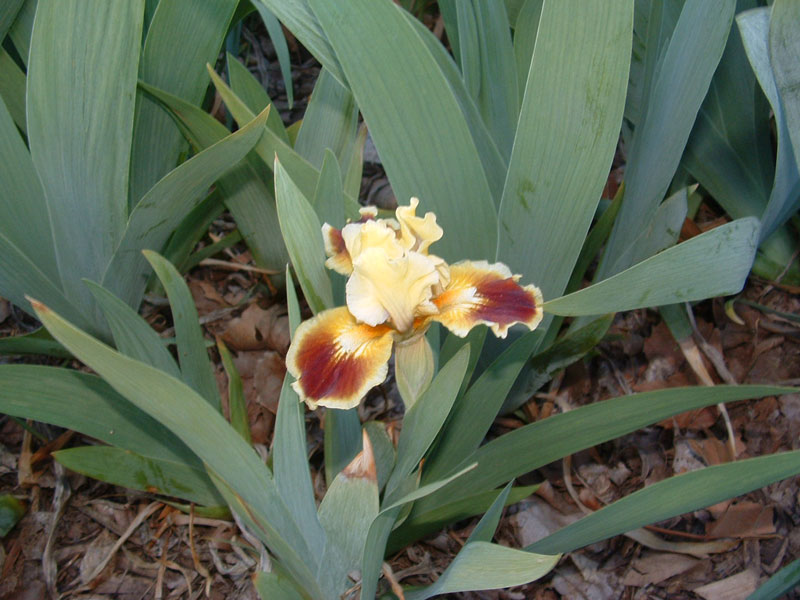
Lissa was exhausted this evening, but I pried her off of the couch for a quick wander through the garden to see what’s growng. Out front, she spotted the lovely little iris you see above. It’s at the front of our big iris bed, which is looking like it’s about ready to pop, but not quite. So for now, it’s the little early ones poking out here and there.

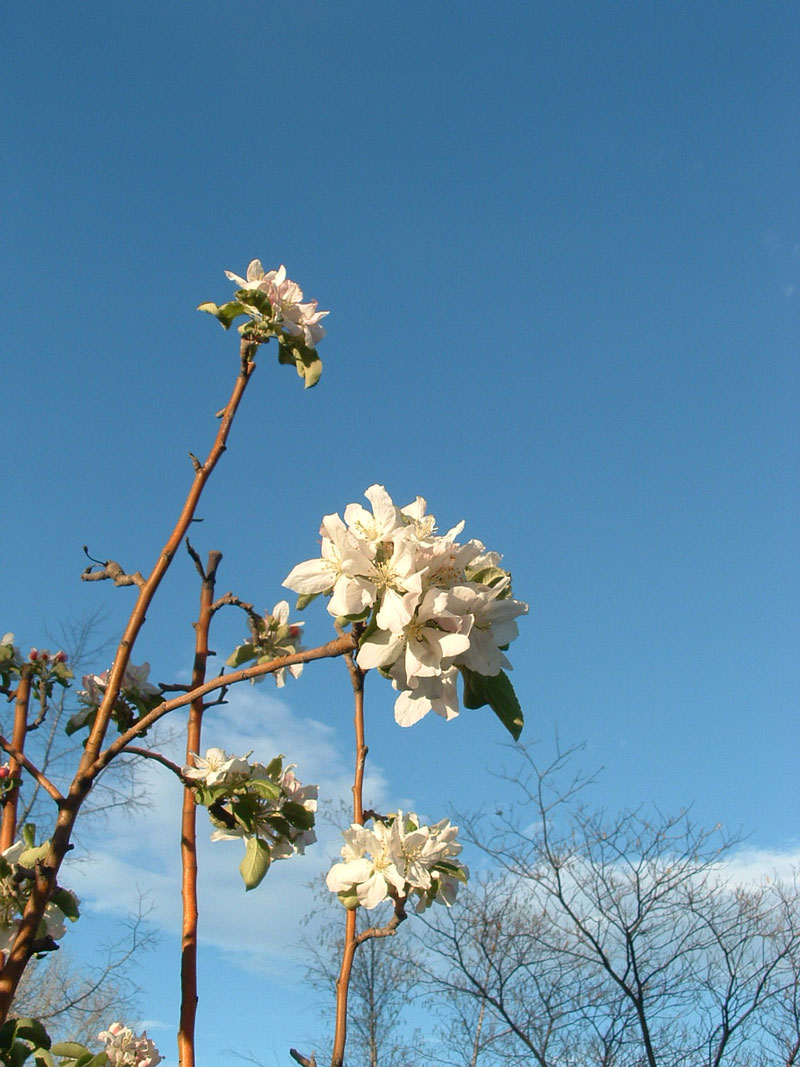
Out back, the apple trees are in blossom, and the wisteria is starting to leaf out. We’ve got this lovely miniature oak (we didn’t mean it to be miniature, but one must adapt to one’s garden ecosystem – it doesn’t work the other way ’round) is covered with these cute little oakleaf clusters.

Our Harrison’s rose (the yellow rose of Texas) has sent out runners, competing for space with the mums with which it shares a bed. My money’s on the Harrison’s, which has the advantage of being from hardy pioneer stock and being much preferred by the gardeners. (The ecosystem’s not entirely on its own.)

Today’s high was 76, and tomorrow’s forecast to be much the same. I’m playing hooky from work, with a morning on the bike and tickets to an afternoon baseball game.

I love spring.

Stuff I Wrote Elsewhere

Ever since I met Michael Martin Nieto nearly a decade ago, I’ve been fascinated by his work on the Pioneer Anomaly. It’s partly because the anomaly is so intriguing: the spacecraft, as they headed out of the solar system, behaved as though there’s a little more gravity tugging on them than their ought to be. But part of the fascination is Nieto himself. He’s a funny guy, who loves the mystery, and has a very careful attitude toward the whole thing. The hook here is that there are a couple of proposals for new space missions to test the thing. But that’s just an excuse. I really just wanted to write about it again. From this morning’s Journal:

When a scientist finds new data that conflicts with a well-established theory like Newton’s or Einstein’s, the first reaction is not likely to be to book tickets to Stockholm for their Nobel Prize ceremony. The more plausible explanation is that they’ve missed something.

So for the last decade, Nieto, Anderson and others have banged away at the data, trying to make the “Pioneer anomaly” go away.

A software error was one of the first things they tested. They analyzed the data using software developed by two completely different groups, and got the same answer.

With that ruled out, they figured the most likely explanation was what they call a “systematic error”? something about the spacecraft that they’ve missed, perhaps a gas leak that’s sending it off course, or some sort of uneven heating of the craft, or something of that sort.

When people offer Nieto that explanation he’s likely to agree. “I say, ‘Hell, you’re probably right, but I don’t do faith-based science.’ ”

In other words, it’s not enough to say it’s probably a systematic error. You have to find it. But try as they might, the Pioneer anomaly team has been unable to do so.

Pinhead Pika Shafts the Truth

(Note to the Planet GNOME and climate wonk audience: this is local Albuquerque politics. You can skip it. I have a fragmented audience problem. Whatever. It’s my blog.)

There’s so many intentional misstatements of fact in Pinhead Pika Brittlebrush’s commentary on Quirky Burque, that (honest to God!) I really don’t know where to begin. While I don’t want to call fellow Albuquerque blogger Pika “Orange Helicopters” Brittlebrush a fool, she clearly doesn’t have our best interests at heart.

Before addressing Brittlebrush’s bizarre assertion that the cat fight should stop and be replaced by a more civilized discourse, I’ll offer a disclosure Pika “Yellow Minibikes” Brittlebrush won’t: she once had lunch with Greg Payne’s gardener’s second cousin, who also once had coffee with the guy who does James Scarantino’s taxes.

Next thing you know, Scarantino and Payne are at each others’ throats with a series of retaliatory smear jobs, and now Pika “Red Hovercrafts” Brittlebrush is trying to shut things down. Coincidence? Folks, c’mon… not in this business!

Stuff I Wrote Elsewhere

From today’s Albuquerque Journal:

Tired of nuclear weapons that behave like finicky Ferraris, a small group of nuclear weapons designers is beginning to think about an alternative. Think Volkswagen Bug? nothing flashy, just cheap and reliable.

The program, created under prodding from Congress and the Pentagon, is modest in size, just small teams of designers at nuclear weapons labs in New Mexico and California. But if it succeeds, it could lead to a new generation of nuclear weapons fundamentally different from the finely tuned, lightweight killers designed for the Cold War.

Jackie Chan Update

Thanks to all who responded to my plea for help making my way through the Jackie Chan oeuvre.

Dave makes a good point: “I think you have stumbled on to one of those questions that Buddhists use to clear the mind of thought for meditation. How can you judge whether a Jackie Chan movie is bad?”

Chan’s made 90 films. Therefore the fact that four of the six people who emailed me with their favorites mentioned Drunken Master and Police Story suggests we’ve moved beyond statistical fluke into the realm of consensus. They’re going into the Netflix queue.

Amazon-style, we also got a note suggesteing Buster Keaton. Good call, DW.