Jackie Chan

We signed up for Netflix, and I’m now confronted with a dilemma: How do I tell which Jackie Chan movies suck?

I got hooked almost 10 years ago when my sister dragged me to see Rumble in the Bronx, which was hilarious. After that, we’d see each new one together. I’ve taken no great joy in his crossover into American cinema, but I loved the old Buster Keaton kung fu master stuff.

My first Netflix pick was Project A, which left something to be desired. I mean, the kung fu bicycle scene was genius, but the rest of the film rather flagged. And his body of work is so, um, voluminous. I must find a filter.

Daybook

Food/family: Nora, for her birthday dinner, chose sushi. Excellent.

Reading: I’m still picking my way The Great Maya Droughts. It’s an oddly structured tome, with the author spending a great deal of time laying down exceptionally thorough theoretical foundations, as if defending against imagined arguments against what he’s trying to say. It seems odd to me that one would need to defend the assertion that climate influences the arc of human culture.

Free software: DV’s burnout post troubled me. What little time I have to devote to free software work these days I’ve been spending on libxml. I’ve seen Daniel be extraordinarily responsive, over and over again, to users with well-articulated needs and – and this is critical – a willingness to listen to Daniel when he reframes the problem.

Climate: From the Journal of Climate comes a tidbit from Shaleen Jain and colleagues of some relevance, I think. Variability of flows in four major western North American rivers increased over the last half of the 20th century. That means wetter wet years and drier dry years. They draw a dotted line between the trend, warming sea surface temperatures and projected 21st-century warming. They draw a solid line between the trend and water supplies in the West.

Invasive Species

A bunch of threads to connect here:

Thread one: My own bias – invasive species are bad. The woods along the Rio Grande, my beloved bosque, are rich with native cottonwoods, but the riches are being inexorably choked out by the non-native salt cedar (Tamarix ramossisima). I am reasonably certain this is bad.

Thread two: Rudy Carillo’s battle with the London rocket (Sisymbrium irio), a Eurasian invader that is thriving on the back of our record-setting winter precipitation:

The plant is the winter home to a species of leafhopper that carries the dreaded curly top virus. When the weed dies out in mid-spring (it’s a winter annual from northern Europe, as the common name implies) it’s certain that those same insects will move on to a variety of garden favorites, including chile and tomato plants, transmitting the virus as they proceed. According to the big agricultural school down south, curly top virus is deadly to the state’s chile production: the last infestation, in 2001, destroyed between 40-50% of the crop.

My across-the-street neighbor, not noted for tidy gardening, has a front yard thick with London rocket. A couple of weeks ago, he mowed them. They’re already tall enough again for the neighborhood cats to hide in them. I am reasonably certain this is bad.

Thread three: The worldchanging Jennifer Forman Orth, author of the Invasive Species Weblog. ISW is one of those Internet treasures, the carefully assembled insights of a smart person with an odd but useful obsession. I am reasonably certain that Orth’s ISW motto – “It’s Time to Wipe Out Invasive Plants” – is good.

Thread four: The cover story in the May 2005 Discover Magazine, in which Alan Burdick argues that my conventional wisdom, that invasive species are bad, may be simply wrong. While there are individual cases in which invasive species have caused very specific kinds of damage, the case is not generalizable, Burdick argues. In many cases, he writes, what I would call “invasive species” are more like benign immigrants, sliding into an ecosystem while causing little displacement.

I’m not saying I’m convinced that Burdick is right, but it’s always fun to have one’s preconceptions well challenged. I eagerly await Orth’s review of Burdick’s observations.

Horse Cookies

Down in Albuquerque’s far south valley, there’s a lovely shady spot along the bike trail with a pasture, home to a single horse. Frequently the horse can be found over along the trail, poking his head through the fence to watch the cyclists.

This morning, as I passed I saw a guy who had pulled his bike over and stopped. He was feeding the horse.

I rode on, and a few minutes later the guy caught up with me. I asked him what he fed the horse – imagining Power Bars or something.

“Horse cookies,” he said. Turns out he has horses of his own, and has these little baked horse treats that they love. So whenever he’s headed on a ride down by the pasture, he sticks a couple of horse cookies in his pocket. He whistles as he rides by, then makes a quick turn around and by the time he gets back, the horse is over by the fence waiting for his cookies.

Wearing Yellow

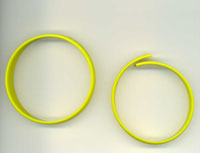
Friday, my yellow LiveStrong band broke. I’d been wondering how much longer I should wear it, and I figured that was an out. Then last night at dinner, Lissa asked me if I wanted to wear hers. Jeez. The cancer survivor gives you her LiveStrong band. You pretty much have to wear that.

Two LiveStrong bands, one broken