When You Don’t Have Cable

Daughter Nora, at sixteen, has raised the cheerful mockery of her parents to a high art.

“This is what happens when you don’t have cable,” she said after I explained that we were watching not one but two turltes in the backyard. See, we’ve got two turtles, but we hardly ever see them, and it’s been since forever that we’ve seen both at the same time.

Lissa was still in bed this morning when Sadie raised the alarm. I though she was just barking at the back door to come in, but when I went out she was barking and dancing around two turtles scrunched inside their shells by the back door, trying to avoid Sadie’s excess of enthusiasm. I brought Sadie inside, alerted Lissa, and an hour of amusing turtle watching began.

First one of the turtles (they are named Speedy and Olivia, though we are not entirely sure which is which – they look quite similar) bumped at the other one, crashing into its shell. Then they wandering began. Lissa took many pictures, referred to old photographic documentation to try to sort out the question of which was Speedy and which was Olivia. Olivia climbed up into one of the little bird baths that sit on the ground. She’s a desert turtle. That seemed odd.

Nora mocked us, suggesting alternative names for the turtles and repeating variations of the cable TV joke. She even turned on her computer, that she could mock us in her blog. But she did have to venture outside to see for herself the turtle sitting in the pond.

“She thinks we’re kooks,” Lissa said, “but she did want to come out and see the turtle in the water.”
Hollywood and Climate Change

An intriguing bit of research published on the letters page of Science today (sub. req.) about the effect of the “Day After Tomorrow” climate porn film on public attitudes toward, and knowledge of, climate change. Andrew Balmford and his Cambridge colleagus surveyed a bunch of movie patrons, some before and some after seeing the film.

This has all the usual problems and biases of this sort of a survey, including the fallacy of sell-reporting – “Say you’ve got $1,000. How much would you like to spend on….” But the results were nevertheless instructive in at least a qualitative way. After seeing the movie, folks were more likely to want to spend money on greenhouse mitigation. But they were less likely to correctly understand the science.

Overall, the data thus suggest that seeing an entertaining if exaggerated illustration of the possible effects of climate change succeeds, in just 125 minutes, in raising public concern–but at the price of reducing public understanding. It would be interesting to see if these divergent effects hold in other countries, and which, if either, persists over time. More generally, our findings confirm that intense dramatizations have real potential to shift public opinion. However, the question remains whether such portrayals can be made more accurate (and thereby less confusing) without losing their popular appeal.

Paper and Pen – the Underrated Technology


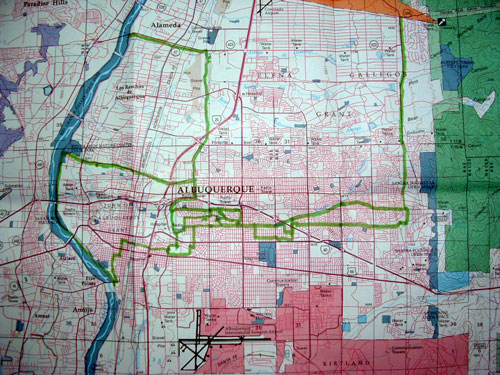
Albuquerque map

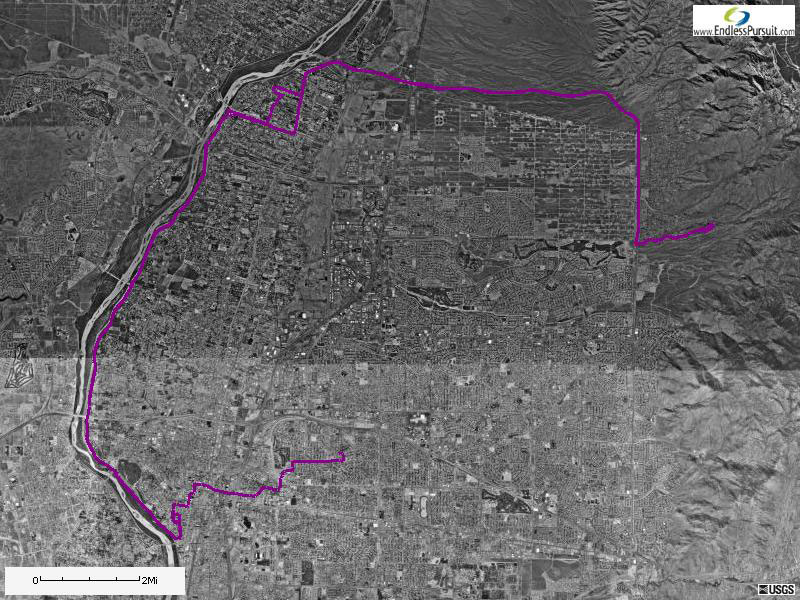
A couple of months back, a friend loaned me a GPS gizmo, and I thought it was one sweet toy. I could slip it in the pocket of my bike shirt when I went riding, then plug it in when I got back and get a map of where I’d been, plus an elevation and speed profile.

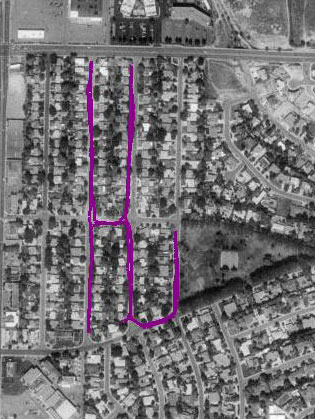
Lissa and I went out walking around the neighborhood, tracing out a greeting to the world.

I coveted this toy. I love the concept of GPS art, and I imagined myself pocketing the little thing every time I rode, building up a rich map of my two-wheeled travels around the greater Albuquerque area.

And then I bought a map. (Click below to read more, this is kinda long for the aggregators.)
Continue reading ‘Paper and Pen – the Underrated Technology’ »

Harlow the Journalist

Interesting letter in the September Physics Today (more catching up on the reading) from Sidney van den Bergh at Dominion Astrophysical Observatory in Vancouver about Edwin Hubble and Harlow Shapley, two huge dudes in early 20th century astronomy. (Hubble figured out that the there were other galaxies beyond our own, but he thought they were evenly distributed. Shapley noticed they were sorta clumpy, which turns out to matter a great deal.)

Van den Bergh tells us that Hubble originally trained as a lawyer, while Shapley “began his career as a journalist.” Good to see he thought better of it.

Clouds and Climate

Catching up on my reading last night (I get too many weekly science magazines*, all of them good), I curled up last night with a piece in the July 24 New Scientist (apparently not on line) by Fred Pearce about uncertainties in the climate models because of water vapor and clouds.

Pearce talks about relatively new model results suggesting that uncertainties over water vapor feedbacks are creating a big tail on the warm side of the curve of uncertainty over CO2 doubling – in other words, increasing the odds for Earth ending up on the warm side of the one to twelve degree C warming range.

The story gives a good accounting of what the uncertainties are, and why water vapor is hard for the modellers. But then Pearce concludes with these frankly astonishing comments:

Some climate scientists find these new figures disturbing not just for what they suggest about the atmosphere’s sensitivity to greenhouse gases, but also because they undermine existing predictions. Uncertainty about those predictions is stopping politicians from acting to halt global warming. So, they argue, even suggesting that the model results are less certain could be politically dangerous.

But other climate scientists fear creating a spurious certainty about climate change. Since we don’t know what the future holds, they say, we shouldn’t claim to know. These people see the predictions of climate models as less like a weather forecast and more like a bookmaker setting odds for a high-stakes horse race. There are no “dead certainties”. They say that humanity has to act prudently and hedge its bets about future climate change in the absence of certainty. We will, they argue, never be able to see through the clouds, and politicians will just have to accept that.

I rather wish Pearce had named names here, especially the scientists described in the first paragraph above who seem to think that they ought not be sharing the truth with the public and policy makers lest we get all confused about what to do about greenhouse climate change. That “we’re scientists and we know best” attitude is the sort of profound arrogance that has gotten scientists into trouble on the climate change debate.

* I’m getting New Scientist, Science, Nature and Science News right now – all terrific, but who has time to read it all?

Watching Ivan

I admit I’m crazy obsessed with watching the hurricanes come.

Part of it is the inherent drama. And part of it is the remarkable way in which internet distribution of information makes so much available that used to be solely the province of professional weather geeks.

My latest discovery is the Weather Underground Tropical Weather page. For each current storm, they assemble all the latest information, including maps where they overlay all the forecast tracks from all the major weather models. You can really get a feel for how hard hurricane forecasting must be. (You can see the big spread in the models after Ivan makes landfall, thought that seems to be slowly sorting itself out.)

On that subject, Andrew Revkin had a good piece in today’s New York Times:

TALLAHASSEE, Fla., Sept. 13 – At the National Hurricane Center, a gray bunker bristling with satellite dishes on the outskirts of Miami, meteorologists scanned readings last weekend gleaned by aircraft plunging into the eye of Hurricane Ivan and they squinted at satellite images while preparing a fresh forecast for the track of the dangerous storm.

After assessing the data and the output of half a dozen supercomputer storm simulations, Stacy R. Stewart sat in front of a map of the Atlantic and Caribbean with an eraser and colored pencils, drawing the storm track newly estimated for the next five days. The map was filled with erasures of older storm projections that had at one point been the best bet but now were off by hundreds of miles as the storm’s northerly curve drifted west.

This is the state of hurricane science in the new century: a mix of growing skill and persistent uncertainty, of intuition and algorithms, satellites and erasers.

Signs of Fall

Things I saw today, all signs of fall:

  • Kids running – an invitational cross country meet, my iconic autumn sport – at the UNM north golf course
  • The first clumps of yellow leaves on the bosque cottonwoods
  • A praying mantis on our screen door
  • Lissa making cactus juice, a mess of the most lovely, deep rich shade of purple scattered all about the kitchen

Today we must go to the fair.