Why Bobby’s Back

Bobby Julich gives it one more shot:

“It’s not about winning races or being on the podium of the Tour, winning the money or becoming famous,” Julich said. “For me it was one thing: For those three weeks in 1998, I was in the zone. That was the most amazing feeling. If there’s anything I want to experience again before I retire, it would be to feel that again, that sensation.”

(From Velonews’ excellent profile of Bobby as he take one more shot at the pinnacle of the European peleton.)

Obesity, Health Care Costs, and Life on the Commons

Andrew Sullivan suggests, in response to yesterday’s CDC report on obesity, that if one wants to be fat, that’s a personal choice:

What’s to be done on a collective basis? I have an idea: nothing. If people want to eat themselves into misery and early death, it really isn’t anyone else’s business.

Well, perhaps. Or perhaps in the sort of commons we’ve built for ourselves, where we all share one another’s health care costs, either through pooled insurance or tax-funded care, one’s obligations spread a bit farther than the end of one’s fork.

John Malkovich and the Garden Gnomes

So it’s been suggested that I don’t write enough about gnomes or something, but that’s weird, because sometimes they’re all I think about, and it’s all I can do to not write about them. I’m sort of embarassed to admit it, but sometimes I’ll lie in bed at night, in the dark, and imagine my gnomes, talking to me.

I just wanna say that I’m so happy to be part of a community that loves gnomes as much as I do.

Church sign


It raises all sorts of philosophical questions about the nature of self, about the existence of the soul. Am I me? Is Malkovich Malkovich? Was the Buddha right, is duality an illusion? Do you see what a can of worms this portal is? I don’t think I can go on living my life as I have lived it. There’s only one thing to do. Let’s get married right away.

The thing is, I’ve never seen the movie.

Think Globally, Trade Emissions Locally

A British research group is suggesting a sort of localized version of Kyoto-style emissions trading, according to the BBC:

Every man and woman in the country could be issued with a fixed number of permits to pollute the atmosphere under an idea from government-sponsored researchers. It’s been proposed by academics at the Tyndall Centre – one of Britain’s top institutes for climate change policy.

They say it’s the best way of helping Britain hit its long-term target of cutting by 60% the emissions thought to be changing the climate. People living simple lifestyles could make money by selling their excess pollution permits to those wanting to live in the fast lane.

(Thanks to Mike Newman for the link.)

Laughing Lizard

We drove Janis up Jemez Canyon today, a day that had that first-day-of-spring-emerging-from-hibernation feel to it.

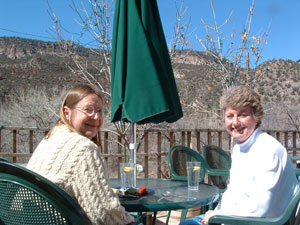
Lissa and Janis on the patio at the Laughing Lizard

You can see from the clothes that it’s still got some chill to it, and if you looked in the opposite direction, toward the north-facing slopes, you’d have still seen snow. But it was warm enough to eat quite comfortably on the patio at the Laughing Lizard. The locals were emerging into the street, aggressively wearing shirtsleeves, with cheery hellos and big spring grins.

We drove Janis up to the soda dam, a big plug of travertine laid down by hot springs across a narrow point in the canyon. It’s an odd tourist destination – it smells bad, and you’ve got to brave traffic to cut back and forth across the highway to see the dam and the most active little springs, which are across the road. But it’s geology at a near-human time scale, worth the trip.

Mainly we just ogled the rock, which is at its best down the canyon in the Triassic redbeds of Jemez Pueblo, the reddest rocks it has been my privilege to see in my travels ’round the southwest.

Playing Tourist

Lissa’s friend Janis – a deep old childhood sort of friend – is visiting for the weekend from California.
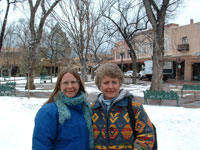

Lissa and Janis at the Santa Fe Plaza in the snow

We hit a brief but thick snowstorm yesterday on the drive to Santa Fe, leaving the plaza (above) in picture postcard condition. Early lunch at the diner (I barely got in on the tale end of breakfast, which meant a breakfast burrito slathered in rich red chile) and then over to the Georgia O’Keefe.

O’Keefe has almost become a cliche, a pastiche of rich-toned southwestern landscapes, but the museum does a good job of reminding that she really stands square amid the sweep of 20th century art, more than cow skulls etc.

Janis wanted to see the folk art museum, which is another treasure, almost visual overload. To recuperate, we had coffee at the newsstand in my sister’s old neighborhood off Canyon Road, where we stumbled into one of those classic Santa Fe moments – pony-tailed guru, speaking to eager disciples:


“The word is the vibration.”

There also was some talk of prophecies and transformation, and real estate.

Nyet on Kyoto?

A new UN report may signal the death knell for the Kyoto treaty by giving Russian treaty opponents the ammunition they’ve been looking for, according to a piece today by Paul Webster in Science (subscription required). The problem, according to Webster, is that previous UN calculations that seemed to show the Russians would have carbon credits to sell may be wrong, having failed to take into account burgeoning new Russian economic activity. Russia is key, because Kyoto doesn’t come into effect until countries representing 55 percent of the world’s carbon emissions sign on. With the U.S. out, as Webster and others note, Russia is pretty much the key. But the only way the Russians can win the political support internally is if Russia can make money selling carbon credits – essentially selling off its reductions in carbon use to other countries that want to use more (this carbon credit market is a central feature of Kyoto). If Russia doesn’t have any to sell, political support there will likely evaporate.