Liggett and Berlioz in the Hills of Italy

With winter set in, I’ve been riding some of my miles in the gym on a stationary bike, and I’m still trying to settle in on the best way to do it. Outdoors, riding is play. Indoors is a little uncertain, but must not become work.

They’ve got TV’s in the gym – usually one on CNN and the other on one of the network morning shows – and a tuner thingie that let’s you listen to the TV’s sound on an FM radio. So I’ve tried CNN. And I’ve tried NPR, though the reception inside the building is pretty poor. But there’s something about the distraction of words in my ear that isn’t quite working.

So today I took my CD player and listened to Hector Berlioz’s “Harold in Italy”. It’s a piece he wrote after a trip wandering the mountainous Abruzzi, and I settled in and closed my eyes and let Hector be my guide as my friends and I rode sometimes hard and fast, sometimes at leisure, through these long winding valleys, past old villages to the base of these spectacular alpine climbs, then up.

The joke in cycling is that we all hear Phil Liggett in our head, doing the blow-by-bow commentary on our town line sprints or as we switchback up a difficult hill. But the wordless play-by-play of Belioz worked a charm.

The final movement – the Orgy of the Brigands – is a frenzy, and I was hammering up through steep woods, alone by this time on the steep climb, breaking out of the trees above timberline onto a false flat near the finish line, then steep again, and I looked down at my heart monitor. I was pegged.

In my mind’s eye I won the stage, zipping up the jersey for the finish line. It was a memorable ride. I’ll have to try that again.
Rio Grande River

I just noticed an accidental joke I left in the GNOME dictionary docs.

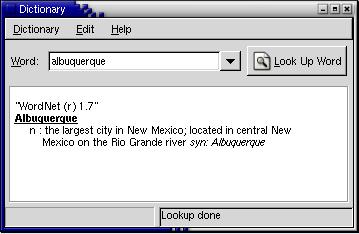
To personalize the screenshot, I took an image of the dictionary looking up the definition of Albuquerque. It’s been this way through several generations of GNOME releases:

Dictionary Screenshot

This evening when I was checking docs for the 2.6 release I noticed what the search engine had returned:

Albuquerque

n : the largest city in New Mexico; located in central New Mexico on the Rio Grande river

Rio Grande river would be, uh, redundant. Like Sierra Nevada mountains or La Bajada hill.

Shaun Rocks

Garnome built while I was at a lovely party last night. Included is the new Yelp (2.5.2) magic done by Shaun, magic that makes help display with great speed and alacrity, even the big ol’ Gnumeric docs.

Living High

A team of Russian archaeologists has found a site in far northern Siberia that?s all kinds of interesting.

For starters, there?s the age. Radiocarbon dating puts the age at about 30,000 years old. That?s Pleistocene, ice age times. That?s the oldest human occupations north of the Arctic Circle yet found. This is key, because for the first Americans to get here, they had to go up and across the Bering Strait, which is up hard against the Arctic Circle. Before this, the first solid evidence of folks making up there was half that age.

But since this is a story about how folks first got from Asia to the Americas, the second bit is even more interesting. The archaeologists found a worked horn of a wooly rhinoceros that they say ?bears a striking resemblance to Clovis foreshafts from North America?. Clovis culture is one of the first in North America, soon after the ice age slipped off. There?s a lot of arm-waving in archaeology, but this is arm-waving of a pretty interesting variety. This is an inference that those poor frozen sods in northern Siberia can be linked to Clovis culture.

New Scientist has a story, and the original paper is in Science (subscription required I think).

Global Warming

The Goddard Institute for Space Study has its December 2003 global climate data posted, and it shows 2003 as the third warmest in the century-plus of data they’ve got:

upward trending global climate data graph

That’s a 10-year rolling average to smooth out the noise in the data. You can see what Karoly et. al. suggest is a natural warming trend for the first half of the 20th century, and our greenhouse handiwork for the more recent half century.

The full GISS data set is here if you want to pull it down and play with it yourself.

Intelligence in Missouri?

The Missouri legislature will consider a bill this session requiring “equal treatment of science instruction regarding evolution and intelligent design”.

Talk about muddy thinking. Try this “Hypothesis”, a scientific theory reflecting a minority of scientific opinion which may lack acceptance because it is a new idea, contains faulty logic, lacks supporting data, has significant amounts of conflicting data, or is philosophically unpopular.

The bill’s list of definitions for some reason singles out “Extrapolated radiometric data” for special treatment, suggesting a young-Earth creationist hand on or near the tiller, which is almost surely the kiss of death for these guys.

Climate Debates

I’ve been reading a lot of climate science lately, partly for the newspaper (see especially this piece on the warm 2003, which I’ve mentioned before) and partly for the book.

But even though I delved into the controversies a bit in my ABQJournal piece, I’ve largely stayed away from the hurly burly of the debate between climate scientists and the skeptics on the question of human-induced global climate change. The whole argument seems so talk radio that I just don’t have much stomach for it.

But I poked my story at David Appell, and he blogged it. And the talk radio stuff began. It’s been kinda fun, actually, mixing it up. I hope I haven’t soiled myself too much in the process. After all, one owns ones posts.

Stove

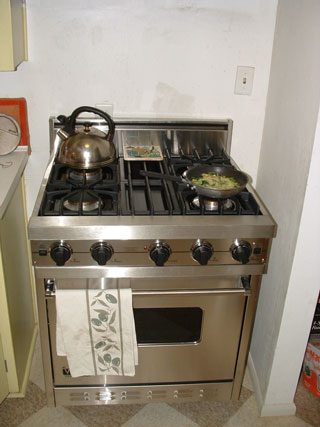
The new stove arrived yesterday. The old stove was one of those hideous cheap white things that’s always the cheapest thing on the showroom floor. We inherited it with the house when we bought it.

The new one is a thing of beauty.

New Viking stove

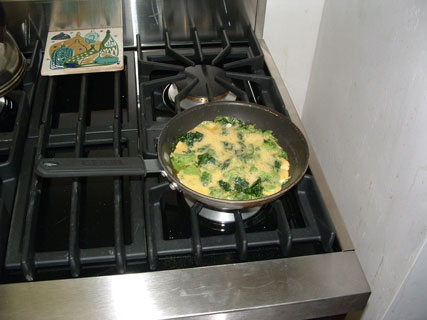
That’s my first omelette cooking on the new stove. It has spinach and broccoli in it.

omelette cooking on new Viking stove

Is there some sort of postmodern irony associated with the fact that I blogged the omelette before I finished eating it?

The Internet and Coffee Houses

We aren’t so smart and innovative as we think. From the Economist:

Where do you go when you want to know the latest business news, follow commodity prices, keep up with political gossip, find out what others think of a new book, or stay abreast of the latest scientific and technological developments? Today, the answer is obvious: you log on to the internet. Three centuries ago, the answer was just as easy: you went to a coffee-house. There, for the price of a cup of coffee, you could read the latest pamphlets, catch up on news and gossip, attend scientific lectures, strike business deals, or chat with like-minded people about literature or politics.

The coffee-houses that sprang up across Europe, starting around 1650, functioned as information exchanges for writers, politicians, businessmen and scientists. Like today’s websites, weblogs and discussion boards, coffee-houses were lively and often unreliable sources of information that typically specialised in a particular topic or political viewpoint. They were outlets for a stream of newsletters, pamphlets, advertising free-sheets and broadsides. Depending on the interests of their customers, some coffee-houses displayed commodity prices, share prices and shipping lists, whereas others provided foreign newsletters filled with coffee-house gossip from abroad.

(From Smart Mobs.)