
I rode bike this morning in spirit with my friend Jaime, who’s doing Ironman Florida as we speak. I don’t really understand the swim bit, so I’ve no idea whether 1:12:45 is any good, but he averaged 20.24 mph on the bike for 112 miles, which as far as I’m concerned is kicking some very fast ass. As we speak he’s in the second half of the run. Go Jaime!
Australian Drought
Doing some reading on climate variability, I ran across a web page for the Climate Variability in Agriculture program, an Australian research effort. My research has been focused on the southwestern U.S., so I don’t know a lot about the nature of decadal-scale climate variability Down Under, but the underlying theme of the CVA project seemed entirely sensible – thinking about climate variability not as some weird aberration from the way things are supposed to be, but rather thinking about it as the norm. Climate varies…
DCV is very important for Australian cropping systems. While there have been many examples where farming practices in Australia have been developed during periods of above-average rainfall, research found that in later decades reliable rainfall patterns did not persist. In some cases this led to environmental degradation, a rapid decline in productivity, and increased farm abandonment, all of which have been at a great cost to individuals and the nation as a whole.
Dust From Africa
Intriguing paper in tomorrow’s Science about the connection between drought in Africa and dust in Barbados:
Great quantities of African dust are carried over large areas of the Atlantic and to the Caribbean during much of the year. Measurements made from 1965 to 1998 in Barbados trade winds show large interannual changes that are highly anticorrelated with rainfall in the Soudano-Sahel, a region that has suffered varying degrees of drought since 1970. Regression estimates based on long-term rainfall data suggest that dust concentrations were sharply lower during much of the 20th century before 1970, when rainfall was more normal. Because of the great sensitivity of dust emissions to climate, future changes in climate could result in large changes in emissions from African and other arid regions that, in turn, could lead to impacts on climate over large areas.
Prospero and Lamb (subscription required)
The “varying degrees of drought since 1970” bit coincides with the elevated rainfall period in the southwestern U.S., which ended in the late 1990s. This suggests and area for further inquiry.
Anonymice
Good rant on Slate by Jack Shafer about a pet peeve of mine, the amazingly excessive and corrosive use of anonymous sources in D.C. reporting these days. Shafer’s point is that anonymous sources have their place – protecting the nameless whistleblower inside government or whatever from harm. But mostly these days it’s handed out willy nilly to shield people from accountability for their words. That’s different, and it’s bad.
“Got Everything You Need?”
It was on of those true cycling moments.
Got lights for the town bike, riding home from work after dark for the first time, cutting through the industrial neighborhood near my work, got a flat. Hisshisshisshiss as the tire spins in the dark. I popped out a CO2 cartridge, tried to nurse the tire (it had slime in it) but no go. So I’m sitting in the wind in a parking lot along a busy street, wheel popped off changing the tube, and a bike guy rides up.
“Got everything you need?”
I’ve asked the question a hundred times myself, and whenever I’m stopped changing a flat on the bike trail someone else riding by will slow and ask me. “Got everything you need?” And they always have everything they need, and I always have everything I need, but there’s still something powerful about the gesture, like we’re all in this together.
It was especially comforting sitting in a parking lot in the wind after dark at the side of a very busy street.
Bosque Diaries
Maybe I’m loony to apply the collective open source free software model to everything, but I think it may apply to ecosystem restoration.
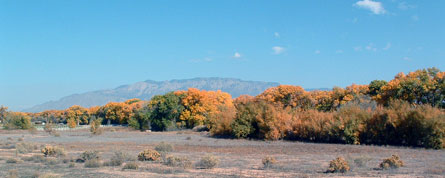
Lissa and I went down to the bosque this afternoon to cut some salt cedar. As you can see, the cottonwoods are in full color, and it was a beautiful warm afternoon. We walked into the La Orilla burn site, where a fire in the spring of 2002 torched 35 acres or thereabouts. It’s become a case study of restoration – well cleared, with new cottonwood poles planted. But the invasive salt cedar is pushing its way back in.
The coalition of government agencies with jurisdiction here, led by the city, is trying to keep on top of the situation by revisiting the site periodically and whacking down the salt cedar to give the cottonwoods room and time to take hold. But what if a bunch of the users of the space took matters into their own hands and just whacked down salt cedars here and there as they walked in the bosque?
Couldn’t hurt.
Our ulterior motive in this case was art supplies – the slender salt cedar shoots have a beautiful red bark, ideal for making stuff out of, and Lissa has long coveted a working supply. So we haulted out big armfuls. I think we need to make it a habit to go back and get lots more.
November Slaughter
My Book of Days tells me that November is “Tachwedd” in Welsh, which translates as slaughter. “Similarly, the Dutch used to call this month slachtmaand, since beasts were slaughtered in it.” Old English similar, though I despair of reproducing it here.
These early November hours
That crimson the creeper’s leaf across
Like a splash of blood, intense, abrupt,
O’er a shield: else gold from rim to boss
And lay it for show on the fairy-cupped
Elf-needled mat of moss.
FireBlogging
Sister Lisa sends along this, a photobloggish account of one family’s evacuation from our old neighborhood in Southern California.
Nut-crack night
In addition to the more well-known holiday, today is, according to the Book of Days, “nut-crack night” (also known as the “oracle of the nuts”):
A lad and lass each place a nut in the fire; the course of their courtship is predicted by the behavior of the nuts, whether they burn quiety together or jump apart.
This evening also apparently offers the opportunity for divination by cabbage-pulling.
I love holidays.
Quantum Computing Breakthrough
Japanese scientists have made a breakthrough in quantum computing:
A research team in Japan says it has successfully demonstrated for the first time in the world in a solid-state device one of the two basic building blocks that will be needed to construct a viable quantum computer.
The team has built a controlled NOT (CNOT) gate, which is a fundamental building block for quantum computing in the same way that a NAND gate is for traditional computing.
Research into quantum computers is still in its early days, and experts predict it will be at least 10 years before a viable quantum computer is developed. But if they can be developed, quantum computers hold the potential to revolutionize some aspects of computing because of their ability to calculate in a few seconds what might take a traditional supercomputer millions of years to accomplish.
Remember scientist prediction math – when they tell you a problem can be solved in 1 year, it’ll take 2. Two years really means five. Five means 10, and 10 means they have no earthly idea.