The Value of Water in Alternative Uses

Where are the fountains?

As has become my December tradition, I’m in a Las Vegas hotel room preparing for this year’s meeting of the Colorado River Water Users Association/finishing up grading my University of New Mexico Water Resources students’ final papers for the just-finished semester.

This year’s class – our introductory course for graduate students in our Masters of Water Resource program – focused on “The Value of Water in Alternative Uses”. That’s the title of a 1950s-era study attempting to put valuation numbers on New Mexico’s transbasin diversion of Colorado River water, which was then in the just-being-cooked-up stage. We used the paper as a jumping off point for a lot of discussion about how we use water, and how we might use it differently, and how we decided about such things.

Our students did some terrific work exploring the questions in ways that really stretched all of us:

  • what are the benefits of adding more urban trees, especially in poor neighborhoods
  • how could we better use stormwater to benefit the communities it flows through
  • how can we put more water back into rivers for fish and the environment

(Note: If you like to think about such things, we’re accepting applications for fall 2020!)

One of the things we’ll be talking about in the CRWUA panel I’m moderating Thursday is the question of how we incorporate values and interests and communities that have traditionally been left out of water management decision making. That question was at the heart of the work our students did this year to such good effect.

We’re saddled with institutions (and by this I mean both the more traditional sense of agencies and actors, but also the “institutionalists'” sense of the underlying rules themselves) developed around other dominant values that aren’t so good at incorporating new or evolving ones.

The UNM water students did a great job of thinking and talking about what sort of new institutions we might need to incorporate the values they wanted to think about. It’ll be interesting to see how this year’s CRWUA feels when I approach it with that in mind.

Maybe that’s what my next book should be about.


Litigation to settle our Colorado River disagreements is a terrible idea

Preparing for a panel I’ll be moderating at next week’s Colorado River Water Users Association meeting on the next steps in negotiating river management rules, I went back to a similar panel held last summer at the University of Colorado’s Getches-Wilkinson Center. (the session starts at around 3:23:00 here)

Lake Mead’s “bathtub ring”

John Entsminger of the Southern Nevada Water Authority offered a concise summary of the questions to be resolved (John’s comments, short and worth a listen, begin at about the ~3:34:00 point on the video linked above). Among them:

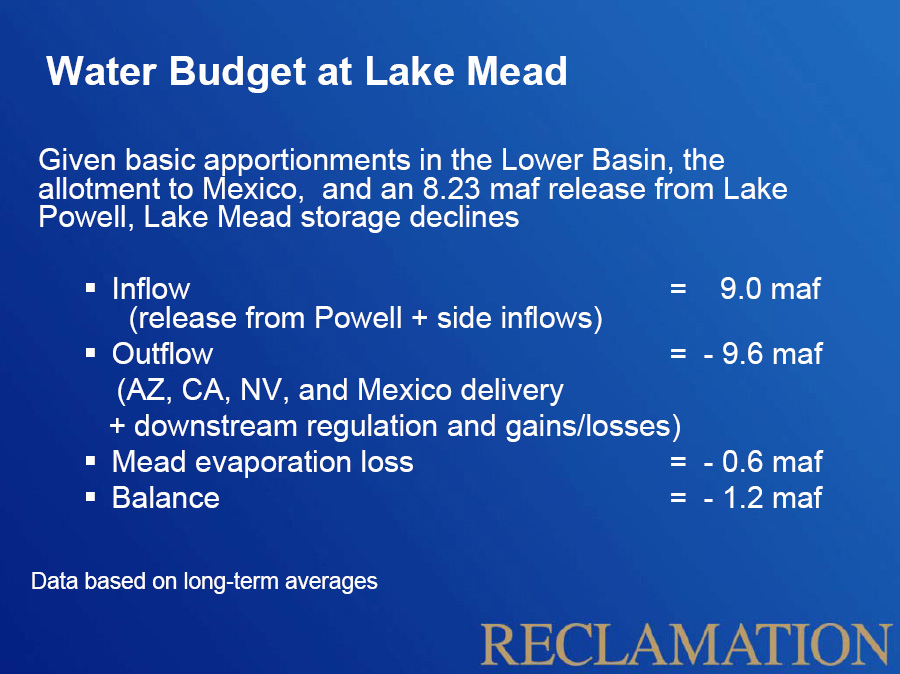
  • the “structural deficit”, in which Lower Basin water users taking their full legal entitlement remove more water from Lake Mead than flows in
  • California’s seniority over Arizona under the Colorado River Basin Project Act of 1968 (this is the bit where, under shortages, the Central Arizona Project canal to Phoenix and Tucson could get cut to zero while California still is allowed to take a full supply)
  • the Upper Basin’s legal obligation to deliver an average 7.5 million acre feet at Lee Ferry (or maybe 8.25maf) even as climate change shrinks the river

John’s list includes other bits as well (those interested in what happens next on the river are encouraged to watch the video). But the three bullets are important because there are some folks who are beginning to argue for a litigation approach. Clearly, the argument goes, a proper interpretation of the Law of the River favors “us” on this important question (where all values of “us” have a  legal argument for why they will win such a dispute).*

Eric Kuhn and I, in the conclusion of our new book Science be Dammed, think such litigation is unlikely because the principals understand what a terrible idea it would be:

In many ways, the basin states are in a similar position to that of the late 1920s. In 1927, six states chose to continue the ratification process of the imperfect compact they had negotiated rather than reopening the negotiations to appease Arizona and face an unknown future. One of the more likely outcomes was a future without a compact, an unacceptable situation to all of the states but Arizona. Today, the choices are to continue with the 1922 compact as written, with its embedded flaws but open to broad interpretation by the parties, or to engage in major litigation at the United States Supreme Court. The outcomes of litigation could include a future without a compact, a future where the compact has been so narrowly interpreted limiting future cooperative and innovative solutions, or even a future where the river is “federalized” far more than it is today.10 All of those are unacceptable to most, if not all, of the basin states. This means that while litigation is always possible, the inherent risks and ensuing chaos are so great that its chances are much diminished.

For those attending CRWUA, the panel will be at 11 a.m. Thursday. John Entsminger will be one of the panelists, along with

  • Ted Cooke from the Central Arizona Project
  • Terry Fulp from the Bureau of Reclamation
  • Andy Mueller from the Colorado River Water Conservation District
  • Jennifer Pitt from Audubon
  • Tina Shields from the Imperial Irrigation District
  • Daryl Vigil from the Jicarilla Apache Nation

* To be clear, because on re-reading after posting I saw how this could be misinterpreted, John Entsminger wasn’t arguing for a litigation approach at all. He was merely pointing out the unresolved legal questions.

California’s use of Colorado River water this year on track to be the lowest since at least 1950

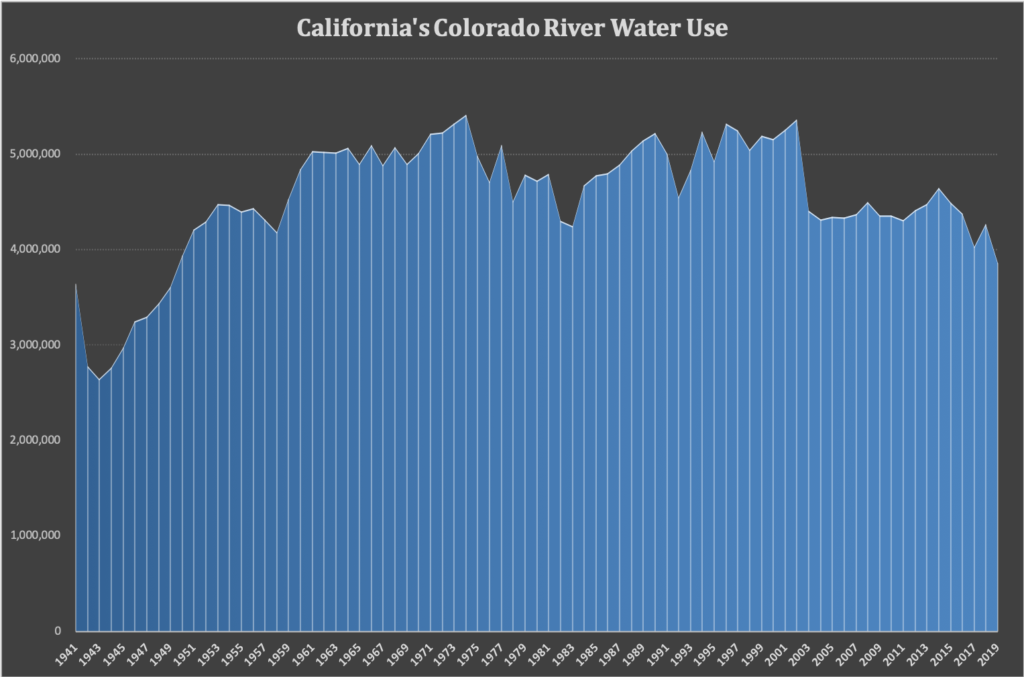
California’s use of Colorado River water this year is on track to be the lowest since at least 1949. (the latest forecast numbers are here)

My data on the early years is sketchy, but thanks to the folks at the Metropolitan Water District of Southern California, who recently shared an excellent dataset they assembled some years ago, I’ve got data back to 1950. The current forecast of 3.92 million acre feet of California use of Colorado River water is lower than any year in that record.

graph of California use of Colorado River water use, showing decline in recent years

California use of Colorado River water

There are a couple of things going on here. First, a good Sierra Nevada snowpack meant the Metropolitan Water District of Southern California didn’t need as much Colorado River water this year. But the Sierra snowpack, while good, clearly wasn’t the largest since 1950, right?

The second and arguably more important reason is a point Eric Kuhn and I make in our new book Science Be Dammed. While much of the book is about the problem of ignoring science on the supply side, we also argue in its concluding chapter that we are at risk of ignoring science on the demand side as well. Simply put, water use is going down. Here’s a squib from the book’s closing chapter:

There also is an empirical reality on the water demand side that has been insufficiently taken into account, but which provides a significant opportunity to help solve the river basin’s problems once we are willing to take it seriously. The widespread presumption that population growth means growing water demand drives much of the politics of water planning in the Colorado River Basin. But it is wrong. Simply put, we are consistently using less water. In almost all the municipal areas served with Colorado River water, water use is going down, not up, despite population growth. Water use in the basin’s major agricultural regions also is going down, even as agricultural productivity continues to rise. This is not limited to the Colorado River Basin. Such “decoupling” between water use, population, and economies is common across the United States.

I’ve been thinking about this a lot as I prepare for the this month’s Las Vegas gathering of the Colorado River Water Users Association. I’m moderating a sort of “what happens next” panel as we start talking, post Drought Contingency Plan, about the next steps in negotiating a new framework for post-2025 river governance.

We have some obvious stuff to talk about:

I’m hoping the discussions at CRWUA and after take seriously this remarkable shift we’re seeing on the demand side. As Eric and I argue in the book, it opens important space for solving our problems if and when we acknowledge that we don’t need as much water as we thought.


On New Mexico’s Rio Grande, the biggest year since 1995

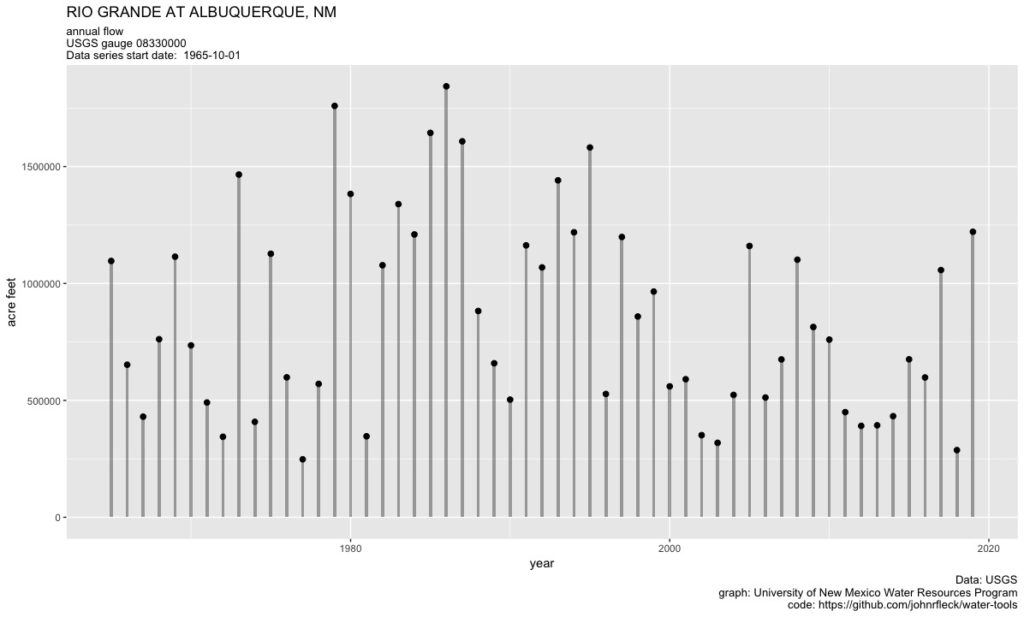
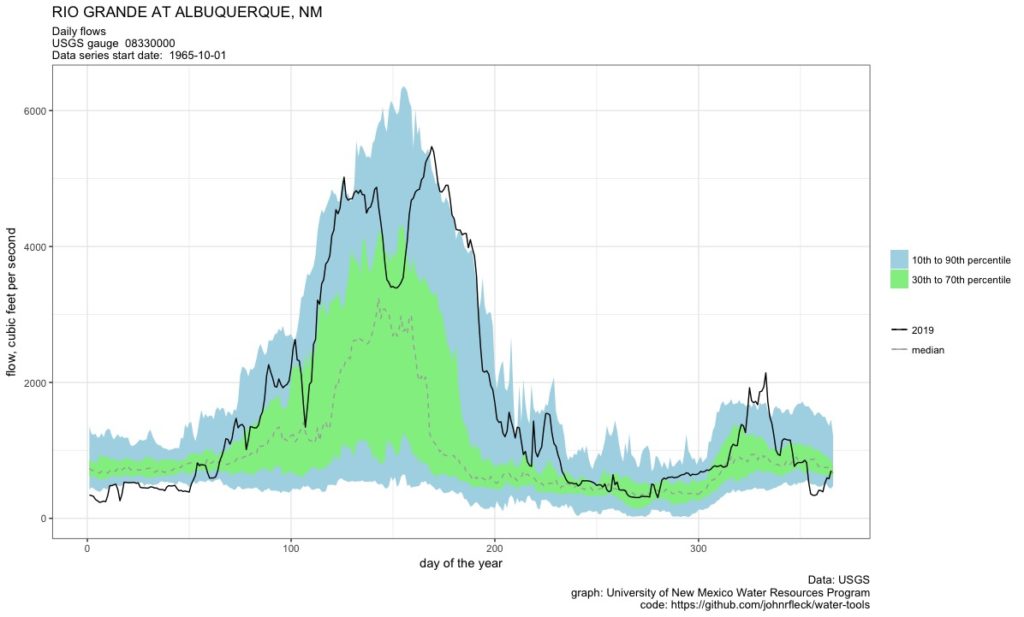
We’re closing out 2019 with big flows on the Rio Grande through Albuquerque – at least big for this time of year. Flow at the Albuquerque gauge Friday topped 2,000 cubic feet per second, setting a record for Nov. 29 at a gauge that goes back to the mid-1960s.

graph of high 2019 flows on the Rio Grande through Albuquerque

2019 flows through Albuquerque

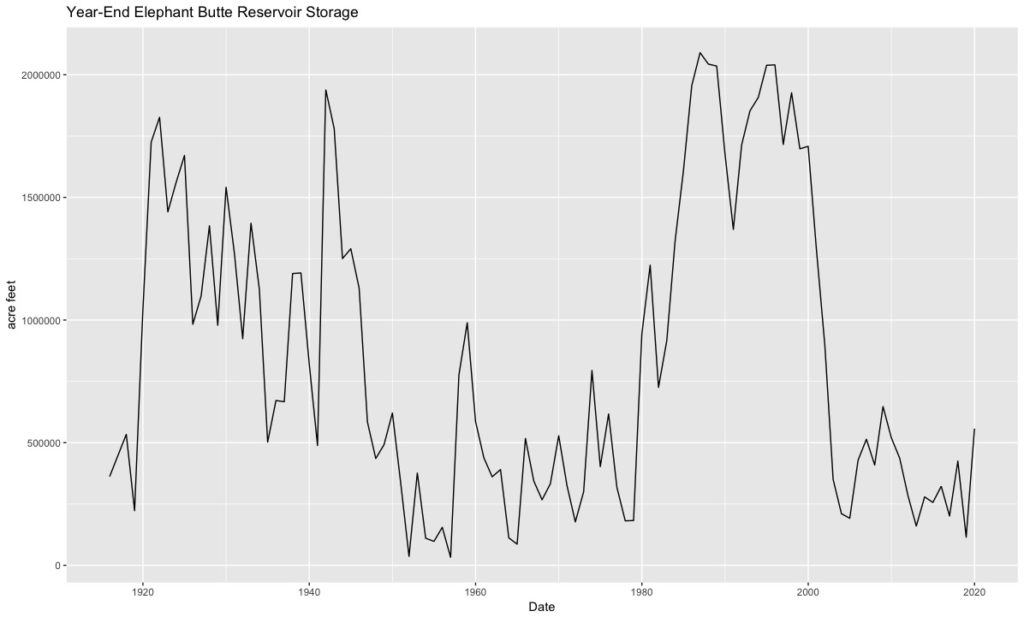
A couple hundred of those cubic feet per second were the result of a large storm, but mostly it’s institutional. In response to the big snowpacks of last winter, water managers are moving a lot of water down through the system, shifting it from upstream storage in El Vado Reservoir on the Rio Chama to Elephant Butte Reservoir. Elephant Butte is our Rio Grande Compact measurement point, and in a wet year like this our delivery obligation thereto goes way up.

In this regard, the gauge at the El Vado release point is really interesting.

2019 flows out of El Vado Dam, graphed

El Vado releases, 2019

Kuhn-Fleck webinar Jan. 22 to talk “Science be Dammed”

Eric and I will be doing a Webinar Jan. 22, sponsored by the American Water Resources Association:

In their new book Science Be Dammed, Eric Kuhn and John Fleck explain how even when clear evidence was available that the Colorado River could not sustain ambitious dreaming and planning, river planners and political operatives irresponsibly made the least sustainable and most dangerous long-term decisions. Arguing that the science of the early twentieth century can shed new light on the mistakes at the heart of the over-allocation of the Colorado River, Kuhn and Fleck delve into rarely reported early studies, showing that scientists warned as early as the 1920s that there was not enough water for the farms and cities boosters wanted to build. Contrary to a common myth that the authors of the Colorado River Compact did the best they could with limited information, they show the boosters selectively chose the information needed to support their dreams, ignoring inconvenient science that suggested a more cautious approach.

Registration here

Historic New Mexico Instream Flow Right Approved

Granting a New Mexico Instream Flow Right

Water policy folks in other western states may yawn at this, but in New Mexico it’s a big deal. The New Mexico Office of the State Engineer has approved the state’s first instream flow water right. Here’s a summary from Audubon, the group that put the deal together, explaining how it works.

The deal would allow water to flow down a stretch of the Rio Gallina, just upstream from its confluence with the Rio Chama. Previously the water had been diverted during high flows to a holding pond to irrigate about 40 acres of land on the Gallina’s south side.

It has long been believed that New Mexico law allows instream flows, but the right is implicit, not explicit. Here is the explanation from the folks at the Utton Center at the UNM School of Law:

In 1998, the Attorney General of New Mexico issued an opinion stating there is nothing in the New Mexico Constitution,statutes, or case law barring the State Engineer from approving an application to change the purpose of use of an existing water right to instream flow. The opinion concluded that New Mexico law does not require a diversion to beneficially use water and a court would likely define beneficial use to reflect current concepts of public interest,waste, and reasonable use. The Office of the State Engineer (OSE) indicated, in a parallel memorandum, that it could act favorably onan application for instream flow if there was sufficient dominion and control over the flow, such as accurate and continuous gauging devices to perfect the right and demonstrate continued use of the water.

We haven’t had anyone actually try to establish such an instream flow in the two decades since. Until now.

Building resilience in New Mexico water – Water Dialogue meeting, Jan. 9

I look forward every year to the annual gathering of the New Mexico Water Dialogue. It’s always a great meeting – the speakers etc. But even more so, it’s a great gathering of our version of “the network” – the diverse collection of folks across cultures and geographies in our state who understand the importance of collective dialogue about our shared future.

This year we’ll be hearing from Dave Gutzler (UNM climate) and Melinda Harm Benson (UNM geography, a resilience scholar who’s helped many of us think carefully about how to frame our goals and understandings of the way our water system works). I encourage folks among my New Mexico readership to click the link above and sign up to attend.

If trends continue, Phoenix is on a path to groundwater “safe yield”, according to new research

If past trends in greater Phoenix – agricultural land transitioning to urban – the area is on track to groundwater “safe yield”, according to new research by an Arizona State University team:

Under (business as usual) conditions where population is expected to increase and agricultural activities to gradually decrease, our results indicate a reduction in the use of groundwater of ~23% that, in turn, will likely allow achieving safe-yield. If the decrease in agricultural activities will be less drastic or remain constant in time (i.e., more food will be produced locally), additional water from more energy-intensive water sources (groundwater and CAP) will be needed.

A shift in the trend – less ag land decline – makes it less likely that Phoenix would meet the goal, the researchers found. A shift to more renewables means an even better prognosis for groundwater, given the significant use of water for power plant cooling. And it probably goes without saying that a multi-decadal drought would make things harder.

The paper is Guan, Xin, et al. “A metropolitan scale water management analysis of the food-energy-water nexus.” Science of The Total Environment 701 (2020): 134478. Found behind a paywall here.