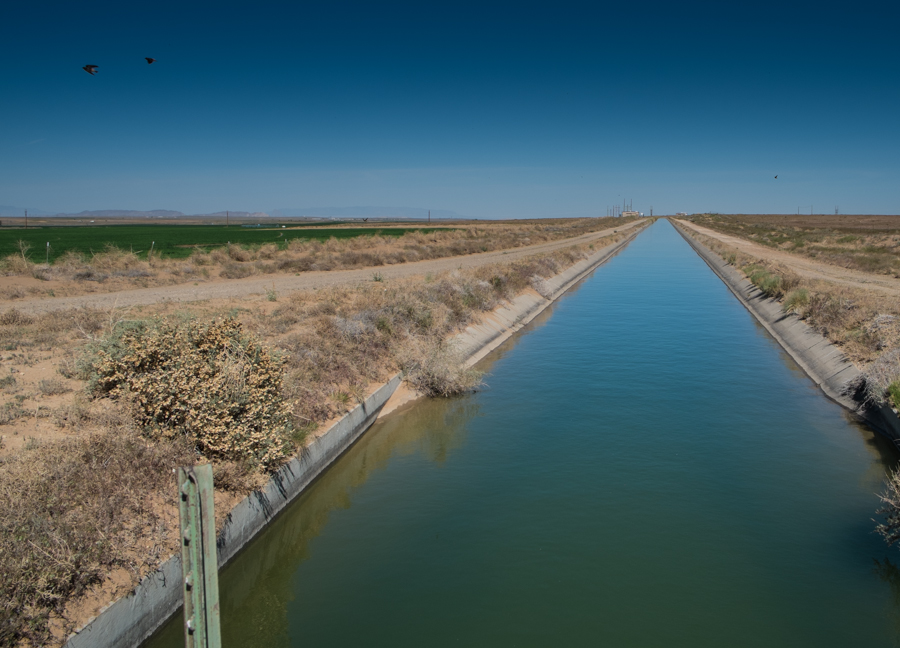
Navajo Indian Irrigation Project canal, May 2014
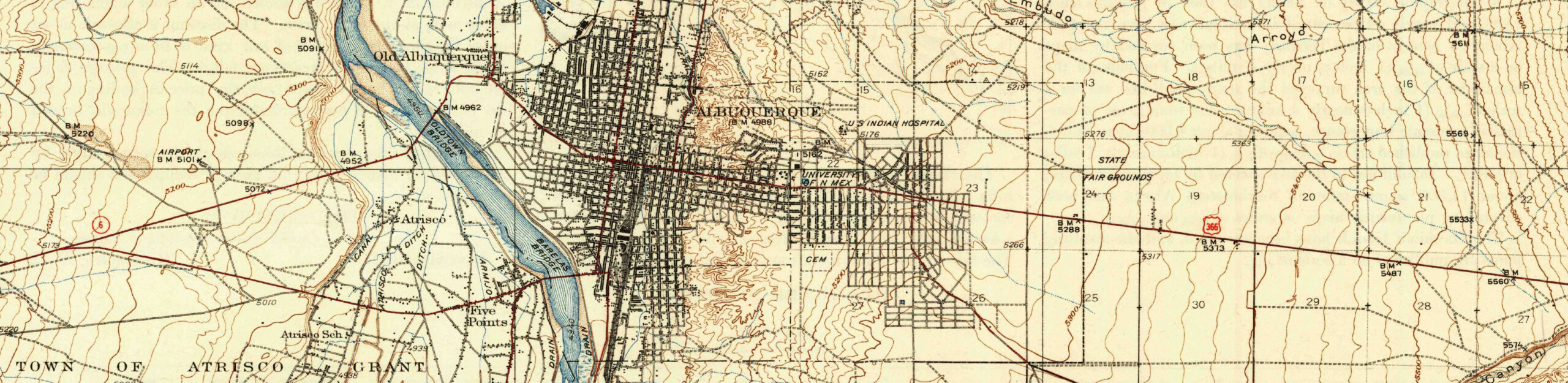
Navajo Indian Irrigation Project canal, May 2014
One more great tidbit from Tony Davis’s story today about Arizona’s water woes:
Tucson Water customers have sharply scaled back water use. Total use sank to 1989 levels last year despite continued population growth, Wilson said.
tl;dr The idea of conserving water before enforcing shortages in the Colorado River Lower Basin, rejected by water managers less than seven years ago, seems now to be all but a given, though much remains to be worked out.
longer: Tony Davis has an excellent story in this morning’s Arizona Star on what looks from the outside like a sudden shift in the direction of Arizona’s Colorado River rhetoric:
For the first time, the state agency that operates the multibillion-dollar Central Arizona Project warns that water shortages could hit Tucson and Phoenix as soon as five years from now.
Chances are slim a shortage will come that soon, but they’re expected to rise in the next few years due to drought, growing water demand and declining water levels in Lake Mead at the Nevada border. Over a 10-year period ending in 2026, the likelihood of urban CAP shortages is 17 to 29 percent in a given year depending on weather, particularly the impacts of climate change, CAP says.
The recognition that there is a problem – a “structural deficit” in which Arizona, Nevada and California are using more water annually than the big river can provide – is not new here. What’s new is Arizona’s starkly public recognition of the problem and the specific sort of action being called for. Again, Davis:
Among its suggestions are that the feds and states spend $20 million to $100 million annually on projects to conserve water and find outside supplies. That’s already about to start on a small scale. CAP, Las Vegas, Southern California’s Metropolitan Water District and Denver are likely to begin spending about $2 million apiece next year, in a pilot project to pay farmers and other non-residential users to take cropland out of production or make other cuts to conserve water.
“We don’t know what the federal government would do in those circumstances. That’s why we’re trying to get ahead of the game now, and say the seven states in the Colorado River Basin need to work together,” said Mitch Basefsky, a CAP spokesman.
In 2007, when the seven Colorado River basin states and the U.S. Bureau of Reclamation adopted the Interim Guidelines for Lower Basin Shortages and Coordinated Operations for Lake Powell and Lake Mead, the river powers rejected (sort of) a proposal from a coalition of environmental groups called “Conservation Before Shortage”. (Details in this pdf.) The CBS proposal called for basin water users to fund conservation actions before the shit hit the fan – perhaps, for example, paying farmers to implement water conservation improvements or fallow fields: “the use of voluntary, market-based conservation as a method to mitigate involuntary shortages”.
The basin states and feds instead opted for involuntary shortages. Once Lake Mead’s surface elevation drops below 1,075 feet above sea level on any Jan. 1, shortages are immediately imposed on Nevada and Arizona water use.
The earliest we could hit 1,075 appears to be 2016, but Arizona’s very public pronouncements (as Tony so ably documents) combined with the current discussions over the Colorado River System Conservation Program suggest some sort of “conservation before storage” approach is all but a given.
The questions now seem to be:
The state’s first protracted drought occurred in 1868 and lingered on until 1872 or 1873. The west side of the San Joaquin Valley suffered most. There the wheat crop was a total loss in 1870 and 1871, and by the fall of the latter year the parched valley had turned to dust…. [B]anks foreclosed on mortgages; and the state’s newspapers reported on an abundant crop of irrigation schemes designed to render California immune from nature’s capricious cycles.
That’s from Donald Pisani’s 1984 history of California irrigation. Amazing echoes of 2014 show up on page after page of this book.
Ian James at The Desert Sun has a great Sunday paper deep dive into the stress climate change is placing on Lower Colorado River Basin water, including this observation from John Entsminger, Las Vegas’s new water chief, on the money needed to pursue the solution space:
Entsminger, whose Las Vegas water agency is backing the new conservation program, called for more investments aimed at saving water on a large scale, including money from the federal government.
“Nothing in our economy is going to work without sufficient water to make it work, from food supplies, to energy production, to making microchips. All of these things are water-intensive and are going to need a secure water supply. So, at what level, locally, regionally or federally, do you begin to look at funding mechanisms to make the investments that are necessary to stretch these water supplies?” Entsminger said. “Ultimately you’ve got to talk about how to pay for it.”
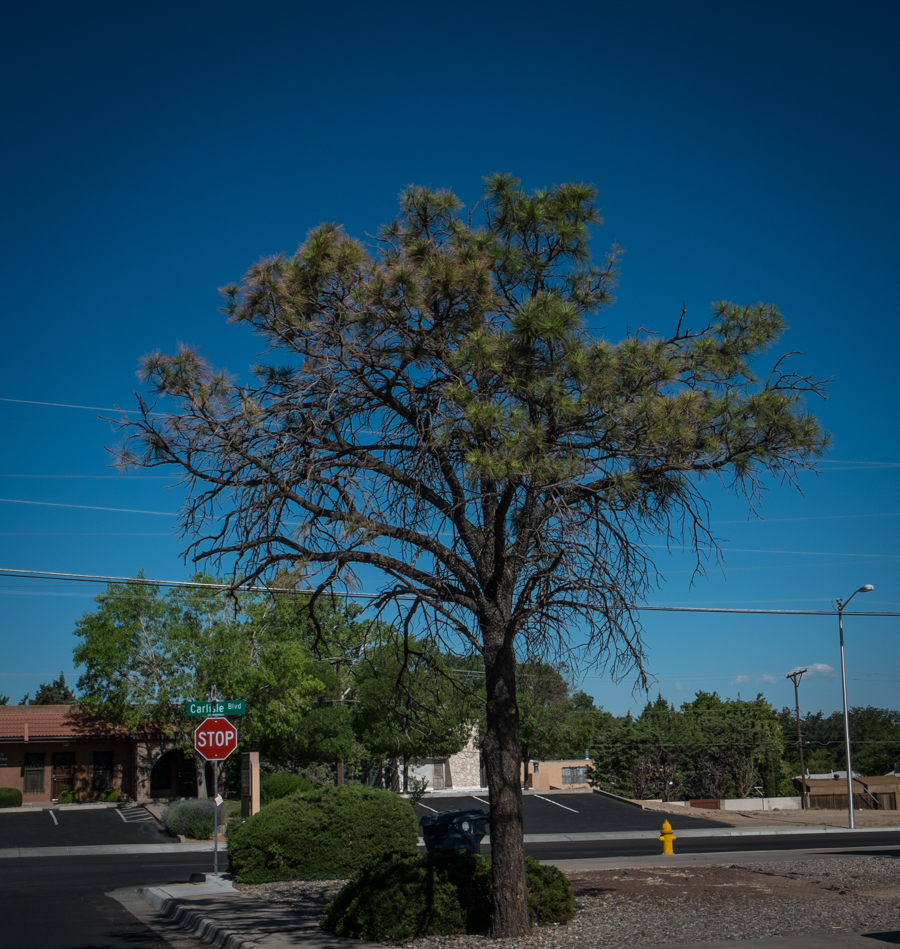
Dying pine tree in my neighborhood, June 2014
Is this what water conservation looks like?
I’m not sure who got to decide that 10 inches of precipitation a year (25 cm) or less defines a “desert”, but by that standard my neighborhood barely slips under the line. In the 15 years that I’ve been collecting data, I’ve averaged 9.78 inches, and data from the PRISM people puts the long term average at 9.71 inches (24.8/24.6 cm).
Years ago, University of New Mexico emeritus biologist Loren Potter took me for a walk around the neighborhood for a newspaper story, pointing out the strangeness of the artificial ecosystem we’ve built. We bring trees that can’t make it on 10 inches a year, then don’t always water them as much as they need. The result was, even then, an urban forest under stress.
As I wrote in the Journal last week, Albuquerque has cut its water use to 134 gallons per person per day. A big part of that involves a reduction in outdoor watering. A result of that is evident on my morning walks – a lot more stressed trees.
Building farms and cities in the desert, moving the water to do it, then responding to the scarcity problems that result, is complicated.
Clouds over the neighbors’ house, June 2014

Capital, by Thomas Piketty, at Costco
Berkeley agricultural economist E. Phillip Leveen seems to have been* the person who coined the term “iron triangle” to describe the political structure behind large scale 20th century water development in the western United Staes. The “triangle” is an attempt to describe the relationship between federal water agencies, members of key congressional committees responsible for allocating tax money for the great water works, and water users – generally agricultural water users. Here’s Leveen describing the U.S. Bueau of Reclamation in 1972:
The Bureau must find political support for its program to be successful. Congress provides the funds for the program, but only in response to political pressures from constituents. Thus, the Bureau must form an alliance with a powerful political constituency which can “demand” its product from Congress. The most effective political groups are generally small, cohesive producer groups rather than large, amorphous constituencies. These latter groups, even if given benefits equivalent to the small group, are less likely to organize politically because the costs of organizing large groups are higher and the benefits per individual are lower in comparison to the small group. According to this model, then, the Bureau’s support of the large landowners was dictated largely by the need to form an effective constituency.
Over most of the 20th century, that seems to have been a reasonable model for how things worked. But has it broken down?
Consider my story from this morning’s newspaper, about new water legislation from Sen. Tom Udall, D-N.M., aimed at drought and water management targets, primarily on the Rio Grande:
Saying the days of big water projects and large federal investment are over, Udall said in an interview Wednesday that the legislation looks instead at the full range of the federal government’s water operations in the state, and ways current laws could be tweaked and additional financial support provided to stretch the state’s limited supplies.
It is not a criticism when I characterize this bill as “small ball”, a series of legal tweaks and relatively small financial incentives aimed at the narrow piece of New Mexico water management that involves federal control and/or room for discretionary action. It rather, I think, describes a new state of affairs that seems to look nothing like an “iron triangle”, where the opportunities and constraints have changed and we’re still sorting out what a new role for the federal government, and a new political structure, might look like in a time of scarcity.
* Leveen’s 1972 piece is the earliest use of the phrase “iron triangle” to describe western water management that I’ve been able to find. (I’d love any earlier references.) Leveen, in a footnote, attributes the underlying concept to Theodore Lowi’s 1969 book The End of Liberalism. In it, Lowi describes a “triangle” in federal agricultural policy and politics through several examples, including the Extension Service and the Soil Conservation Service. Lowi doesn’t specifically mention water agencies.
Last night, I shared Part I of an interesting discussion by Arizona water managers of the risk facing Lake Mead and Lower Colorado River Basin water users in Nevada, Arizona and California:
Absent some big wet years or management intervention, Lake Mead could drop to levels in the next five to eight years that would make it nearly unusable – especially for power generation and water for Las Vegas, but also at some risk for other downstream users.
The evaluation by the Central Arizona Project water managers is pretty grim. But Part II, in the morning light, may be more interesting. It’s the boldest proposal I’ve seen in public from inside the water management community for fixing the lower basin’s “structural deficit” – the fact that routine Colorado River water use in the three states is greater than the river can supply.
It’s a “share the pain” proposal, and calls for taking steps ahead of the problem to slow Lake Mead’s decline “based on principal that all Colorado River water and power users share risk”.
It would:
So maybe I was too gloomy blogging into the late hours last night? Does the “Drought Response and Sustainability Plan” now in the works offer the chance to get ahead of the problem?
Here’s the full CAP slide deck. The stuff about the solution space begins on page 32: