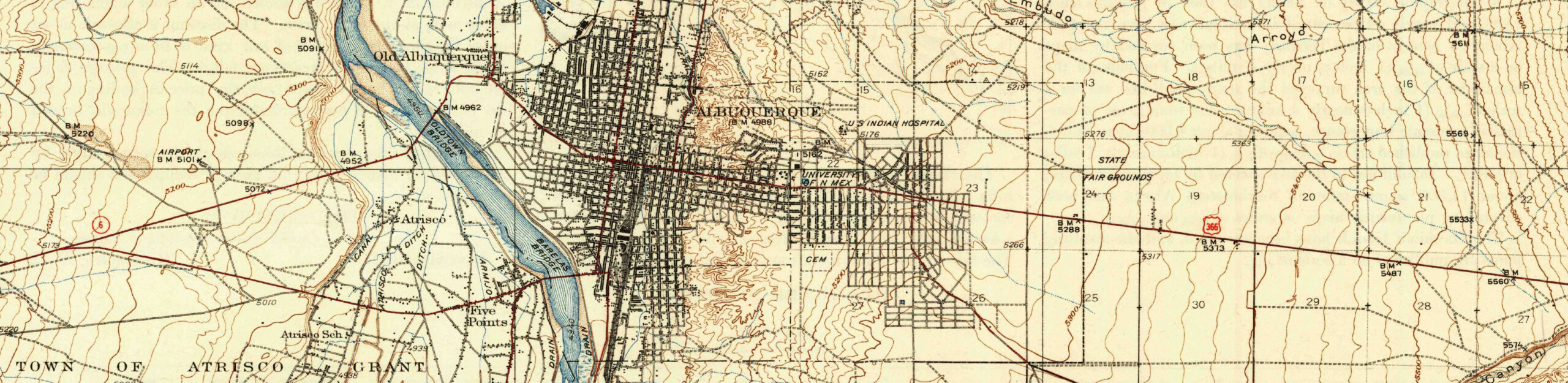
declining Colorado River Basin groundwater reserves

Colorado Basin groundwater declines, courtesy Chris Austin

Colorado Basin groundwater declines, courtesy Chris Austin

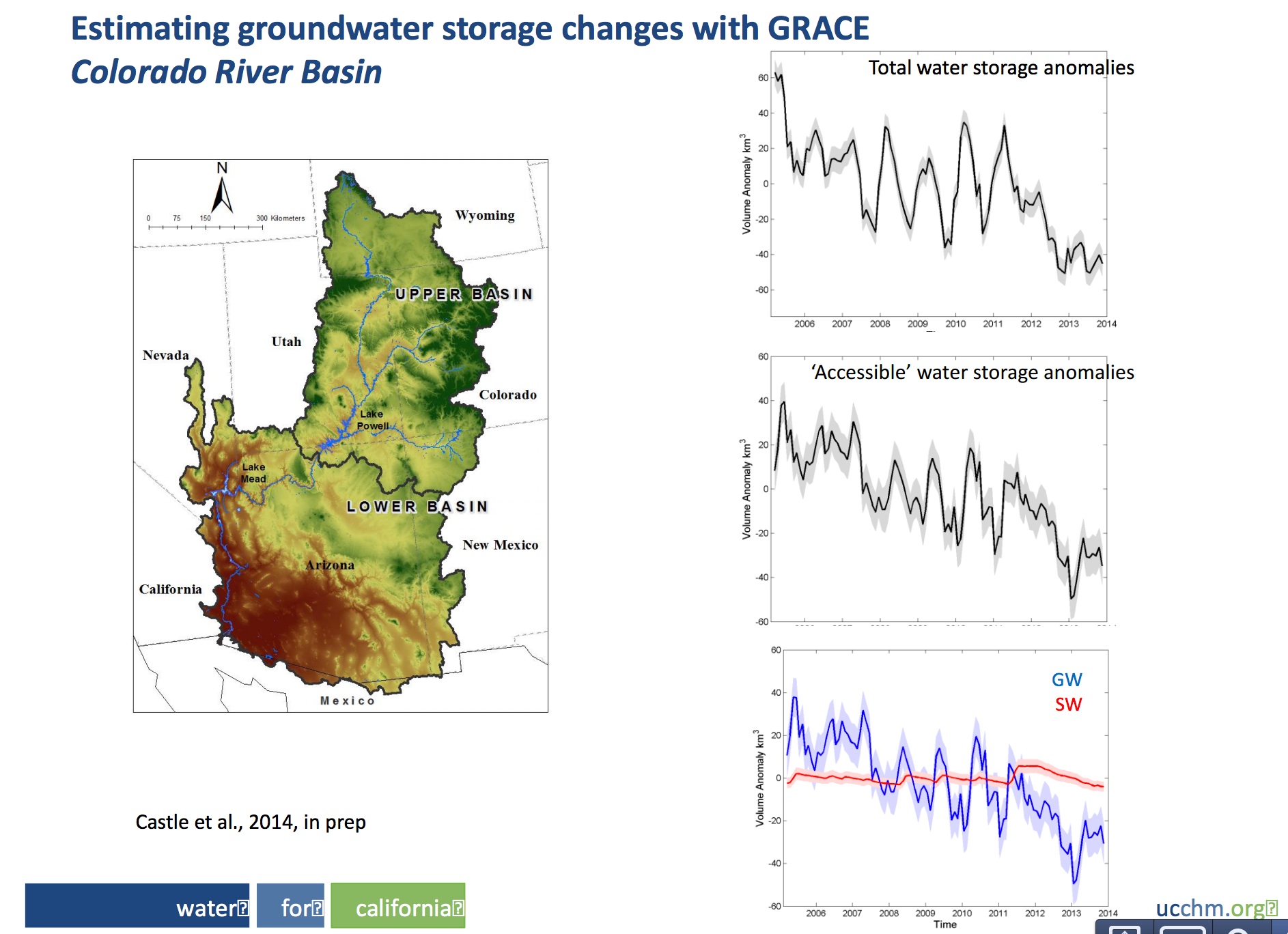
New data from NASA’s GRACE satellite, which scientists use to track changes in groundwater storage, shows some remarkable declines in the Colorado River Basin, according to a recent presentation by Jay Famiglietti of UC Irvine to a California legislative committee (huge thanks to Chris Austin for catching this and bringing it to my attention):

“Unfortunately, looking beyond our borders isn’t going to help – just like in California, the Colorado River basin is in long term decline,” Mr. Famiglietti said, presenting a slide showing the total water storage for the Colorado River basin. “When we separate the surface water storage in Lake Powell and Lake Mead and the groundwater storage, we get the graph on the bottom, which is showing us what’s happening. With Lake Powell and Lake Mead’s storage, not much of a trend albeit there’s a recent decline, but the important thing to recognize here is that the groundwater losses from the Colorado River Basin in this time period completely swamped the losses and dominated the total water storage change. They are far bigger than the surface water changes. The message is that we pay all this attention to surface water management, and while no one’s watching, the groundwater is being depleted at a rapid clip.”
 

the value of water depends on how dry it is

Variability is at the core of water management. When it’s on the dry side of the range, some folks are willing to pay a lot for water. But if that involves big capital expenditures, are you willing to sit on the cost when things get wet? Brett Walton explains how this is playing out in Queensland:

Queensland spent big during the decade of drought that choked Australia at the turn of the 21st century.

The northeastern province built a $AUS 2.6 billion facility to purify and reuse sewer water and a $AUS 1.2 billion plant to remove the salt from seawater. Both were completed in 2008, but the desalination plant did not begin operating until 2009.

But just a few years after completion, the rains returned, reservoirs refilled, and cheaper water supply options became available. The shine has worn off these capital investments now that the plants sit unused while still requiring hundreds of millions of dollars annually in debt payments and maintenance costs.


A river means different things to different people

The Havasu News-Herald, which serves Lake Havasu City along the Colorado River, assured its readers today that the environmental pulse flow, which is passing through on its way from Hoover Dam to the Colorado River delta, shouldn’t have an impact on Lake Havasu recreational boating:

Lake Havasu will remain at normal water levels during the next six and a half weeks as the Minute 3:19 Pulse Flow brings water to the once-parched Colorado River Delta in Mexico, according to Bureau of Reclamation Water Resources Specialist Aaron Marshall.

Marshall said normal water levels at Lake Havasu approximately range between 445 feet and 449 feet above sea level. As of Thursday, the lake’s water level was at about 447.5 feet, which is about a foot less than a week ago.

“Fluctuations of a few feet are normal for our operations in Lake Havasu,” Marshall said. “The pulse flow will not have any effect on the lake’s elevation changes.”


Here’s a solution to drought – green paint!

In the 1980s, a film crew came to Iowa to film “Field of Dreams”, carving a baseball diamond out of a corn field:

The look of the new ball field itself didn’t inspire confidence: because of a nasty regional drought, the landscape, typically lush, had turned brown and fallow. To make the farmland presentable, the crew was forced to irrigate, but even that didn’t fix the problem fully. Right before filming began, Robinson decided, in desperation, to paint the cornstalks and portions of the grass green.

That’s Adam Doster in the Atlantic, h/t to Brett Walton

Following the flow

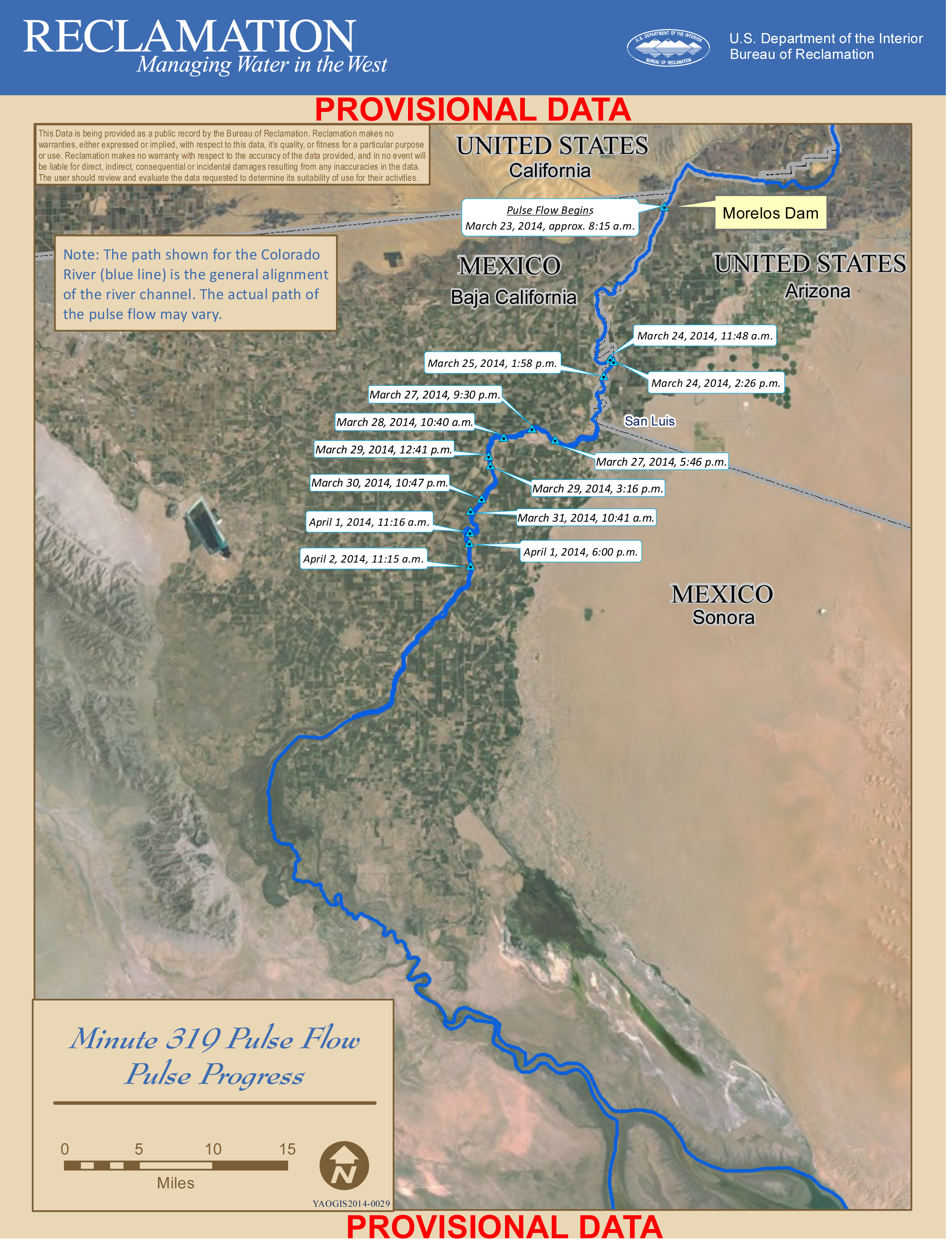
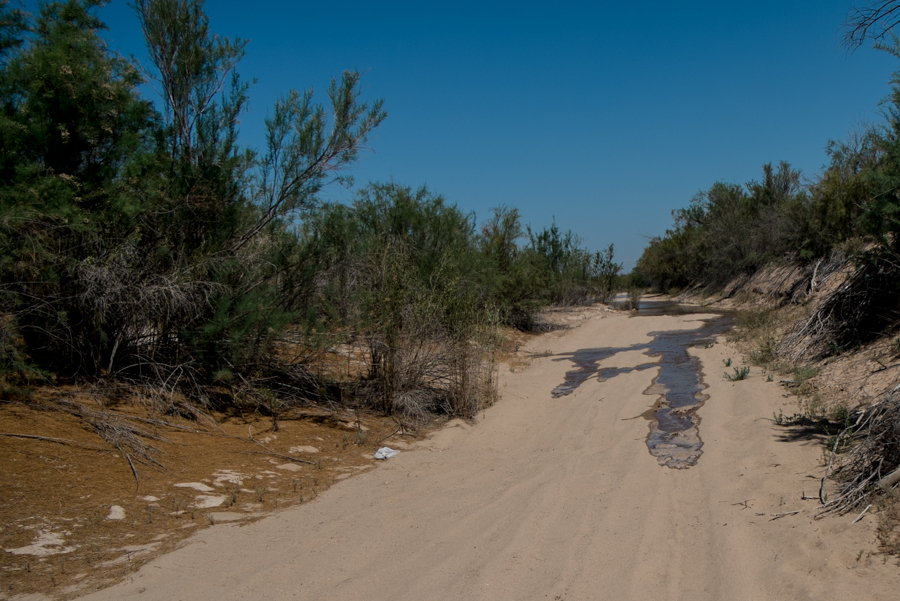
While many of us have had to return to more mundane lives, Jennifer Pitt remains in the Colorado River delta, documenting the environmental “pulse flow” as it makes its way toward the ocean. The water’s been slowing as it crosses dry stretches where depth to groundwater is great and dry sand soaks up a big share, and moving more quickly across the stretches where water tables are high, mostly due to nearby irrigated agriculture. Where the Colorado River once spread in sheets of flooding across this delta, now we do some of the same thing with water in irrigation canals. Here’s Pitt:

Now that the dry reach has been saturated, we expect water to move more speedily. The leading edge of the pulse flow will now travel the middle and lower reaches of the delta, reaches that are typically wet due to high groundwater and drainage from nearby agricultural fields. Infiltration will not be nearly as great, and the water should run rather than creep. The pulse flow still has miles to go, but these miles should be easier to travel.

Will the pulse flow reconnect the Colorado River to the sea? We still don’t know. We don’t even know that we’ll be able to see it when it does. But scientists will be out there taking conductivity measurements, and will tell us if, and when, water at the river’s mouth becomes less salty as freshwater arrives.

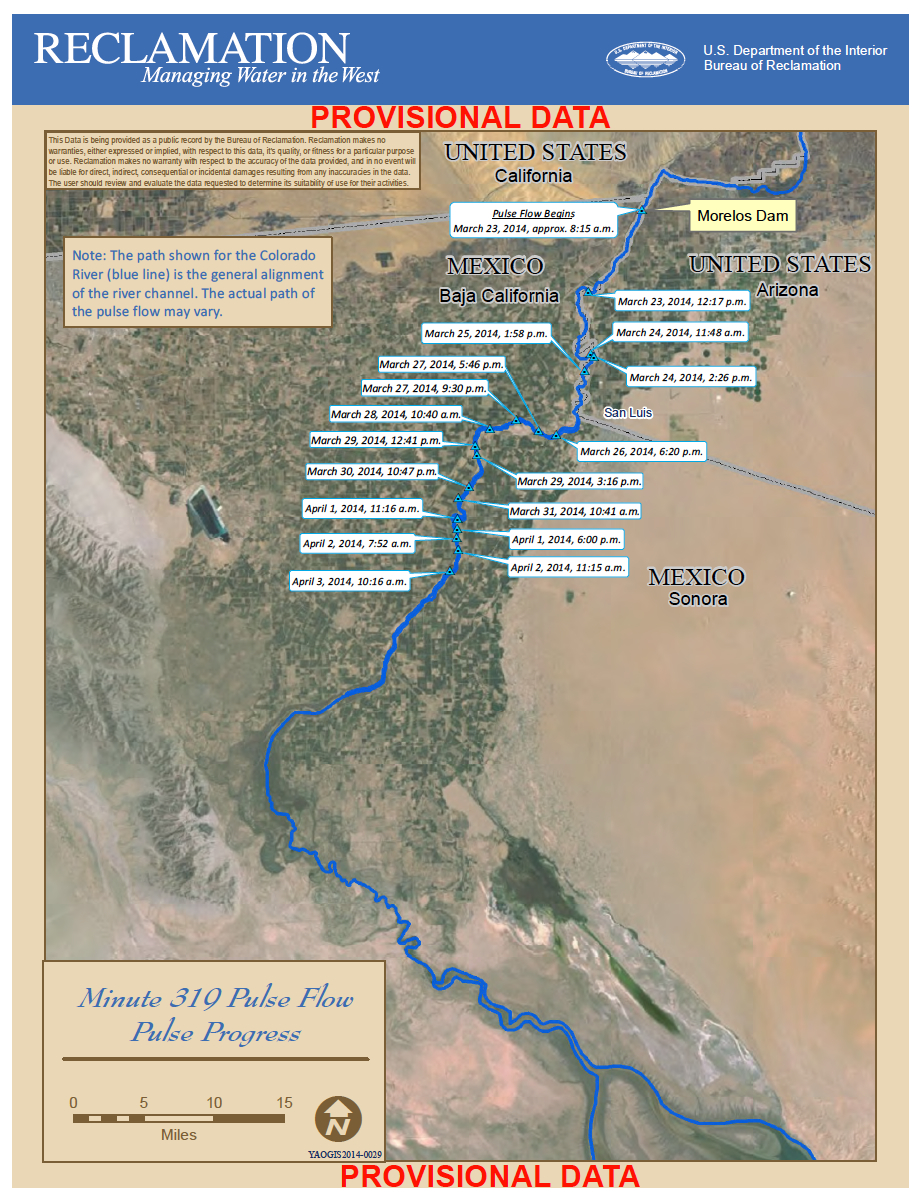
Pitt posted a nice map from the U.S. Bureau of Reclamation documenting the water’s progress:

Pulse Flow progress, courtesy USBR

Pulse Flow progress, courtesy USBR

Minute 320?

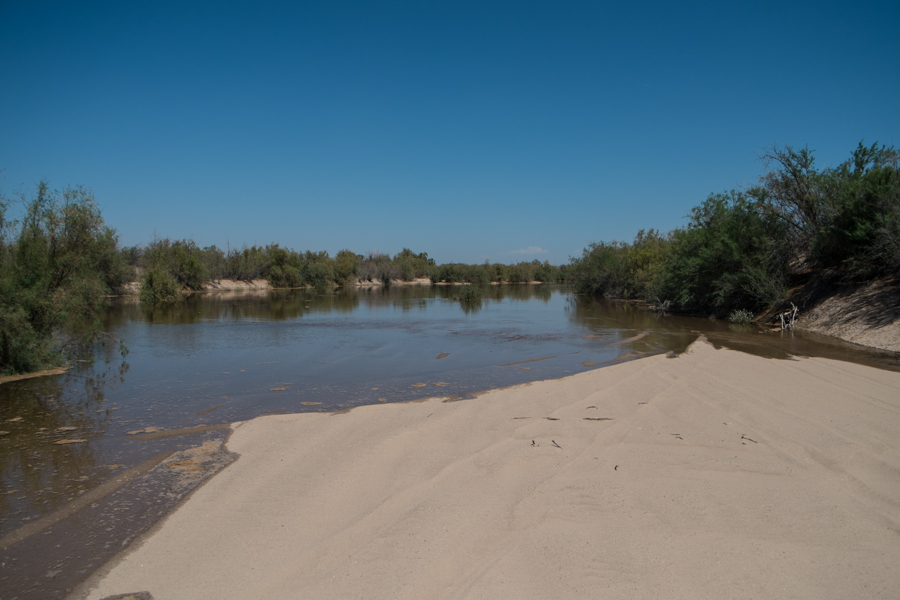
Fingers of water creeping down the Colorado River channel, pulse flow, March 25 2014, by John Fleck

Fingers of water creeping down a Colorado River side channel, pulse flow, March 25 2014, by John Fleck

In High Country News, Matt Jenkins on  the Colorado River delta environmental “pulse flow”, which grew out of “Minute 319”, an addendum to the U.S.-Mexico water treaty:

Over the past two decades, the Delta’s advocates have argued their case with perseverance, and a lot of good numbers. By monitoring the effect of the pulse flow, they’re hoping to make the case for a followup agreement — a Minute 320 — to kick off a long-term program of regular floods that mimic the natural dynamics of the river.


Colorado “pulse flow”: fighting deeply held perceptions

pulse flow in a dry riverbed, near San Luis, March 25, 2014, by John Fleck

pulse flow in a dry riverbed, near San Luis, March 25, 2014, by John Fleck

Folks working on the current Colorado River “pulse flow” must fight against the deeply held perception that the river in Mexico’s Colorado River delta is “dead.” Blame Phillip Fradkin, whose 1981 book “River No More” is one of those touchstones in the regional literature that dominates public understanding, even if it isn’t quite right. Writing in the Journal of Arid Environments in a 2001 special issue on the potential for delta restoration, Mike Cohen of the Pacific Institute wrote this:

[D]espite reports that the delta was a dead ecosystem where the Colorado River no longer reached the sea (Fradkin, 1981), agricultural drainage and the occasional space-building releases of Colorado River water from upstream reservoirs have prompted significant new growth of valuable native riparian and emergent wetland habitat, sup- porting the largest and most critical arid wetland in North America and sustaining avian and aquatic species of concern (Glenn et al., 1992, 1996; Luecke et al., 1999). Flood releases have also been strongly correlated with a rise in the shrimp catch in the Upper Gulf (Galindo-Bect et al., 2000), an indication of the renewed viability of an important estuary.

The Fradkin meme has made the political side of restoration efforts harder, because of the perception that the delta had already been lost. In fact, those ag return flows and high water tables from irrigation have kept some stretches within the levees through the Mexican delta wet. Jennifer Pitt of the Environmental Defense Fund makes that point in a post yesterday documenting her pulse flow river-chasing adventures:

These releases – lasting eight weeks – are being made from Morelos Dam, about 100 miles (160 kilometers) upstream from the river’s end at the Upper Gulf of California (Sea of Cortez). About 75 of those river miles (120 kilometers) are typically wet, either from a high groundwater table or the tides that make their way upstream. But a reach of about 25 miles of the channel have been dry for decades, hot sand baking in the desert sun.

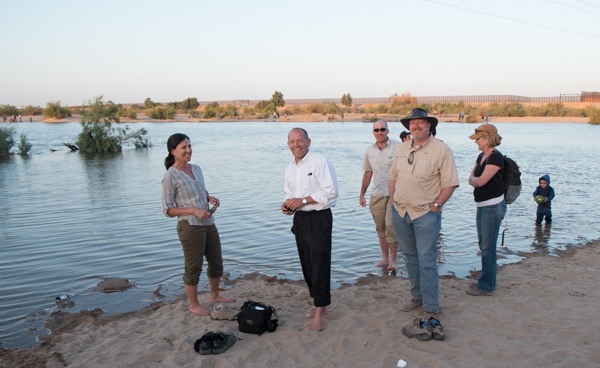
Be sure to check out Pitt’s fun videos, where she seems to have strapped on a GoPro while tromping through the delta. Here’s a picture I took when I bumped into Jennifer, Mike and friends last week at the endless river party at San Luis Río Colorado, grinning. Really, a lot of grinning was involved in this whole thing.

Jennifer Pitt, left, Mike Cohen (sunglasses, wading in the river) and friends on the Colorado River at San Luis, March 25, 2014, by John Fleck

Jennifer Pitt, left, Mike Cohen (sunglasses, wading in the river) and friends on the Colorado River at San Luis, March 2014, by John Fleck

“water hoarding” on the U.S. side of the border

Ricardo Castillo celebrates the Colorado River “pulse flow” and reminds of us the transboundary tensions that preceded it. He sounds pissed:

U.S. Americans proudly boast about the beauty of the Grand Canyon and the might of the Colorado River as “great American treasures.”

Over the past 50 years, however, both the U.S. federal government and the governments in the water hoarding states of Colorado, Utah, Nevada, Arizona and California forgot one little detail. The Colorado River does not stop at the U.S.-Mexico border but flows into the Gulf of California.

So by the time Mexico gets its share of water — which should be on equal terms with the aforementioned states — reality has it that a trickle-down policy has been applied.

The end result has been that the Colorado River Delta, which is in Mexico, has dried up.

The good news is that at long last, U.S. Americans have stopped playing deaf and dumb on this issue and finally agreed to allow the spring pulse flow into the delta. It may not be much as it is — barely 1 percent of the total Colorado River water — but scientists coincide that it will be enough to bring the delta back to life.